
The Last Voicemail
I tried to give my sister back our mother’s voice. I gave her something worse.

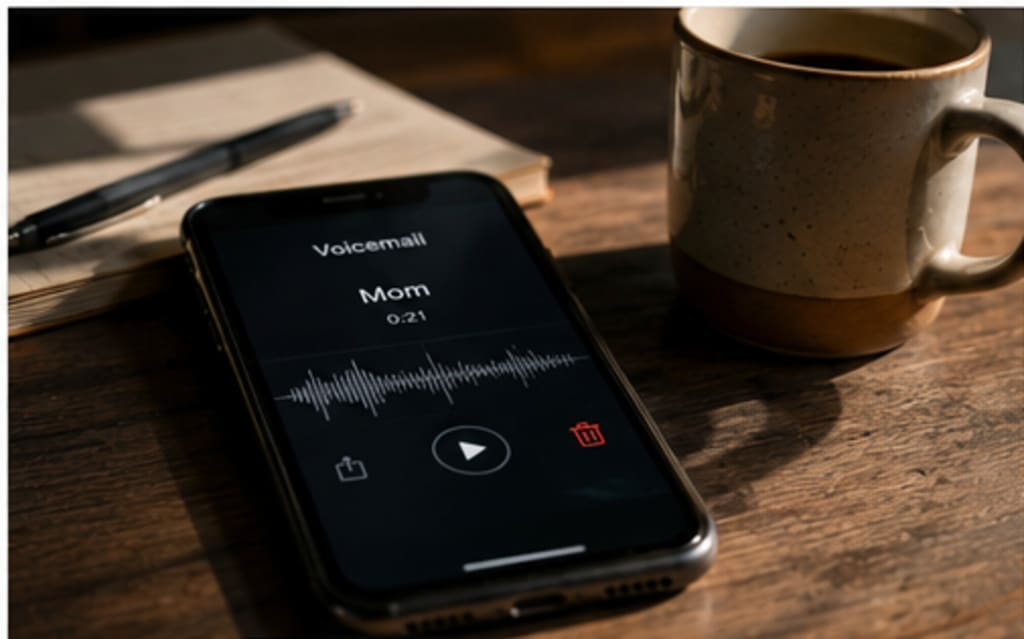
The voicemail disappeared while my thumb was still on the screen.
That is the first thing I need to confess.
Not after some long sequence of bad decisions. Not after the lying, or the editing, or the careful little adjustments I made in the name of love. It began with one ordinary movement: my hand, her phone, a cracked glass screen, the tiny trash icon in the corner.
Then the message was gone.
My sister made a sound I had never heard from her before. Not a scream. Not even a cry. More like the air leaving a house after the front door has been left open too long.
“No,” she said.
I froze with the phone in my hand.
The voicemail had been from our mother. Three months before she died, before the morphine softened the edges of her sentences, before her voice thinned into breath and then into nothing, she had called my sister by accident. Or maybe not by accident. That depended on who you asked.
The message was mostly nonsense. A television murmuring in the background. The beep of some machine. Our mother saying, “Lena? Honey? I think I pressed the wrong thing.” Then a pause. Then, softer, “Anyway. I love you. Call me when you can.”
That was all.
Twenty-one seconds.
Lena listened to it the way some people touch a scar. Not often. Not casually. But when she needed proof that the wound had happened.
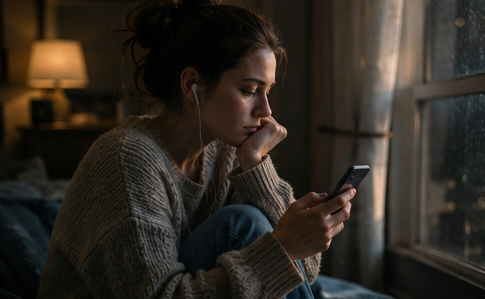
And I deleted it.
I had been trying to help.
That sentence has done a lot of damage in my life.
Lena had asked me to back up her phone because it had started shutting off at random. She was afraid of losing pictures, notes, messages, all the little remains of people and places she had not known she was collecting until the collection became evidence.
“You’re better with this stuff,” she said.
I was not better with it. I was just more confident.
There is a difference.
I told her I would handle it. I told her to make coffee. I told her she didn’t need to hover. I said it with the mild irritation of a younger brother who has mistaken usefulness for authority.
She went into the kitchen.
I opened apps. I tapped around. I found the voicemail. I meant to save it. I meant to share it to my email, then put it in a folder, then send it back to her with some subject line like Mom voicemail backup, as if grief could be organized by file type.
Instead, I deleted it.
When Lena came back in, I was still staring at the empty screen.
“What happened?” she asked.
I could have told the truth right there.
I should have.
I should have said, “I’m sorry. I pressed the wrong thing.”
There are moments when the truth is still small enough to hold.
Instead, I said, “It’s okay. I can get it back.”
I said it because her face had changed. Because the coffee mug in her hand had started shaking. Because I wanted to put the world back the way it had been thirty seconds earlier.
Also because I could not bear being the person who had done this.
That is the uglier part.
I was not only trying to save the voicemail. I was trying to save myself from being known accurately.
I searched the deleted messages folder. Nothing. I checked the phone carrier website. Nothing. I logged into her cloud account while she stood behind me breathing through her mouth like she might be sick.
“Is it there?” she asked.
“Not yet,” I said.
Not yet is a very useful lie. It sounds like hope, but it is really just a way of borrowing time.
For two days, I kept borrowing.
I called customer service. I watched videos made by men who began every sentence with “Actually, it’s simple.” I downloaded recovery software that looked like it had been designed to steal bank passwords. I plugged Lena’s phone into my laptop and watched progress bars creep across the screen with all the ceremony of a medical procedure.
Nothing worked.
Every attempt made the phone worse.
First, her photos duplicated. Then her contacts scrambled, so Aunt Mary became “Mammogram Reminder,” and our dentist became “Dad Work Maybe.” Then the phone locked itself for forty-seven minutes because I tried the wrong password too many times.
Lena sat beside me on my couch, silent.
That was worse than yelling.
My sister is a person who fills silence. She narrates traffic. She talks back to commercials. She asks waiters what their favorite thing on the menu is and actually listens to the answer. But that night she sat with both hands folded in her lap, looking at the locked phone like it was a body under a sheet.
Finally, she said, “You told me you could get it back.”
“I’m trying.”
“I know.”
The way she said it made trying sound selfish.
After she left, I opened every video I had of our mother.
There were not many.
That surprised me. We had lived as if there would be time to record ordinary things later, after the holidays, after she felt better, after the house was clean. So what I had were fragments. Mom laughing at a birthday candle that would not go out. Mom telling me not to film her because her hair was flat. Mom in the passenger seat of my car saying, “Did you turn here? I don’t think this is right.”
I played them over and over.
Her voice came through the speakers unevenly. Alive, but trapped in the wrong moments.
I told myself I was looking for another voicemail. Another “I love you.” Another scrap I could send Lena and say, Here, not the same, but something.
Then I found the old holiday video.
Our mother was in the kitchen wearing a red sweater with a stain near the collar. She was holding a wooden spoon like a microphone and pretending to host a cooking show. My father, still alive then, was somewhere off camera telling her to add more salt.
At the end, she looked directly into the lens and said, “Lena, honey, taste this and tell me if I ruined it.”
Lena’s name. Honey. Our mother’s voice. Almost the same shape as the voicemail.
Almost.
This is where the second confession begins.
I did not plan to fake anything.
Not at first.
I only clipped the audio because I wanted Lena to hear our mother say her name. Then I isolated the sound. Then I cleaned up the background noise. Then I found another video where Mom said “I love you” to my father, bright and quick, almost tossed away.
I cut that too.
It was late. That matters, but not as an excuse. Only as a condition. The worst decisions often happen when the room is dark and the mind begins mistaking possibility for permission.
By two in the morning, I had assembled seven seconds.
“Lena, honey. I love you.”
It sounded wrong.
Not false exactly. But not human. Like a memory trying to speak through water.
I should have stopped.
Instead, I kept improving it.
That was the trap. Each fix revealed a new flaw. Each flaw suggested a smaller fix. If the pause felt unnatural, I shortened it. If the tone shifted too sharply, I softened it. If one word sounded too cheerful, I lowered it. I added a faint hiss, then a little room sound, then a breath stolen from another clip.
By sunrise, I had made a ghost.
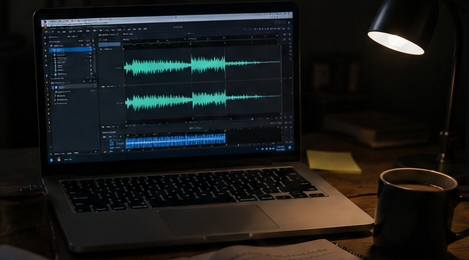
The message did not say what the original voicemail had said. Not all of it. Not “I think I pressed the wrong thing.” Not “Call me when you can.”
Those parts were impossible to recreate cleanly.
So I told myself the important part was there.
Her name. Honey. I love you.
I sent it to Lena at 7:14 a.m. with the subject line: Found a backup.
She called me immediately.
I let it ring twice before answering, because even then, some part of me understood that I had crossed a line and needed two rings to become the kind of person who could speak from the other side of it.
“You found it?” she said.
Her voice was already broken open.
“Yeah,” I said. “It was in one of the backup folders.”
She cried so hard she could not talk.
I sat on the edge of my bed, watching the sun brighten the wall, and felt something that looked enough like relief to pass.
For a while, everything got better.
That is another thing people do not tell you. Sometimes the wrong thing works at first.
Lena called me more. She sent me pictures from Mom’s recipe box. She asked if I wanted Dad’s old toolbox from the garage. At the memorial dinner we held months after the funeral, when everyone had finally become brave enough to gather around grief without pretending it was a holiday, Lena played the recovered voicemail.
She placed her phone in the middle of the table.
“Listen,” she said. “Jason found this for me.”
Our aunts leaned in. Cousins stopped scraping plates. The room went soft.
Then my dead mother’s manufactured voice came out of the tiny speaker.
“Lena, honey. I love you.”
Everyone cried.
Not loudly. Not dramatically. Just enough to let the room become honest.
And I sat there receiving gratitude like stolen property.
Aunt Mary touched my shoulder and said, “Thank God you knew how to save it.”
I almost confessed then.
The words rose in me. I opened my mouth.
But Lena was smiling through tears, and there was our mother’s voice, or something close enough to it, moving from person to person like a candle flame.
So I told myself: The comfort is real.
That became my new defense.
The comfort is real.
It did not matter that the thing itself was false. Lena had lost something and now she had something. Wasn’t that what love did? Filled in the gaps? Softened the worst parts? Made unbearable things bearable?
I built an entire morality around not wanting to be caught.
The problem came a week later, when Lena asked for the full file.
“I want to save it everywhere,” she said. “Can you send me the original backup too?”
“The original?”
“Yeah, like wherever you found it. Just in case.”
There are lies that require architecture.
I told her the recovery software had exported it strangely. I told her I only had the cleaned version. I told her the raw file was corrupted. Each sentence sounded technical enough to discourage further grief.
But grief is not easily discouraged.
“Can you try anyway?” she asked.
“I’ll look.”
Not yet. I’ll look. I’m trying.
My little collection of cowardly tools.
She started to notice things.
The original voicemail, she said, had been longer.
I said maybe she was remembering the silence around it.
She said Mom had mentioned pressing the wrong thing.
I said maybe that was another message.
She said no, she was sure.
I said grief does strange things to memory.
That was the worst thing I said.
Not because it was cruel in volume, but because it was cruel in precision. I used the truth about grief to protect a lie I had made.
After that, Lena stopped asking me about the voicemail.
She still listened to it. I know because sometimes when we were together, I would see it on her screen. The file name I had given it: mom_lena_recovered_final.
Final.
As if there is any such thing.
Months passed. The phone was replaced. The house was cleaned out. Mom’s sweaters went into donation bags. Her books were divided by who had borrowed them most and returned them least. Life performed its usual magic trick of continuing.
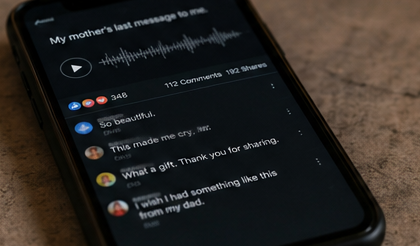
Then, on the anniversary of our mother’s death, Lena posted the audio online.
A black screen. White text.
My mother’s last message to me. Grateful my brother recovered it. Hold on to every voice you love.
People shared it.
They wrote things like beautiful and chills and what a gift.
Someone asked what software I used.
Someone else said they wished they had a message like that from their father.
By dinner, hundreds of people had heard my mother say something she never said in that order, in that tone, in that moment.
That is when I understood what I had really done.
I had not preserved her voice.
I had replaced a moment of her actual living confusion with something cleaner. More usable. More shareable. I had taken the awkward, accidental humanity of the real message — the television, the machine, the wrong button, the request to call back — and edited it into the kind of grief people know what to do with.
I had made my mother more comforting than she had been in life.
I had made her easier.
And because Lena loved it, because she needed it, because everyone praised it, the lie became harder than truth.
The truth was small once.
I deleted it.
I panicked.
I made something I should not have made.
Now the truth had a comment section.
I did eventually tell Lena.
Not immediately. I wish I could say I did it because conscience triumphed, but conscience is rarely that heroic. I told her because she wanted to have the waveform tattooed on her arm.
That is the sentence that finally stopped me.
She sent me the design on a Tuesday morning.
A thin blue line of sound waves curving beneath our mother’s handwriting.
Thinking of putting it here, she wrote, with a picture of her wrist.
I stared at it for a long time.
Then I drove to her apartment without answering.
She opened the door smiling, holding her wrist like it was already marked.
“What do you think?” she asked.
I said, “Please don’t do it.”
Her smile faded.
I told her everything.
Not well. Not cleanly. There is no elegant way to tell someone you forged a ghost for them. I tried to begin at the beginning, but beginnings are difficult when every part is your fault. I said the voicemail deleted. I said I was sorry. I said I thought I could fix it. I said I used videos. I said I never meant for it to go that far.
Lena stood very still.
When I finished, she asked, “So that isn’t Mom?”
“It is,” I said, too quickly. “It’s her voice. It’s from videos. It’s just—”
“Don’t.”
One word.
Enough.
She went into her bedroom and closed the door.
I stayed in the living room because I did not know whether leaving would be another injury. The apartment was full of our mother’s things. A lamp. A ceramic bowl. Three cookbooks with notes in the margins. Everywhere I looked, there was evidence of what I had not trusted to be enough.
After ten minutes, Lena came back out.
Her face had become flat in a way I recognized from hospitals.
“I want you to delete it,” she said.
“Okay.”
“Everywhere.”
“I will.”
“And I want you to send me the videos you used.”
I nodded.
“Not because I forgive you,” she said. “Because I want the real pieces back.”
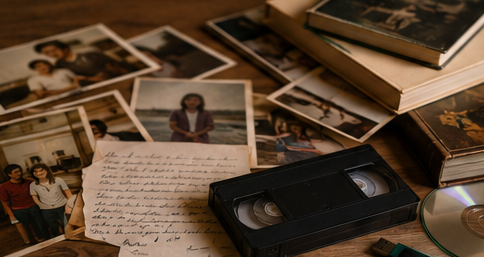
That was the outcome.
Not a dramatic ending. Not a screaming fight. Something worse, maybe. A correction that could not restore what had been corrected over.
I deleted the file from my laptop, my email, my cloud storage, the folder labeled Mom, the folder labeled Recovery, the folder labeled Final. Lena deleted her post. She did not explain why. People kept commenting for two days anyway.
So beautiful.
What a gift.
I’m crying.
The tattoo never happened.
The voicemail was gone.
The fake was gone too.
All that remained were the pieces: Mom asking someone to taste the sauce, Mom laughing at the candle, Mom saying “I love you” to my father in a room where nobody knew yet how valuable every careless word would become.
Lena and I speak now, but carefully. There is a politeness between us that did not used to be there. She does not ask me to fix her phone. She does not ask me to fix anything, really.
I understand why.
Trying to fix something can look like love from the outside. It can look like devotion, skill, urgency, sacrifice. But sometimes fixing is just refusal in work clothes. Refusal to sit in the damage. Refusal to be the person who caused it. Refusal to let loss remain unedited.
I thought I was giving my sister back our mother’s voice.
What I really did was take away her right to remember it honestly.
The original message had been imperfect. Inconvenient. Full of static and accident. It ended without wisdom. Without poetry. Without knowing it would be needed.
“Call me when you can,” our mother had said.
That was the part I could not recreate.
Maybe because it was the only part that mattered.
About the Creator
Jason Hair-Wynn
Theatre artist, director, choreographer, and arts leader writing on accountability, equity, and culture in the performing arts, with a deep belief in storytelling, truth, and spaces rooted in care. And some travel content along the way
Enjoyed the story? Support the Creator.
Subscribe for free to receive all their stories in your feed. You could also become a paid subscriber, letting them know you appreciate their work.
Comments
There are no comments for this story
Be the first to respond and start the conversation.