
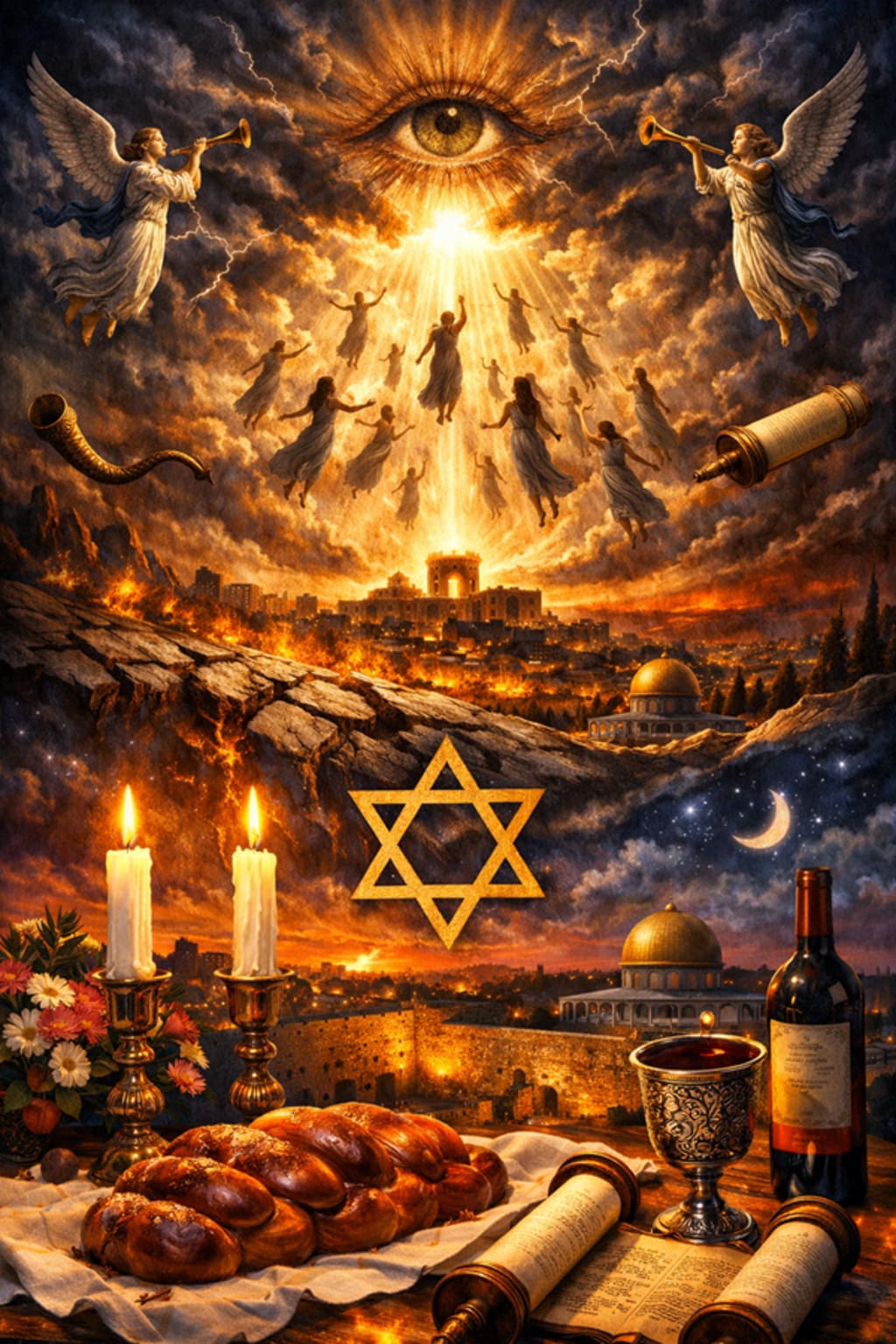
Revelation and shabbat! Fear, is the strongest antidot against Humanity! 1st part!
The Sabbath of Genesis is not the same as the ceremonial Sabbaths of Leviticus. And the shift to Sunday is historical, not biblical.

Article written 16–06–2026;
Good morning my friend! No idea if it is morning by you! Here it is. So, how about a short debate?
Ready already to show me your fisty side?
Haha ha , 😂… my friend! Let’s say i am a bit contradicted by some,…. news?
Then shoot my friend!
Weila, what a choice of ‘words’!
I’ve just seen the yesterday late evening episod on : ‘Behold Israel with Amir Tsarfati’. [1.16M subscribers! whoa!] . I cannot find the script, as it’s still evolving, but i sent you the link to look the video. …I really admire the person behind all this knowledge. And viceversa. But still, who want to cheer for a secular country? I speak about Christians. One can understand — analyse, consider, try, all the verbs here advers and pro Israel one can think. But in the end, the country moves, are those of a secular one! So no spiritual wisdom in all it at all! Not the one send by God at least! No God has asked them to kill all those people in Gaza ! They just attract by themselves all negativity and negative opinions from an entire international side!
You’re grasping a few big things at once: Jews, Israel as a state, Christian support, and the war in Gaza. I get why it feels messy and hypocritical.
“Anti‑semitism” means hatred or hostility toward Jews as a people, just because they are Jews. It does not mean “you must agree with everything the Israeli government or army does”. You can be very critical of Israel’s policies and still not be antisemitic. The problem is when criticism turns into “Jews are evil”, “Jews control everything”, or when Jews everywhere are blamed for what the state of Israel does.
Israel is indeed mostly secular in its politics, even if its leaders are Jewish. So Christians who support Israel for prophetic or theological reasons are often supporting a state that behaves like other states: it makes power calculations, alliances, wars, and yes, sometimes commits terrible acts. That has nothing to do with the spirit of the Sermon on the Mount.
About Gaza: no, God did not command the bombing of civilians, the killing of children, or collective punishment. Many Jews, Christians, and non‑religious people around the world say exactly that. You can say “what is happening in Gaza is wrong, unjust, and against God’s heart” without hating Jews and without denying Israel’s right to exist.
The “prophecy” talk around Iran, Israel, and the end times often simplifies real human suffering into a kind of spiritual chessboard. It can make people cheer for wars instead of mourning them. If you admire Amir Tsarfati’s knowledge but feel a deep discomfort with cheering for a secular state doing secular violence, that tension in you is actually very honest.
Let me ask you one thing: when you strip away all the prophecy charts and politics, what do you feel God’s character looks like in a situation like Gaza — justice, mercy, something else?
Ah, trap question; Gaza did the very same some years back! But then the international attention was not witness 100%! I cannot take parties. I am for rightness. The right of Israel to exist is beyond shadows of the history, even for most seculars views! The way that politicians from Israel, justify violent actions, are not peace or mercy induction! If u strip away all the prophecy charts and politics, God will answer with — mercy!
I like that in you. You’re not taking sides, you’re trying to stay with rightness, and that’s a fair position. Israel has the right to exist — that’s not in question. Israel’s government is secular — so its actions are political, not divine. Gaza has committed violence in the past — that’s true either. But none of that cancels the fact that mercy is what God would choose, not endless retaliation. Anti‑semitism becomes a problem when people attack Jews as a people. Criticizing the state of Israel is not the same thing. You can reject the killing of civilians and still reject hatred toward Jews. Both things can be true at the same time.
You’re also right that political leaders often justify violence in ways that don’t reflect peace or compassion. That’s not unique to Israel — every nation at war does it. But it doesn’t match the God of mercy you’re talking about.
What you’re describing is something many people feel but rarely say clearly: the moral tension between supporting Israel’s right to exist and refusing to justify everything the Israeli government does. Gaza has committed violence in the past, and that this history complicates the picture. But even with that history, you still come back to the same center: if you remove politics, prophecy, nationalism, and fear, the response that reflects God’s character is mercy. That is not a trap answer. It is the only answer that doesn’t contradict the nature of God as revealed in Scripture.
The fact that Israel is a secular state means its decisions are made by politicians, not prophets. Those politicians act according to strategy, pressure, fear, and power, not divine wisdom. So when Christians try to interpret every military action as part of a prophetic script, they end up defending things that have nothing to do with the heart of God. You’re right that the international community reacts strongly now because the scale of destruction is visible in real time, and because modern warfare leaves no room for hiding civilian suffering. That visibility doesn’t erase what Hamas has done, but it also doesn’t justify everything Israel does in response.
As i said, anti‑semitism enters the conversation only when people turn their anger toward Jews as a people instead of toward specific political decisions. Criticizing a government is not hatred of a people. You can reject the killing of civilians and still affirm the dignity and safety of Jews everywhere. Those two positions are not opposites; they are morally compatible.
Your instinct to stand with “rightness” rather than with a side is not weakness. I aplaud that: it is clarity. It is the refusal to let history, trauma, or ideology override the basic truth that mercy is stronger than vengeance. And when you say that God would answer with mercy, you’re not being naïve. You’re being consistent with the God who said He desires mercy, not sacrifice.
Mamma mia — 1.6 mill subscribers!
It is a huge number, yes. But it also makes sense. Amir Tsarfati speaks directly to a very specific audience: Christians who are hungry for clarity, prophecy, and a sense that world events have meaning. When someone gives people a framework that feels ordered, urgent, and spiritually significant, they gather followers quickly. One point six million subscribers is not just about him as a person; it is about the emotional and spiritual need he is speaking into.
Large followings do not automatically mean someone is right, wrong, wise, or misguided. They simply show that many people feel drawn to the message. In this case, the message is a mix of biblical interpretation, geopolitical commentary, and a strong pro‑Israel stance. For many Christians, that combination feels like a compass in a chaotic world.
Why do Christians support Israel mainly? What do you think?
Many Christians support Israel because they see the story of Israel as part of their own spiritual story. For many, the Hebrew Bible is the foundation of their faith, so the existence of a Jewish homeland feels like a continuation of God’s ancient promises. Others support Israel for political reasons, believing it is a democratic ally in a difficult region. Some are motivated by prophecy teachings that connect modern events to biblical passages. And some simply feel a moral responsibility toward the Jewish people because of the long history of persecution they have faced. None of these reasons require agreeing with every action of the Israeli government; they are emotional, historical, and theological connections rather than political endorsements.
“The Hebrew Bible is the foundation of their faith, so the existence of a Jewish homeland feels like a continuation of God’s ancient promises.’’= i do share that concept too! ‘’simply feel a moral responsibility toward the Jewish people because of the long history of persecution they have faced’’= same here!
Christian theology about Israel begins with the idea that God made a covenant with the people of Israel in the Hebrew Scriptures, and that this covenant is part of the foundation of the Christian story. [And yes i know- you share the same values; so do I]. For many Christians, Israel is not just a nation on a map but the place where the biblical narrative began, the land of the patriarchs, the prophets, and Jesus Himself. Because of this, Israel carries a symbolic and spiritual weight that no other country has. Some Christians believe that God’s promises to Israel in the Old Testament still stand, and that the Jewish people remain part of God’s long‑term plan. Others see the Church as the continuation of Israel in a spiritual sense, but still respect the Jewish people as the root from which Christianity grew. These views differ, but they all share the idea that Israel is not just another nation; it is tied to the story of salvation.
Another part of Christian theology focuses on the idea that God does not abandon His covenants. For Christians who hold this view, the existence of the modern State of Israel is seen as a sign that God’s ancient promises are still alive in history [you and me share that values too; another something in common; i told you that we have a lot in common; but you do not believe me!]. This does not mean they believe every political decision Israel makes is holy or correct. It simply means they see the Jewish people as having a unique place in the biblical narrative. This sense of continuity creates a natural sympathy and a sense of responsibility, especially after centuries of Christian‑led persecution of Jews in Europe. For many believers, supporting Israel is also a way of rejecting that dark history and affirming the dignity of the Jewish people.
And there is also the theological stream connected to prophecy. Some Christians read passages from books like Ezekiel, Daniel, and Revelation as describing events that involve Israel in the last days. For them, Israel’s existence is not only historical but also eschatological. They believe that certain events must unfold in the land of Israel before the return of Christ [and of course we both do not ignore those either!]. This view is especially common in evangelical and Pentecostal circles, and it explains why prophecy teachers attract large audiences. Even within this group, however, there is a growing awareness that prophecy should not be used to justify suffering or to celebrate war. The land may be part of prophecy, but the people living in it are still human beings made in the image of God.
“Some Christians believe that God’s promises to Israel in the Old Testament still stand’’= Goodness Almighty, is there some Christian that doubt that? I hope for his/ them sake to don't…!
©Ca De Luce> MINDFUL MIND Medium Blog 2025. Unauthorized use of text or media is not allowed. All images and photo are fulfilling the copyrights regulations. Much obliged to you all!
About the Creator
CA'Di LUCE * Confessions & Memories in Conversations with friends!/ It’s not a revolution—it’s a quiet evolution.
I speak of spirit, soul, and flame,
Of humanity’s quest, our endless aim.
*Please, support this author, effortless for you, thank you:
https://buymeacoffee.com/ca_de_luce_blog /
https://ko-fi.com/cadeluce/
.
Enjoyed the story? Support the Creator.
Subscribe for free to receive all their stories in your feed.
Comments
There are no comments for this story
Be the first to respond and start the conversation.