
The Great Niko Pirosmani
How the Georgian artist is remembered and honored today
I've been working on this story for several months, and it's going to be long but I just wanted to put a lot of things about Pirosmani in one place. You can read it in parts or come back to it, whatever is more convenient. But if you are into art, this is going to be a treat.
Niko Pirosmani (1862–1918) is a national treasure and arguably the best-known Georgian artist to the outside world. Self-taught, he painted in the naive, primitivist, child-like style: two-dimensional people and animals, limited shadow work, and light mostly coming from within the animate subject, contrasting with the black oilcloth he used as canvas. The choice of oilcloth was forced: Pirosmani lived in poverty most of his life and couldn't afford canvas or good paints and brushes.
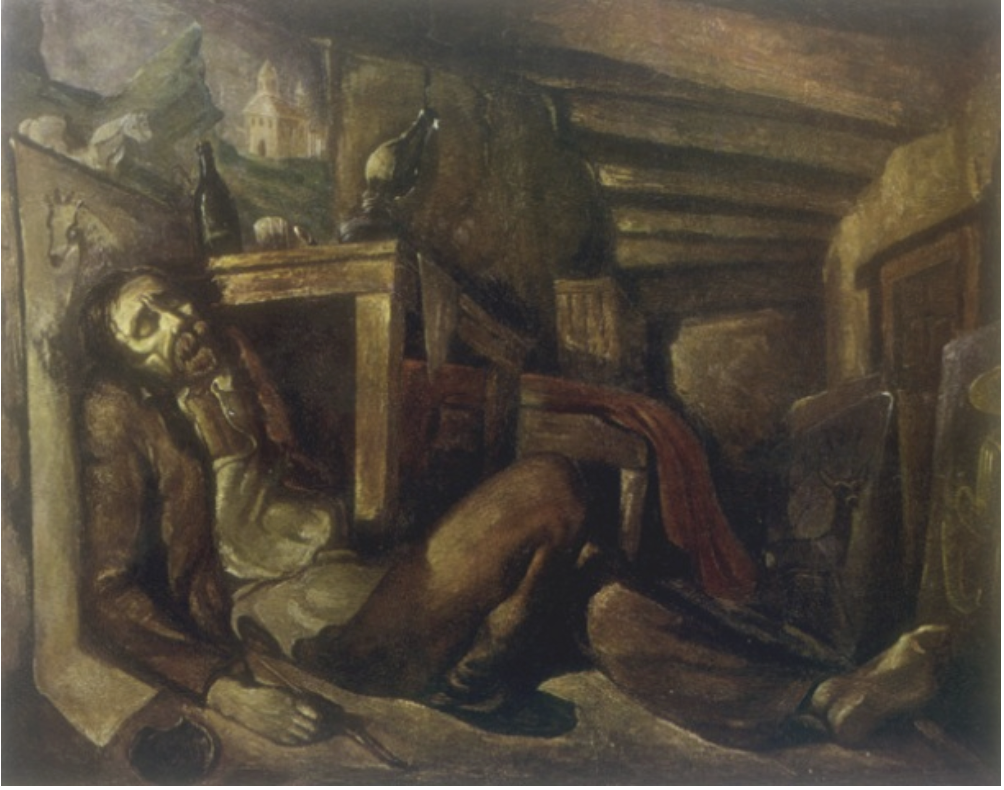
He died in poverty of starvation, exacerbated by the flu pandemic and WWI, in a small damp cellar room under the stairs of a Tbilisi tavern (currently being run as his house museum). A fellow artist Lado Gudiashvili painted this horrific and empathetic picture in 1946, based on his visit to Pirosmani in the winter of 1918. Then 22-year-old Lado came to give Pirosmani some money collected by the Society of Georgian Artists and was struck by his destitute:
Pirosmani died around Easter in April 1918, discovered several days after his death by one of the brothers Kirill and Ilia Zdanevich, both of whom had tried to support and publicize his work as much as they could. Much later, in 1972, Ilia Zdanevich introduced Pirosmani's work to Pablo Picasso, inspiring him to draw Pirosmani's sketch I wrote about in One Work story. Pirosmani was buried in an unmarked grave with other flu and starvation victims and the grave is still unknown.
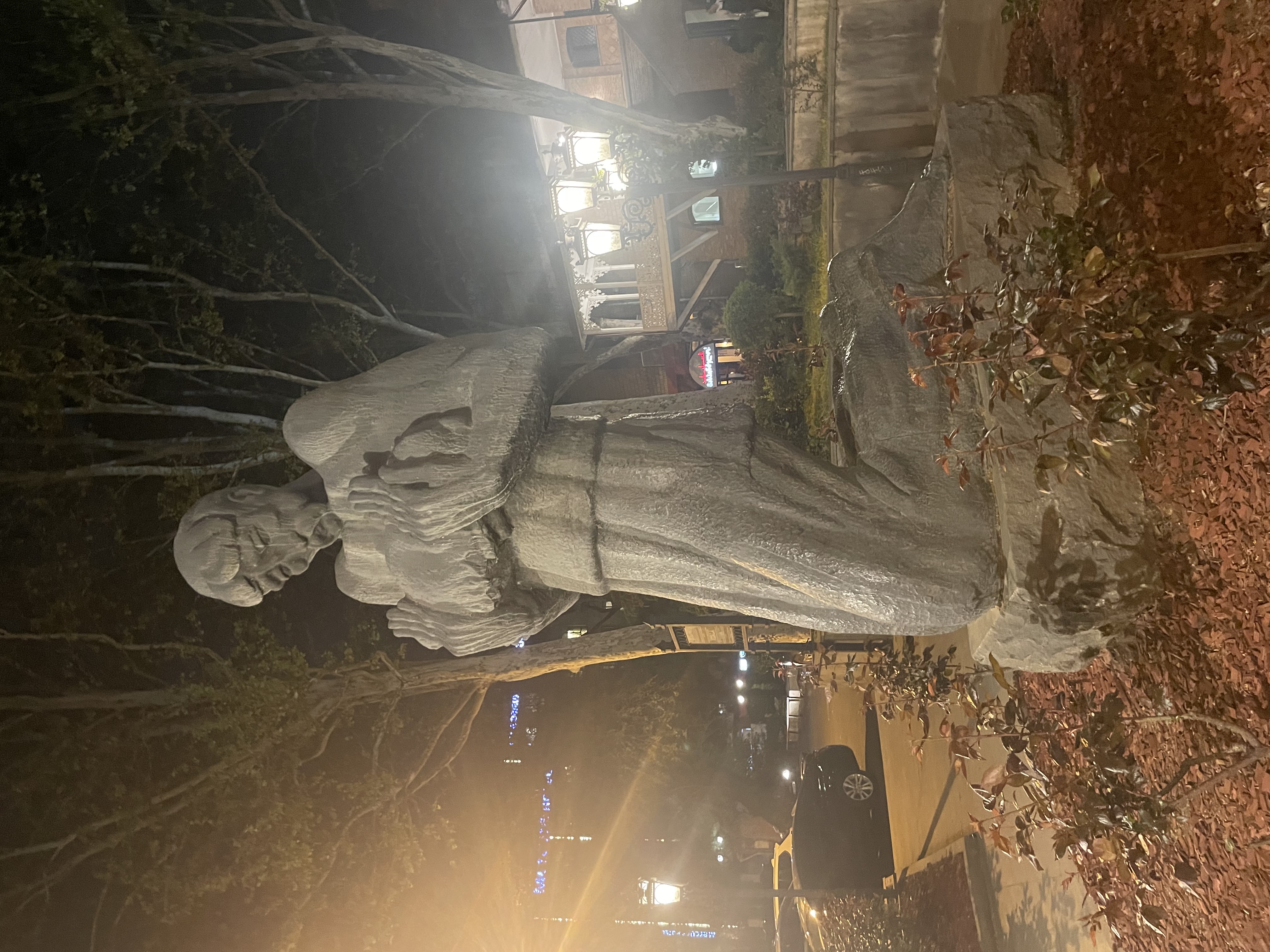
His death around Easter has a huge symbolic meaning in the second oldest Christian nation in the world (Georgia, then Iberia, adopted Christianity after Armenia (301 CE), only about 25-40 years later). It probably is the reason why Pirosmani is often depicted with an Easter Lamb in his arms, as in this sculpture in Pirosmani park in the Old Tbilisi:
Before I came to Tbilisi, my knowledge of Pirosmani was limited to his most famous paintings (Margarita, Street Sweeper, Giraffe, etc.) and the song titled "A million of Red Roses" by a famous Soviet/Russian singer Alla Pugachova. Here's the song with an option for auto-generated subtitles in English:
When I just arrived in Tbilisi last year, I wanted to see as much Pirosmani as possible. However, the largest collection of his works is kept at the National Gallery and when I came for a visit in September it was closed. I was told that some Pirosmanis were relocated to the Fine Arts Museum because the Gallery had issues with climate control, and moisture and heat could destroy the fragile oilcloth and cardboard Pirosmani painted his masterpieces on. Some of the paintings that were usually housed at the National Gallery were simply put into storage and were completely inaccessible.
I of course went to the Fine Arts Museum and took there everyone who visited me, including my niece and son. But it was only one hall with about 25-30 paintings, and not the most significant of his works. So when the National Gallery finally reopened its Pirosmani exhibit (the entire second floor) in April 2026, I ran there and took lots of pictures. The Gallery has a rotating exhibit of about 80 of the total 152 paintings The Museum of Fine Arts network owns. The entire collection can never be exhibited due to the space constraints and the fact that the paintings need to be constantly maintained and repaired.
Here are some of my favorites:
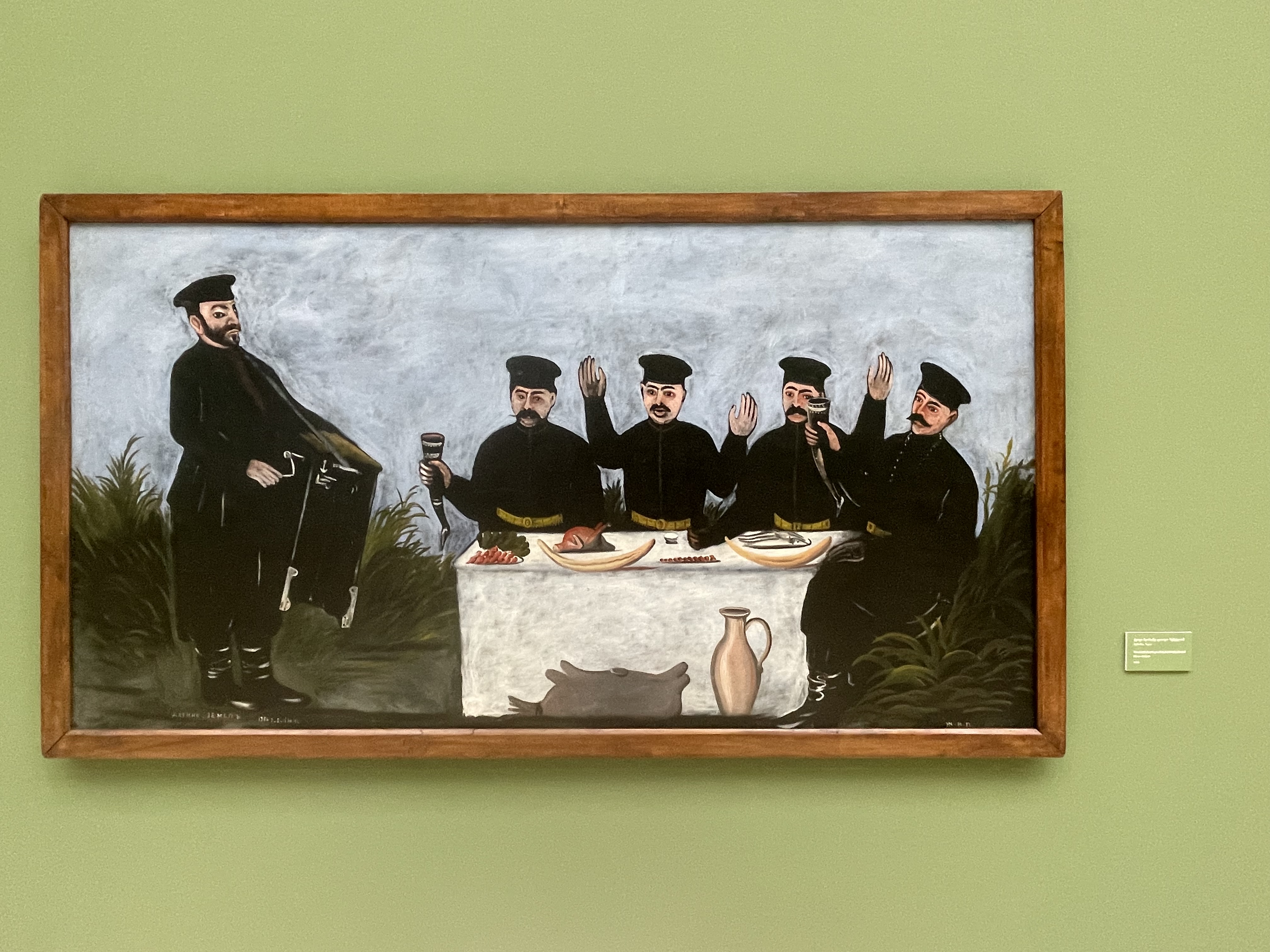
Pirosmani painted a lot of traditional feasts (called "supra" in Georgian), when the food is brought out in stages, beginning with starters like bread, cheese and vegetables and ending with meat dishes. Lots of wine throughout the feast. The paintings' variations would be with people, entertainers, and the setting.
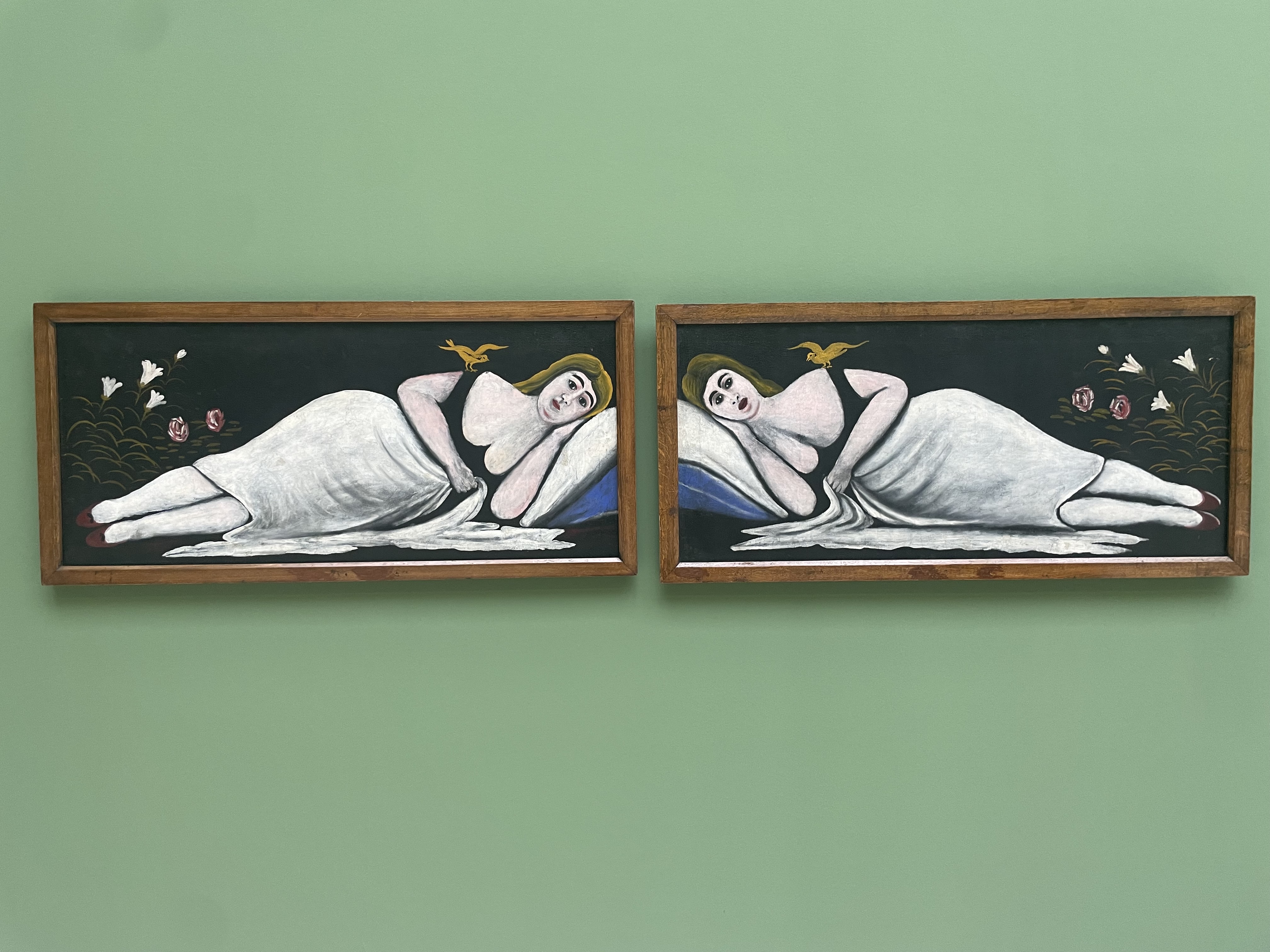
I like The Beauties of Ortachala because it is a large, long diptych portraying voluptuous women from a part of Tbilisi, which at the time was more like a suburb or satellite town, where I lived as well.
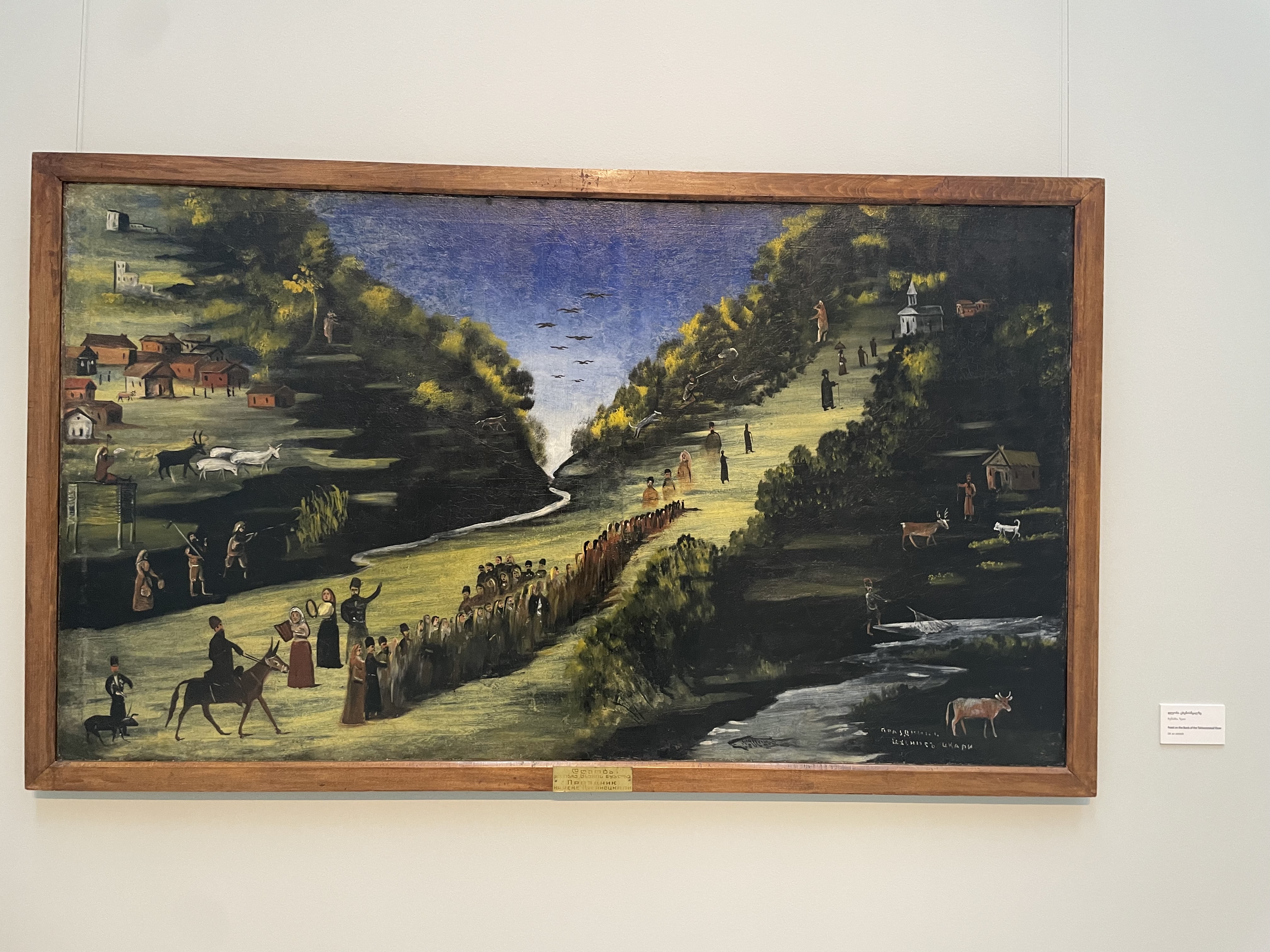
I liked Party by the River Tskhenistskali because it's a large painting (2 x 1 m) that depicts typical Georgian life in a village in preparation for a big party to celebrate good harvest.
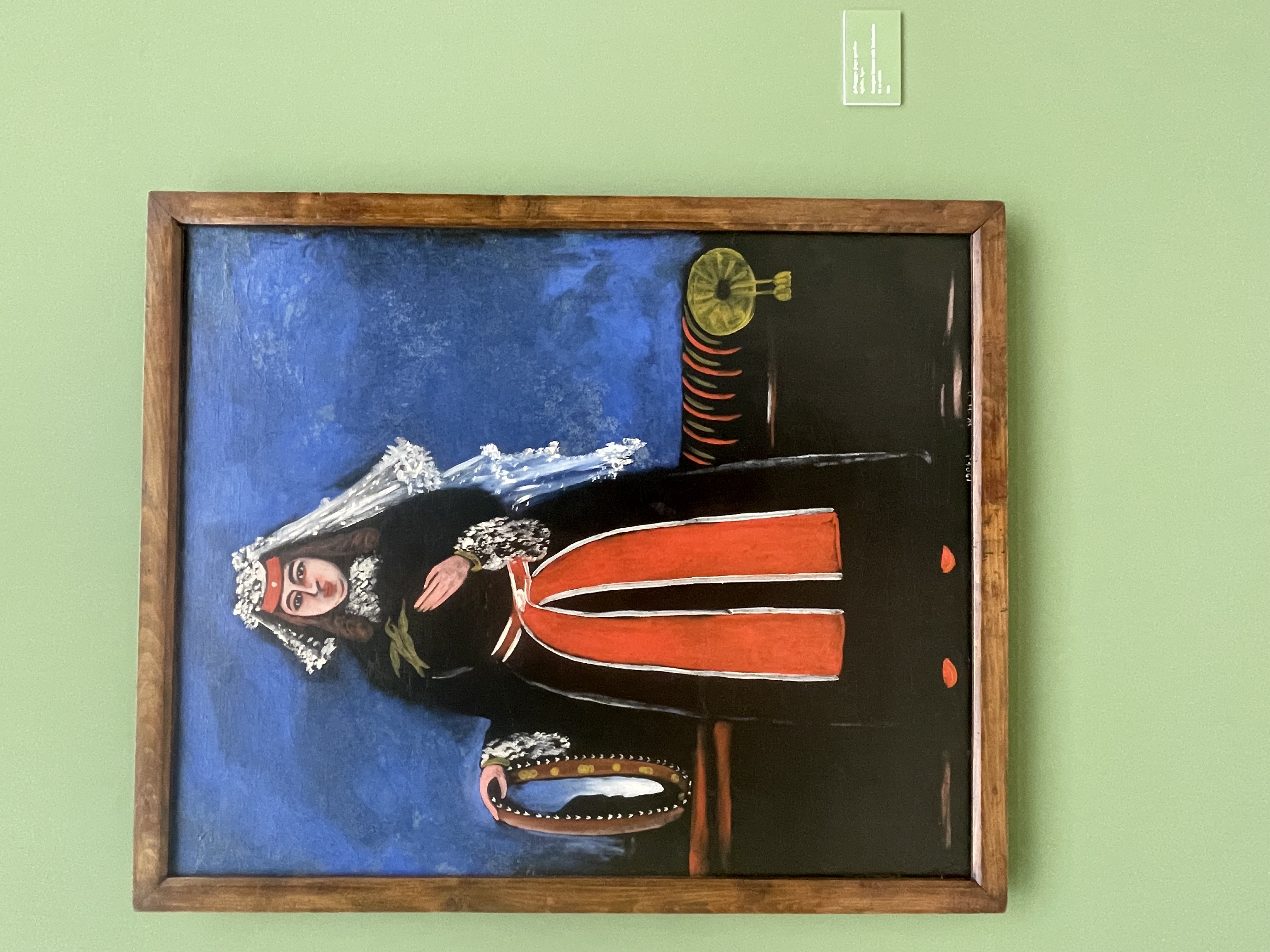
Georgian Woman with Tambourine is one of many in Georgian Women series. I like it because of the contrasting colors. Side note: A remarkably similar painting, Georgian Woman Wearing a Lechaki, fetched £2,230,000 ($2,838,632) at Sotheby's London in November 2018. It had been gifted to Austrian writer Stefan Zwieg in 1928 by the Soviet government. The most valuable Pirosmani ever sold, it remains in a private collection.
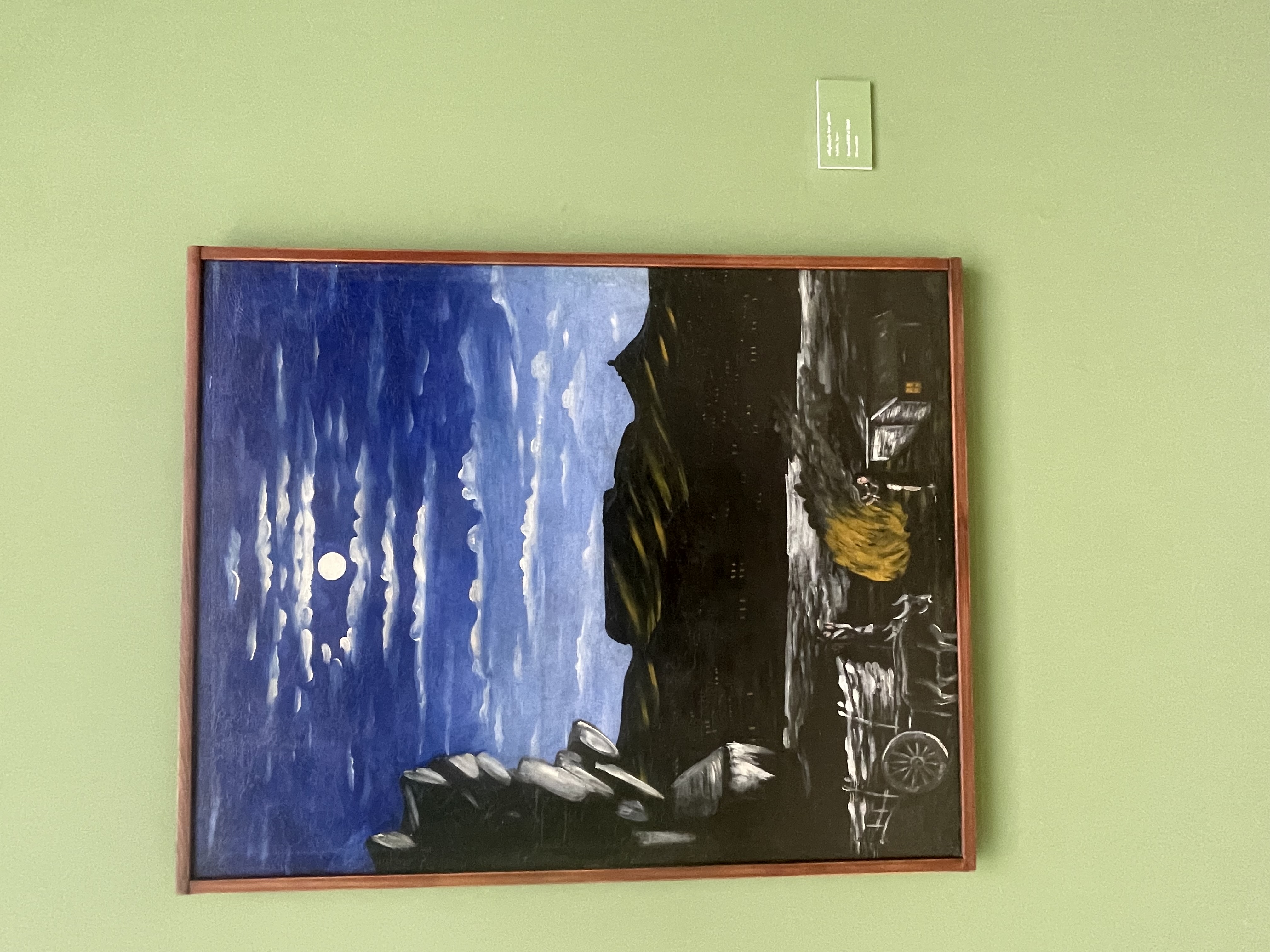
Pirosmani's Arsenal Mountain at Night found its way home from a Christie's Auction House in 2015. The former prime-minister and now a de-factor pro-Russian ruler of Georgia Buzina Ivanishvili bought it for $1.5 million and donated it to the museum. This news report gives more details and has the footage of the National Gallery where the painting is currently displayed. I like this painting because it reminds me of Van Gogh's Starry Night, even though Pirosmani would have never seen it in his life.
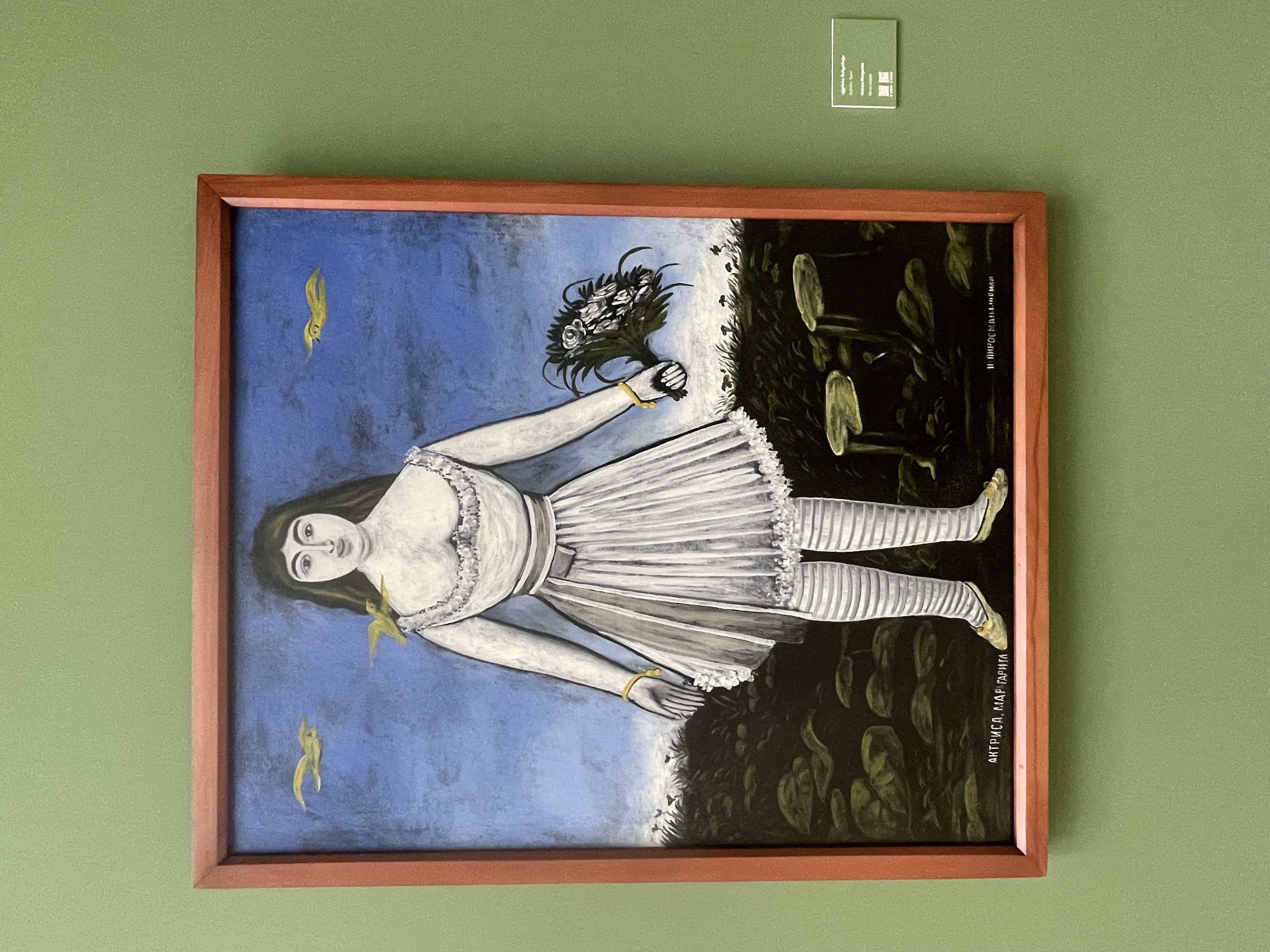
Arguably the most famous painting by Pirosmani, Margarita is the portrait of his unrequited love that later became inspiration for movies, songs, and other paintings. This is the woman he sold everything for, to buy a sea of flowers to cover the square of her hotel. And she just left with her touring company.
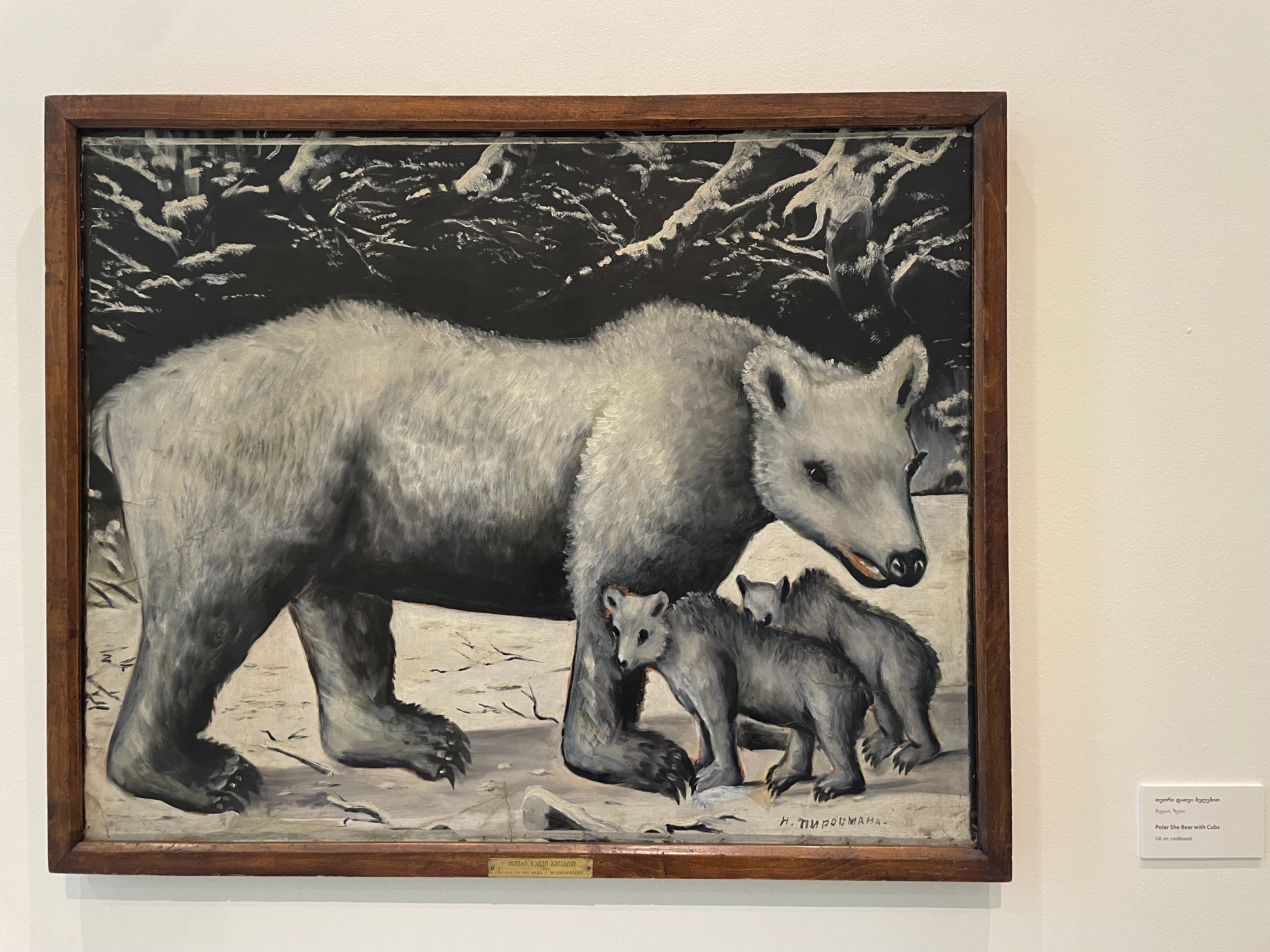
Pirosmani painted a lot of animals, calling them "friends of my heart" and often depicting them with more emotional and tragic depth than humans. There are many paintings of bears, cows, dear, dogs, but even more lambs (at least five are Easter Lambs). The vulnerable, pure nature of the lamb perfectly mirrors Pirosmani’s own tragic life as a gentle, self-taught genius who was not recognized during his life. For homework, I encourage you to research the history and deep symbolism of the Giraffe, which I unfortunately did not photograph at the museum.
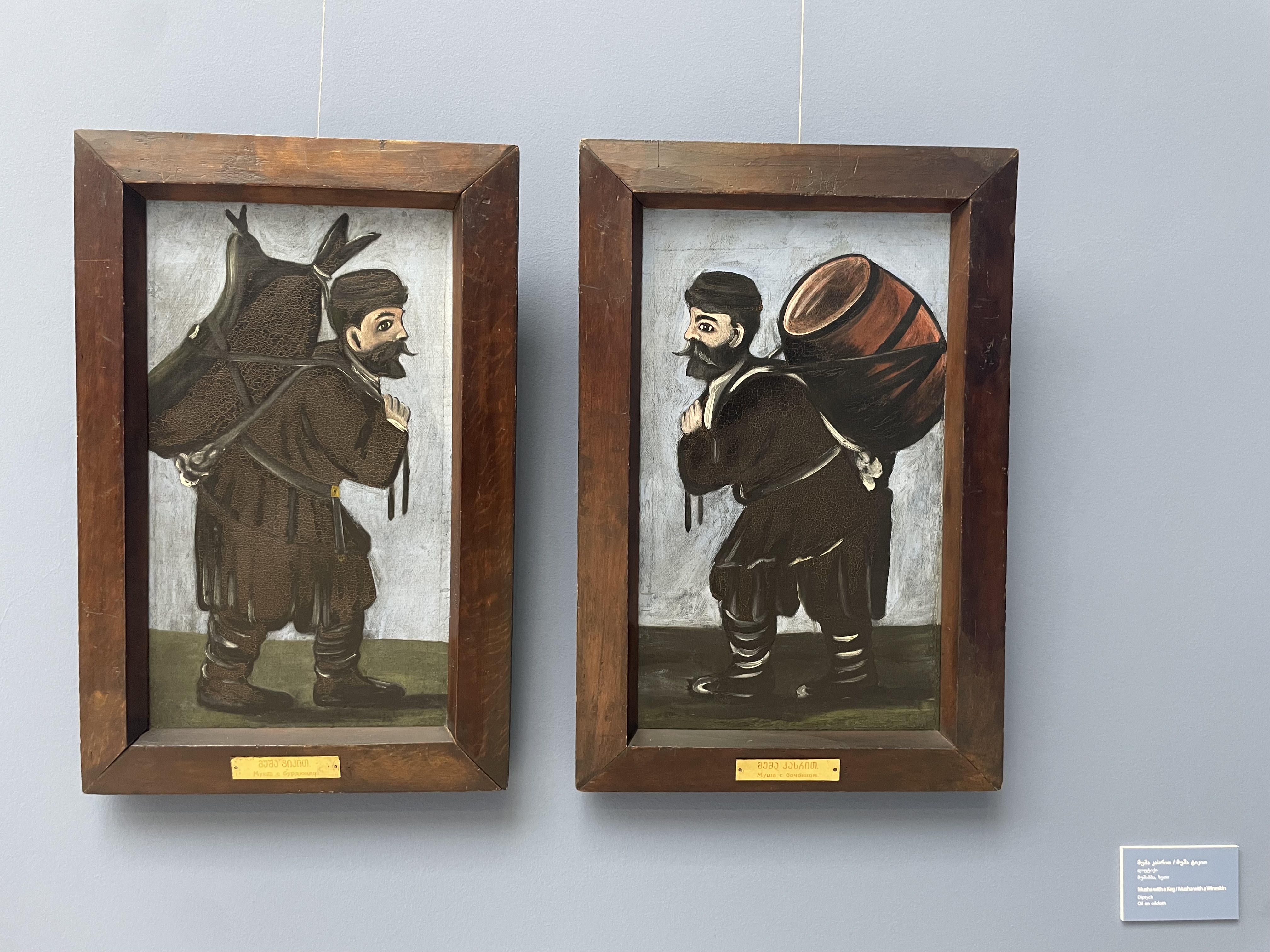
Finally, another one of my favorites -- a small diptych portraying workers during the grape harvesting and wine-making season. I just thought they were so quintessentially Georgian, leaning into the 8,000-year tradition of wine making with qvevries, barrels and wineskins.
There's a smaller Pirosmani exhibit of 16 paintings in the museum of Sighnaghi, the town in Kakheti closest to his native Mirzaani village. Mirzaani has Pirosmani's House Museum at the house he himself built, with a lot of authentic artifacts from his life and 14 paintings. I haven't been to ether of those, but I will definitely make an effort to visit both next time I'm in Georgia.
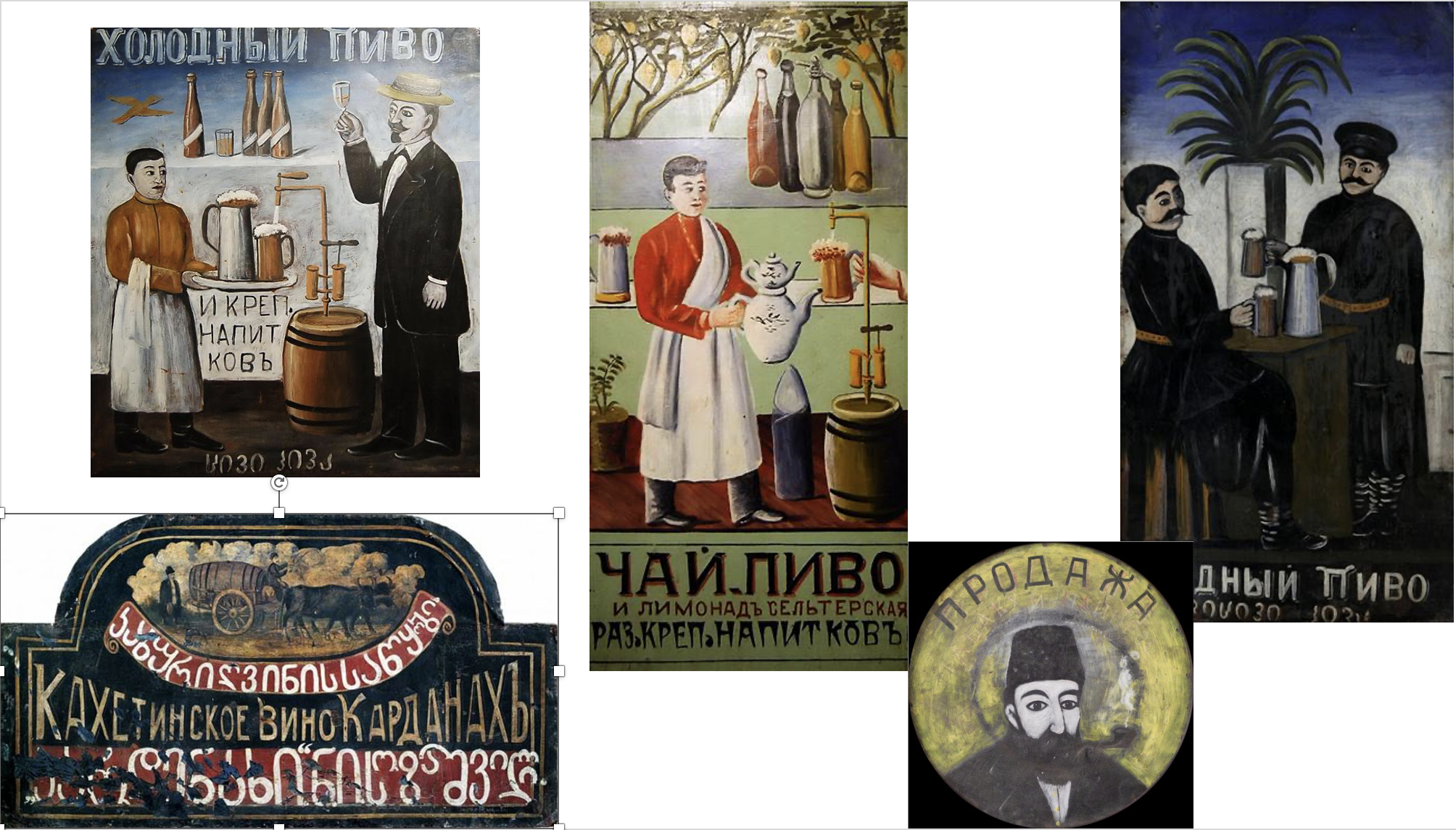
To give you an idea of how Pirosmani survived, I've collected samples of tavern and shop signs he painted for little money. Bottom left, clockwise: a street sign for a Kakhetian wine shop; a sign for the cold keg beer and liquor; an ad for tea, beer, lemonade, Selterskaya vodka, and other hard liquor; another sign for cold beer shop; and a personally branded tobacco ad on a tin can.
Today, Pirosmani is the most celebrated and revered artist in Georgia. As a tourist, you will see a lot of souvenirs with his paintings. Because he never married and had no children, his blood line died with his nephews and nieces (his two older sisters had children) and most of his works and legacy are managed by the state of Georgia.
His life and work inspired a brilliant 1969 biopic movie by Giorgi Shengelaia, one of the greatest Soviet-Georgian directors. The movie covered his life since he decided to move to Tbilisi from his native village of Mirzaani, and to his death, which was symbolically changed akin Tarantino's "Once Upon a Time in Hollywood." There's also a scene with Lado Gudiashvili's visit, and lots of allusions to The Giraffe. The full movie with English subtitles is available here:
Arabeski, a 1985 documentary featuring a lot of Pirosmani's paintings, was filmed by one of the best dissident Soviet-Georgian directors Sergei Parajanov:
But my absolute favorite is a song by a contemporary Georgian singer Tamara Gverdtsiteli, who has an incredible voice range and mastered vibrato better than any modern singer with an auto-tune. I like it because it a love song from one Georgian to another, separated by time but sharing the culture, history, and the language, even though this song is in Russian. I have provided the lyrics for the song below (my own translation, no AI). I hope you enjoy it as much as I do:
1
In the golden country of memories,
On the colorful roads of dreams,
It’s not me you are waiting for, my Pirosmani,
A genius who went crazy for love.
~
Both you and I were born in Tbilisi
But I’m not the one you so cherish,
You are in love with some actress,
Who was born in some faraway Paris.
Chorus:
Niko, Niko, Niko Pirosmani
If only you met me in your time,
I’d have waited for you in the night fog
I’d be singing songs to our children.
2
Niko, Niko, Niko, if only you knew
How sad it feels, I’m shedding tears
That it was not my portrait you painted
But a portrait of a traveling Parisienne.
~
She was not even a great actress,
A daughter of the faraway spoiled Seine
Had it not been for you, crazy Niko,
She’d have been forgotten long ago.
Chorus:
Niko, Niko, Niko Pirosmani
If only you met me in your time,
I’d have waited for you in the night fog
I’d be singing songs to our children.
~
Niko, Niko, Niko Pirosmani
Our romance would have become a legend
I wish the time separating us
Was not an insurmountable obstacle.
3
Not so long ago, near the Seine, I found
The house of the forgotten careless actress
And your long-stolen broken heart
I brought back home to Tbilisi.
Chorus:
Niko, Niko, Niko Pirosmani
If only you met me in your time,
I’d have waited for you in the night fog
I’d be singing songs to our children.
Niko, Niko, Niko Pirosmani!
About the Creator
Lana V Lynx
Avid reader and occasional writer of satire and short fiction. For my own sanity and security, I write under a pen name. My books: Moscow Calling - 2017 and President & Psychiatrist
@lanalynx.bsky.social
Enjoyed the story? Support the Creator.
Subscribe for free to receive all their stories in your feed. You could also become a paid subscriber, letting them know you appreciate their work.
Comments
There are no comments for this story
Be the first to respond and start the conversation.