
One Work: Pirosmani by Picasso
From the horror of Guernica to the awe of the artist's sketch
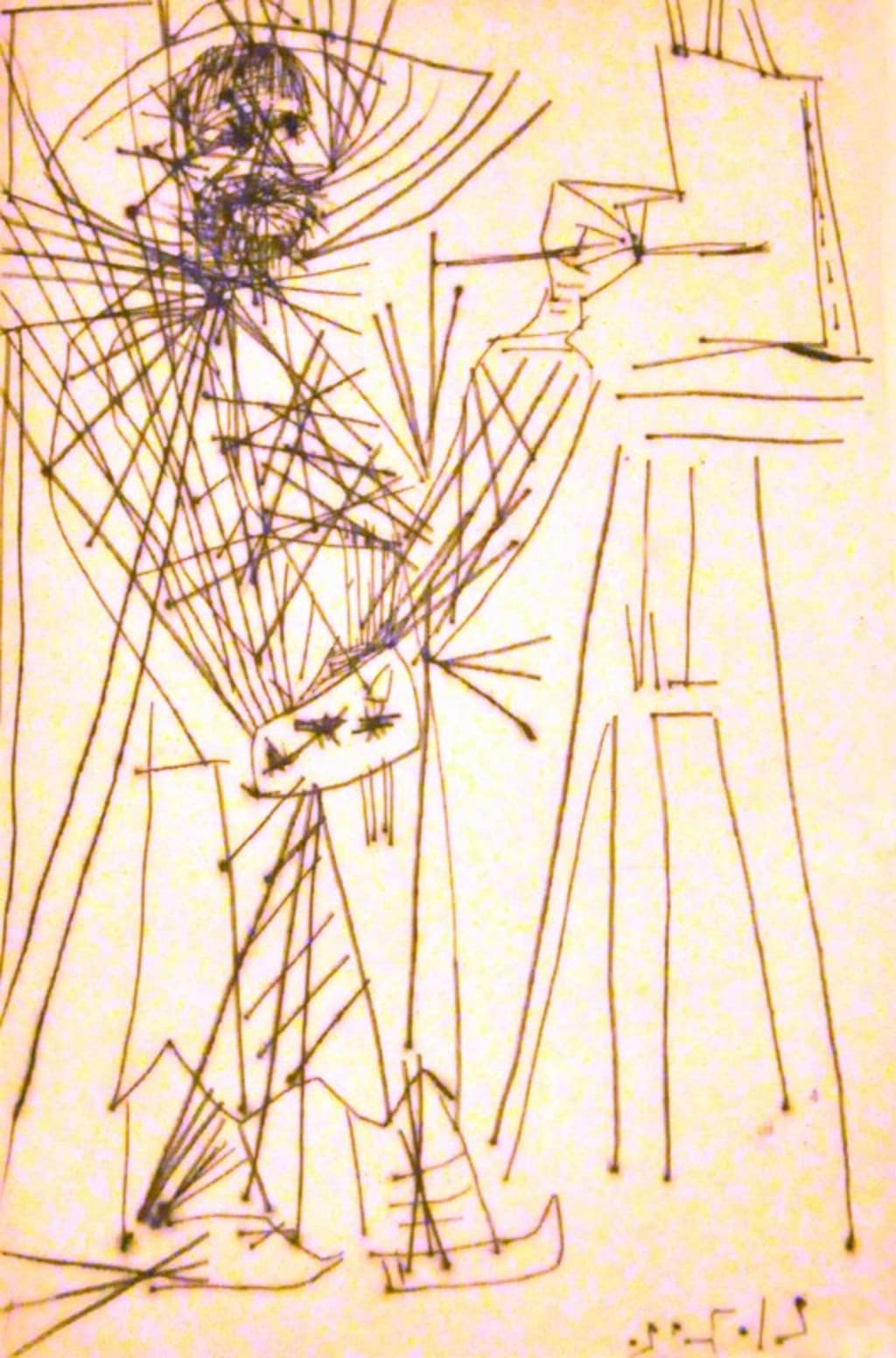
I've been trying to find a way to write about Picasso's sketch of Pirosmani as a separate piece and Paul gave it to me by publishing a piece on Guernica. So, the connection for Raymond Taylor's great challenge is from Picasso's horror of the war to his somewhat chaotic awe of a fellow genius artist he never met in person and learned about very late in life, several months before his own death.
Niko Pirosmani (1862–1918) is arguably the most famous Georgian artist in the world now. But during his life, he was known as someone who painted tavern signs, primitive portraits and landscapes on black oilcloth. The choice of material was somewhat forced as he lived in abject poverty for most of his life. During the short period of time when he was somewhat well off, he fell in love with a touring French variety show singer, sold everything he owned, and bought a million (or so the tale says) roses and other beautiful flowers to cover the square in front of her hotel. But that is a different sad story that produced Margarita, probably the most famous Pirosmani's painting:
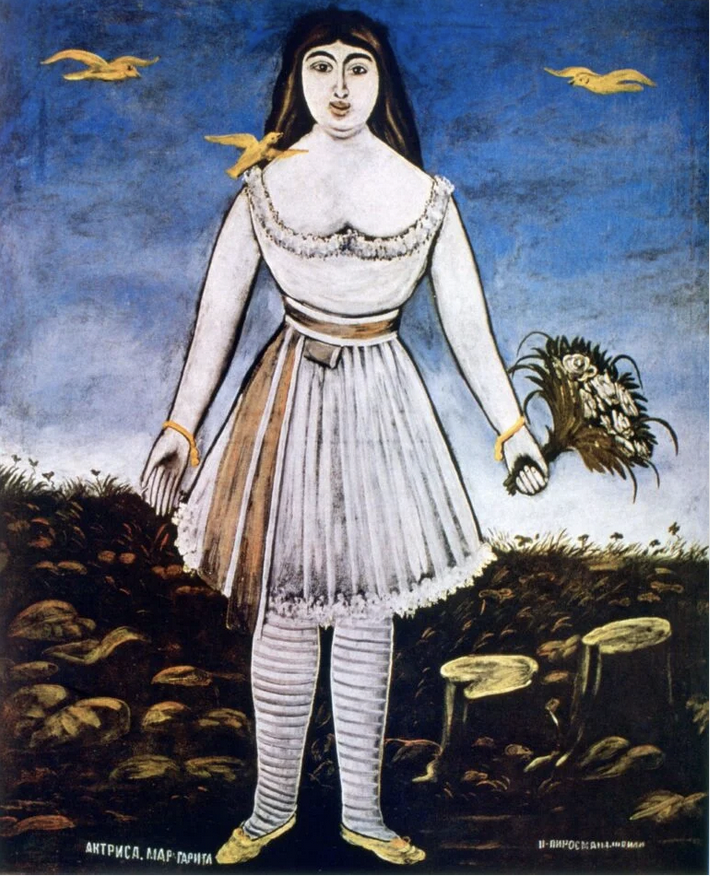
Pirosmani never studied art and painted in his own primitivist style, that is highly recognizable for the black background, somewhat disproportionate and strikingly flat human bodies and animals that nonetheless radiated light from within. He loved his country and his people deeply, and it shows in his paintings.
Pirosmani was never able or willing to achieve fame and status for his art, lived mostly off a small shop he owned and painted tavern and shop signs to survive. The Georgian intelligentsia who "discovered" him around 1912, namely the brothers Kirill and Ilia Zdanevich and artist Mikhail Le-Dantiyu, found him essentially as an anonymous artisan, unknown even within Tiflis. They tried to support him as much as they could but he still died in absolute poverty, discovered several days after his death by one of the Zdanevich brothers.
As someone who was born and grew up in rural Georgia, Pirosmani had no contact with the Russian or European avant-garde circles, no access to art journals, no exhibitions to attend or anything else that could suggest any influence on his works and talent. He was truly a phenomenon in and on himself.
Nonetheless, there's a striking similarity between Pirosmani and Picasso's Blue Period works, when he deliberately went with the naive and primitive style. I've had a long conversation with Claude about this curious coincidence, given that they never crossed paths, lived thousands of miles apart, and as a self-taught artist Pirosmani was largely excluded from all outside influences.
Claude suggested this:
"The similarity between them is probably best explained not by any shared cultural current, but by the fact that visual sincerity, uncorrupted by academic convention, has a natural grammar — and both men, by entirely different paths, were speaking it. One had it stripped away and laboriously recovered it. The other never had it taken from him in the first place. That may be why Picasso, when he finally did learn of Pirosmani later in life, reportedly expressed something close to awe rather than mere collegial appreciation. He may have recognized in Pirosmani someone who had actually done what he himself had only approximated."
Claude's guess is as good as mine in this case.
There is, however, a well-documented record of Picasso's reaction to Pirosmani. When Ilia Zdanevich showed him a catalogue of Pirosmani's works in 1972, Picasso was so deeply impressed that he immediately drew the sketch of Pirosmani. It looks urgent and chaotic, but at the same time, a great tribute to the artist he felt so moved by.
Paul's piece on Guernica is here:
And Raymond's original challenge is still active:
About the Creator
Lana V Lynx
Avid reader and occasional writer of satire and short fiction. For my own sanity and security, I write under a pen name. My books: Moscow Calling - 2017 and President & Psychiatrist
@lanalynx.bsky.social
Enjoyed the story? Support the Creator.
Subscribe for free to receive all their stories in your feed. You could also become a paid subscriber, letting them know you appreciate their work.
Comments
There are no comments for this story
Be the first to respond and start the conversation.