
AI and the End of the Traditional Career Path
Why the Future of Work Will Be Built Around Skills, Adaptability, and Multiple Sources of Opportunity
AI and the End of the Traditional Career Path
Why the Future of Work Will Be Built Around Skills, Adaptability, and Multiple Sources of Opportunity
For generations, the traditional career path followed a familiar pattern.
A person completed their education, secured an entry-level position, worked for one organisation, gradually earned promotions, and eventually retired after several decades of service. Career progression was usually linear. Each role led naturally to the next, professional identities remained relatively stable, and long-term employment was often considered the safest route to financial security.
That model is now disappearing.
Artificial intelligence, automation, remote work, digital platforms, global competition, and rapidly changing business models are transforming how careers are built. The modern professional is increasingly unlikely to remain in one occupation, rely on one employer, or follow a predictable ladder from junior employee to senior executive.
Instead, careers are becoming more fluid, modular, and self-directed.
People may move between employment, freelancing, consulting, entrepreneurship, online education, content creation, and project-based work throughout their lives. They may hold several professional identities at the same time. A marketing specialist may also operate an online business. A teacher may create digital courses. A software developer may consult, write technical content, and build AI products.
Artificial intelligence is accelerating this shift.
AI is not simply changing how people perform their jobs. It is changing what a career means.
The future of work will not necessarily reward those who remain loyal to one occupation for decades. It will reward those who continuously learn, adapt, combine different skills, build visible expertise, and create multiple ways to generate value.
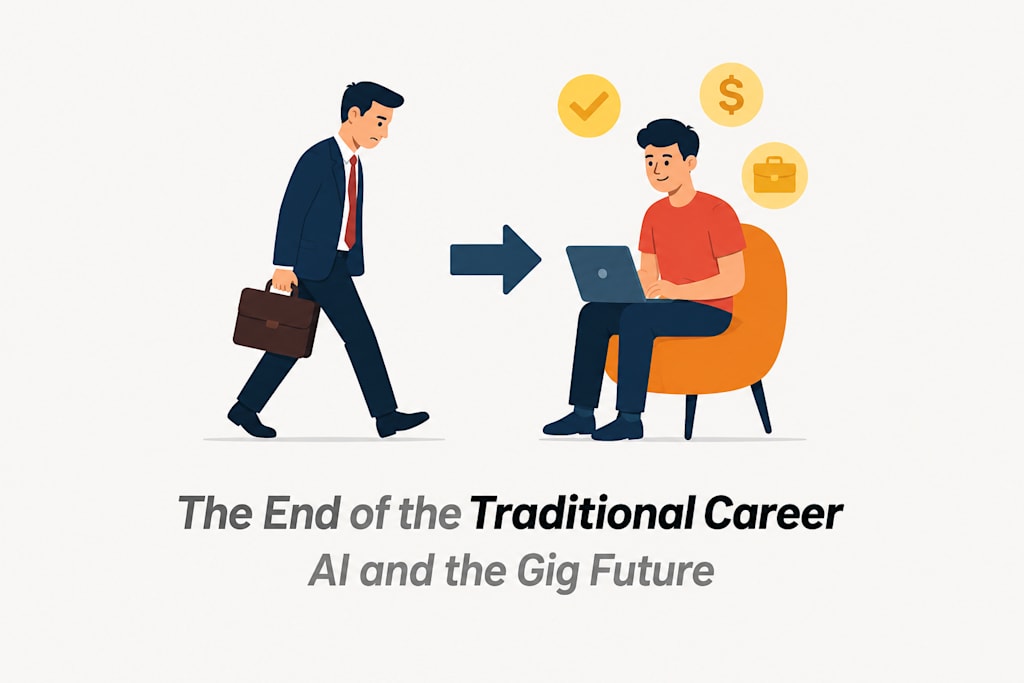
The traditional career ladder is being replaced by a career portfolio.
The Traditional Career Model Was Built for a Different Economy
The old career system emerged during an era of relatively stable industries, predictable organisational structures, and long product cycles.
Companies hired employees to perform clearly defined roles. Workers developed expertise within those roles, and promotions generally depended on experience, seniority, and organisational loyalty.
A person might begin as an assistant, become a supervisor, advance into management, and eventually reach an executive position. Knowledge accumulated slowly, technologies changed gradually, and many professional skills remained valuable for decades.
This structure provided predictability.
Employees knew what qualifications they needed. Employers understood how roles should be organised. Educational institutions prepared students for recognised professions. Career success could often be measured through job titles, salary increases, and years of service.
However, the modern economy operates differently.
Technology changes rapidly. Entire industries can be disrupted within a few years. New business models appear faster than formal education systems can respond. Companies restructure frequently, and global competition allows organisations to access talent from almost anywhere.
Artificial intelligence adds another layer of acceleration.
Tasks that previously required years of specialised training can now be completed with AI assistance. Research, analysis, writing, coding, design, customer support, financial modelling, marketing, and administrative work are being transformed by intelligent systems.
The result is a labour market where job descriptions evolve faster than traditional career planning can accommodate.
AI Is Separating Jobs from Tasks
One of the most important changes created by artificial intelligence is the separation of jobs into individual tasks.
A job is rarely a single activity. It is usually a collection of responsibilities.
For example, a marketing manager may conduct research, write content, analyse campaigns, prepare reports, communicate with customers, manage budgets, coordinate teams, and develop strategy.
AI may automate some of these tasks, improve others, and leave the most complex responsibilities to humans.
This means that AI does not always eliminate an entire profession. Instead, it changes the composition of the profession.
Routine tasks are increasingly handled by software. Human workers are expected to focus on judgment, creativity, communication, relationship-building, strategic thinking, and decision-making.
This task-level transformation makes career planning more complicated.
A professional cannot simply assume that their existing role will remain unchanged. They must examine which parts of their work can be automated, which parts can be enhanced, and which new capabilities will become valuable.
The most resilient workers will not defend outdated tasks. They will redesign their roles around the areas where human contribution remains strongest.
The Career Ladder Is Becoming a Career Web
The traditional career ladder assumes that progress moves upward in a straight line.
The emerging career model looks more like a web.
People move sideways, upward, downward, and across industries. They may temporarily accept a lower title to enter a high-growth field. They may leave employment to freelance, return to education, launch a business, or develop a new technical specialisation.
These movements are no longer necessarily signs of failure.
They are often strategic adaptations.
A journalist may become a content strategist, then an AI communications consultant. An accountant may specialise in financial automation. A customer-service professional may transition into conversational AI design. A legal professional may develop expertise in AI governance and digital regulation.
The connections between industries are becoming more important than the boundaries between them.
Professionals who combine knowledge from several fields can often create more value than those who remain narrowly specialised.
A person who understands healthcare, data analysis, and AI may contribute to medical technology.
Someone who understands law, cybersecurity, and machine learning may work in AI compliance.
A professional with expertise in education, content creation, and automation may build personalised learning systems.
The career web allows skills to travel across industries.
One Profession May No Longer Be Enough
In the traditional model, professional identity was often singular.
People described themselves as teachers, accountants, engineers, lawyers, nurses, designers, or managers.
The future of work may require a more flexible identity.
A person may be an employee, consultant, creator, investor, educator, and entrepreneur at the same time.
This does not mean everyone must work constantly or maintain several demanding jobs. It means that income, expertise, and opportunity may increasingly come from multiple sources.
A software engineer may have a full-time role while also creating online courses.
A financial analyst may publish a specialist newsletter.
A business consultant may sell templates, provide coaching, and operate an AI-powered research service.
A translator may combine client work with localisation consulting, language-data annotation, and digital publishing.
This portfolio approach can create resilience.
When one source of income declines, another may remain active. When one industry changes, skills developed elsewhere may provide alternative opportunities.
The traditional career path concentrated risk in one employer and one occupation.
The portfolio career spreads risk across several professional assets.
Continuous Learning Is Replacing One-Time Education
Traditional careers were often based on a front-loaded education model.
People completed school, university, or vocational training at the beginning of adulthood and then relied on that knowledge throughout their working lives.
That approach is becoming less effective.
Artificial intelligence evolves quickly. Software platforms change. New industries emerge. Skills that were highly valuable five years ago may become standardised or automated.
Professionals must therefore learn continuously.
This does not always require returning to university for another full degree. Learning may happen through online courses, professional certifications, short programmes, workshops, mentorship, practical projects, and direct experimentation.
The key is not simply collecting qualifications.
The key is developing useful, current, demonstrable capability.
Employers increasingly want evidence that a person can solve real problems. A portfolio, case study, working prototype, published article, completed project, or measurable business result may sometimes communicate ability more effectively than a certificate alone.
AI itself can support continuous learning.
Professionals can use AI tools to explain difficult concepts, generate practice exercises, summarise research, simulate interviews, review code, provide feedback, and create personalised study plans.
Learning is becoming more accessible, but it is also becoming more necessary.
Skills Are Becoming More Valuable Than Titles
Job titles can be misleading.
Two people with the same title may perform very different work. A “marketing manager” in one company may focus on strategy, while another may spend most of the day managing advertising platforms. A “data analyst” may work with basic spreadsheets in one organisation and advanced machine-learning systems in another.
As roles become less standardised, specific skills become more important.
The modern professional needs to understand what they can actually do.
Can they analyse complex information?
Can they communicate clearly?
Can they use AI tools responsibly?
Can they automate repetitive work?
Can they lead projects?
Can they understand customers?
Can they solve problems under uncertainty?
Can they learn unfamiliar systems quickly?
These capabilities travel across employers and industries.
A job title belongs to an organisation. A skill belongs to the individual.
That distinction matters in a labour market where companies, roles, and technologies change frequently.
AI Literacy Will Become a Basic Professional Requirement
AI literacy does not mean that every worker must become a machine-learning engineer.
It means understanding how to work effectively with intelligent systems.
Professionals need to know what AI can do, where it can fail, how to verify its outputs, how to protect sensitive information, and how to integrate it into practical workflows.
An AI-literate worker may use artificial intelligence to:
Summarise reports
Research markets
Generate first drafts
Analyse customer feedback
Prepare meeting notes
Create presentations
Automate repetitive processes
Compare documents
Generate code
Design learning materials
Improve business decisions
However, effective AI use requires judgment.
AI can produce inaccurate information. It can misunderstand context. It can reflect bias. It can generate confident answers that are not reliable.
The human professional remains responsible for validation, ethics, and final decisions.
The strongest workers will not be those who blindly accept AI output. They will be those who know how to guide, test, refine, and supervise AI systems.
Entry-Level Work Is Being Redefined
One of the greatest concerns surrounding AI is its impact on entry-level jobs.
Junior employees traditionally gained experience by performing routine work. They prepared documents, collected information, created basic reports, conducted simple research, and supported senior colleagues.
Many of these tasks can now be accelerated or automated.
This creates a difficult question: how will beginners develop expertise if the basic work used for training disappears?
Employers may begin expecting entry-level workers to perform at a higher level from the beginning. Junior professionals may need to demonstrate AI proficiency, practical project experience, and independent problem-solving earlier in their careers.
At the same time, AI can also provide new learning opportunities.
A beginner can use AI as a tutor, research assistant, coding partner, writing coach, or brainstorming tool. People can build projects that would previously have required a full team.
The challenge is ensuring that AI supports skill development rather than replacing it.
New professionals must understand the work behind the output. They should not rely on automation without learning the underlying principles.
AI can accelerate experience, but it cannot fully replace experience.
The Rise of the Independent Professional
Digital platforms and AI tools are making it easier for individuals to operate independently.
A person can now build a website, create marketing materials, communicate with customers, produce content, analyse data, automate administration, and deliver services using relatively affordable technology.
This lowers the barriers to entrepreneurship and freelancing.
A single professional can operate with capabilities that once required several employees.
For example, an independent consultant can use AI to:
Research potential clients
Prepare customised proposals
Generate meeting summaries
Create educational content
Manage follow-up communication
Organise project information
Produce reports
Monitor industry developments
This does not mean running a business is easy. Client acquisition, reputation, financial management, and service quality remain challenging.
However, AI gives individuals greater leverage.
The independent professional can serve more clients, produce more assets, and compete with larger organisations.
As a result, the boundary between employee and entrepreneur is becoming less clear.
Personal Branding Is Becoming Career Infrastructure
In the traditional career model, a résumé was often the main professional document.
Today, professional visibility is becoming more important.
Employers, clients, collaborators, and investors may evaluate a person through their LinkedIn profile, website, portfolio, published articles, videos, online courses, public projects, or community participation.
A personal brand is not simply self-promotion.
It is a visible record of expertise.
Publishing useful work allows professionals to demonstrate how they think, what they understand, and what problems they can solve.
A cybersecurity specialist might publish practical security guides.
A lawyer might explain emerging technology regulations.
A designer might share case studies.
A researcher might summarise complex developments.
A business strategist might publish industry analysis.
Over time, this body of work becomes a professional asset.
It can attract employment opportunities, clients, speaking invitations, partnerships, and business opportunities.
In an unstable job market, visibility can create optionality.
Companies Will Hire for Outcomes, Not Attendance
Remote work and AI-driven productivity are changing how employers measure contribution.
Traditional employment often emphasised hours, office presence, and standardised responsibilities.
The emerging model increasingly emphasises outcomes.
Did the employee solve the problem?
Did the project generate revenue?
Did the system reduce costs?
Did customer satisfaction improve?
Did the product launch successfully?
Did automation save time?
Outcome-based work rewards effectiveness rather than activity.
This may benefit highly skilled professionals who can use AI to produce stronger results in less time.
However, it may also increase pressure.
When tools make work faster, employers may raise expectations. Productivity gains do not automatically lead to lighter workloads.
Organisations will need to establish fair performance standards and avoid treating AI as a reason to demand unlimited output.
The most sustainable workplaces will use AI to improve quality, reduce repetitive work, and support human wellbeing.
Career Security Will Come from Adaptability
The old idea of career security was based on permanence.
A secure worker had a stable employer, a recognised profession, and a predictable salary.
The new form of career security is different.
It comes from adaptability.
A resilient professional can learn new tools, communicate their value, move between industries, build relationships, and generate income through more than one route.
They do not depend entirely on one job description.
Their security comes from transferable skills, reputation, networks, knowledge, and professional assets.
These assets may include:
A strong portfolio
Industry expertise
AI capability
Professional relationships
Digital products
Published content
Certifications
Client experience
A trusted personal brand
Reusable systems and intellectual property
Employment may still provide stability, but personal capability provides mobility.
Human Skills Will Become More Important, Not Less
As AI becomes more capable, uniquely human qualities may become more valuable.
Empathy, trust, leadership, negotiation, ethical judgment, cultural understanding, and emotional intelligence remain difficult to automate.
AI can generate a business proposal, but it cannot fully replace a trusted relationship.
It can analyse customer behaviour, but it may not understand the emotional complexity of a difficult conversation.
It can provide recommendations, but humans must determine what is fair, responsible, and appropriate.
The future workforce will need technical confidence and human depth.
Professionals who combine AI capability with communication, creativity, and ethical judgment will be particularly valuable.
The goal is not to compete with machines at machine-like tasks.
The goal is to use machines while strengthening the qualities that make human work meaningful.
The Risks of the New Career Economy
The end of the traditional career path creates opportunity, but it also creates risk.
Portfolio careers may produce irregular income. Freelancers may lack employment protections. Workers may feel pressure to remain permanently available. Continuous learning can become exhausting. Digital platforms may change their policies or reduce visibility without warning.
Not everyone has equal access to technology, education, time, or professional networks.
There is also a danger that companies will shift too much responsibility onto workers.
If organisations expect employees to fund their own training, manage their own career security, and adapt constantly without support, the new economy may deepen inequality.
Governments, educational institutions, and employers will need to modernise their systems.
Training should be accessible throughout life. Employment protections should reflect remote and platform-based work. Benefits may need to become more portable. Career guidance should prepare people for nonlinear careers rather than only traditional occupations.
AI transformation is not only a technical issue.
It is a social and economic issue.
How to Prepare for a Nonlinear Career
Preparing for the future does not require predicting exactly which jobs will exist in ten years.
It requires building flexibility.
Start by understanding your existing skills.
Identify which tasks you perform well, which problems you can solve, and which knowledge could transfer into other industries.
Then examine how AI affects your work.
Which tasks can be automated?
Which responsibilities will become more important?
Which tools could improve your productivity?
Which new services could you offer?
Build one or two complementary skills.
A writer might learn SEO, analytics, or AI-assisted research.
A lawyer might study cybersecurity or data protection.
A project manager might learn workflow automation.
A designer might learn generative AI and product strategy.
A financial professional might learn data visualisation.
Create visible proof of your ability.
Publish an article, build a small project, complete a case study, design a portfolio, or document a successful process.
Develop professional relationships before you need them.
Networks are not only useful for finding jobs. They provide knowledge, collaboration, support, and access to emerging opportunities.
Finally, build financial resilience where possible.
Emergency savings, multiple income streams, and reduced dependence on one employer can provide greater freedom during career transitions.
The Future Belongs to Career Architects
The traditional career path offered a route to follow.
The emerging world requires people to design their own routes.
This can feel uncertain, but it is also empowering.
Professionals are no longer limited to the opportunities available inside one organisation. They can learn from global experts, work with international clients, build digital businesses, publish their ideas, create new services, and combine skills in original ways.
AI increases this possibility by reducing the cost of production, research, communication, and experimentation.
A single person can now test ideas, create prototypes, reach audiences, and operate systems that would once have required significant capital.
The career of the future will not necessarily be defined by one title.
It will be defined by a collection of capabilities, experiences, relationships, and assets.
People will move between roles, build independent projects, collaborate across borders, and continuously reinvent how they create value.
The career ladder is ending.
In its place, a more complex landscape is emerging—one filled with uncertainty, but also with greater freedom, creativity, and opportunity.
Final Thoughts
Artificial intelligence is not simply adding new tools to the workplace. It is dismantling many of the assumptions that shaped employment for generations.
Education will no longer end when formal study finishes.
Professional identity will no longer be limited to one occupation.
Career progress will no longer follow a single upward path.
Security will no longer come only from staying with one employer.
The most successful professionals will become lifelong learners, adaptable problem-solvers, visible experts, and intelligent users of technology.
They will build careers as portfolios rather than ladders.
They will combine employment with independent projects, technical tools with human judgment, and specialist knowledge with broad adaptability.
The end of the traditional career path does not mean the end of meaningful work.
It means the beginning of a new model—one in which individuals must take greater responsibility for shaping their professional future.
AI may change the tasks we perform, the organisations we work for, and the industries we enter.
But the most important career advantage will remain deeply human:
The ability to learn, adapt, create, connect, and move forward when the path is no longer clearly marked.
Stay Connected
For more detailed articles about artificial intelligence, automation, business strategy, digital careers, and the future of work, follow my work on these platforms.
Substack
https://substack.com/@mrscallimi
Subscribe for free and premium articles exploring AI tools, future technologies, business opportunities, automation strategies, and practical methods for staying competitive in the changing digital economy.
Patreon
Join the Global AI Intelligence community for exclusive premium articles, deeper AI analysis, business growth strategies, practical automation workflows, downloadable resources, and members-only content.
Thank you for reading. If this article helped you understand how artificial intelligence is reshaping careers, consider sharing it with professionals, students, entrepreneurs, and anyone preparing for the future of work.
About the Creator
Siamak Callimi
Siamak Callimi
I’m Siamak Callimi — a passionate creator, storyteller, and entrepreneur dedicated to helping people unlock their potential and achieve real results.
THE 30-DAY DISCIPLINE BLUEPRINT
https://samurai301.gumroad.com/l/zkhwk
Enjoyed the story? Support the Creator.
Subscribe for free to receive all their stories in your feed.
Comments
There are no comments for this story
Be the first to respond and start the conversation.