supreme court
The highest court has the highest stakes. Analysis of Supreme Court justices and their always-controversial rulings.
America Is Handing the Keys to the Burglar
Given the recent events in our political system, it is completely logical to argue that the Department of Justice should not exist under the authority of the Executive Branch. Think about it for a moment. We have created a system in which the very office that may need to investigate the President ultimately answers to the President. How is that not a conflict of interest? The Treasury Department presents a similar problem. The institution responsible for safeguarding the nation's finances operates under the direct authority of the Executive Branch as well. If the purpose of government is to establish checks and balances, why are some of the most powerful agencies in the federal government effectively controlled by the very branch they may one day need to scrutinize? These are not radical ideas. They are common-sense observations. If the Department of Justice were accountable to the Judicial Branch and the Treasury were accountable to Congress, it would become significantly more difficult for corruption to gain a foothold. It would be harder for political influence to interfere with investigations. It would be harder for administrations to pressure institutions into serving political objectives rather than constitutional ones. Instead, we have created a system that increasingly resembles a bank handing the vault combination to a man already suspected of robbing it. What has been most disturbing is not merely the corruption itself, but the willingness of elected officials to watch it unfold and do absolutely nothing about it. Every member of Congress who sits quietly while constitutional guardrails are weakened shares responsibility for the outcome. I do not care whether the individual has an R or a D next to their name. I do not care whether they call themselves conservative, liberal, progressive, or moderate. If your duty is to protect the republic and you remain silent while its institutions are compromised, you are part of the problem. You do not get to claim innocence simply because you did not personally light the match. If you watched the fire spread and chose not to act, history will remember your role just the same. Jan 6th was such a period where inaction dominated one political party of the other. Too many Americans have been conditioned to believe that criticism of one party automatically means support for the other. That is exactly the kind of thinking corruption depends upon. The moment citizens stop demanding accountability from their own side is the moment political loyalty becomes more important than truth. Corruption thrives in tribalism. Once voters decide that winning matters more than principles, politicians learn they can get away with almost anything. They learn that outrage can be manufactured. They learn that scandals can be dismissed. They learn that supporters will excuse behavior they would have condemned if the other side had done the exact same thing. That is the true definition of fandom. And republics are not sustained by fans. We are living in a time of fans, followers, and celebrity. The Founding Fathers understood something that many Americans seem to have forgotten. Human beings are flawed. Ambitious people seek power. People who acquire power rarely volunteer to give it back. That is why the Constitution was built around limitations, restraints, and competing centers of authority. The Constitution assumes that power must be watched because power has a tendency to expand. Today, we are watching that expansion happen in real time. Congress increasingly behaves like a public relations department for whichever party happens to hold power. The Executive Branch continues to accumulate authority regardless of who occupies the Oval Office. The courts, which should serve as impartial referees, are now viewed by millions of Americans through a partisan lens. The result is predictable. Trust would collapse. And once trust collapses, everything else begins to follow. America's adversaries understand this better than many Americans do. China, Russia, Iran, North Korea and even Cuba are all watching and waiting. None of them need to launch an invasion fleet across the Pacific or land troops on American beaches. They simply need to wait. They need to watch as Americans turn against one another, as confidence in our institutions evaporates, and as political leaders place personal ambition ahead of national interest. The greatest strategic victory America's enemies could achieve wouldn’t come through military conquest, but from watching us destroy ourselves. History has shown us this pattern repeatedly. We learn this things beginning in grade school. The Roman empire did not disappear because a foreign army suddenly appeared at the gates. Long before Rome fell from external pressure, it had begun rotting from within. Political factions became obsessed with power. Institutions weakened. Public trust eroded. The republic slowly surrendered the very principles that had made it strong. And it began to crumble. The same lesson appears throughout history. Perhaps the most relevant modern example is the Soviet Union. The USSR did not collapse because American tanks rolled into Moscow. It collapsed because the institutions holding the country together had lost credibility. Citizens stopped believing what their leaders were saying. Government agencies became more concerned with preserving power than solving problems. Bureaucracy replaced accountability. Reality became increasingly disconnected from the narratives being pushed by those in charge. By the time Mikhail Gorbachev attempted to reform the system, the decay had already spread throughout the structure. The problems were no longer isolated. They were systemic. The foundation had already cracked. That is the lesson Americans should be studying. The danger is not that America becomes the Soviet Union. We are better than them, they made silly mistakes. The problem is evident that we believe that America is somehow exempt from the forces that brought down every great power that ignored its own warning signs. We have convinced ourselves that our institutions are permanent. They are not. See right now they are very fragile. We have convinced ourselves that our Constitution is indestructible. It is not indestructible, and we are not indivisible. We have convinced ourselves that the republic can survive indefinitely regardless of the quality of leadership entrusted with its care. But like a cancer in its 5th stage our institutions will be over ran by the most aggressive form of the disease. History has spoken time and time again. The recent military actions involving Iran should concern every American who still believes in constitutional government. The issue is not whether one supports or opposes Iran. The issue is whether the constitutional process still matters. The framers gave Congress the authority to declare war because they feared exactly what history had repeatedly demonstrated: concentrated power eventually seeks to expand itself. Yet modern presidents increasingly act first and ask constitutional questions later. They operate under the guise that military action is necessary, and that it is justified. Then they tell us it is limited. We won’t be drawn into an endless war. The bloodshed will be small but worth it. It serves our national interests. It protects the homeland. Those explanations may change from administration to administration, but the pattern remains remarkably consistent. Every president finds reasons to expand executive authority. Every president discovers new emergencies. Every president encounters circumstances that supposedly require exceptions to the rules. And every expansion becomes the starting point for the next one. Bit by bit. Year after year. Administration after administration. The boundaries continue to shift. That should alarm all of us, all of the ones who call themselves Americans, regardless of party affiliation. The Constitution was never intended to be an inconvenience for politicians to work around. The founders envisioned it to be a restraint on power itself. The republic survives only as long as the people demand that restraint remain intact. That whoever is guarding the hen house sounds the alarm when the wolves appear. This has never been a Republican problem, or a Democratic problem. This has always been an American problem. Someone fell asleep on their watch now the wolves are no longer outside the of hen house. They’re already inside. Some occupy elected office. Some wear expensive suits and sit in boardrooms. Some stand behind podiums. Some sit behind cameras and microphones. The worst part? Many others sit quietly in Congress pretending not to notice what is happening around them. The greatest threat facing the United States is not a foreign government. We have a strong and advanced military and our reach is broad and extensive. This threat is the growing number of people entrusted with protecting the republic who have decided that loyalty to party matters more than loyalty to country, loyalty to power matters more than loyalty to principle, and loyalty to ambition matters more than loyalty to the Constitution. While in the military, the teach God first, country second. Party affiliation doesn’t exist in the decree. History has issued this warning before. Countries like Rome received the warning but ignored it. So did The Soviet Union ignored it. There are countless nations dating back in history who received the warning but simply ignored it. Those inactions lead to their demise. Now the question stands with us, and whether we will ignore it too. Because by the time the walls begin to collapse, it will be far too late to ask why nobody sounded the alarm.
By Chris Ricks4 months ago in The Swamp
WW3 Coming Soon
WW3 Coming Soon The fear of a Third World War has returned to global discussions because of rising political tensions, military conflicts, economic rivalry, and growing mistrust between powerful nations. Many people wonder whether humanity is moving toward another devastating global conflict similar to World War I and World War II. While there are many causes of international tension, experts believe one major reason could again lead the world into great wars: the struggle for global power and dominance.
By Wings of Time 4 months ago in The Swamp
When Intent Is Unprovable, Outcomes Still Matter
Accountability Cannot Depend on Mind Reading One of the most effective defenses a powerful system can use is the demand for provable intent. When harm becomes visible, the answer often comes quickly: nobody meant for this to happen. No one intended harm. There is no evidence of malice. That response can sound reasonable because intent does matter. A deliberate act is morally different from an accident. Motive can clarify the character of an action. But intent cannot be the only doorway into moral judgment, especially when the system being judged is large enough to hide motive behind layers of process, policy, delegation, and institutional language.
By Peter Thwing - Host of the FST Podcast5 months ago in The Swamp
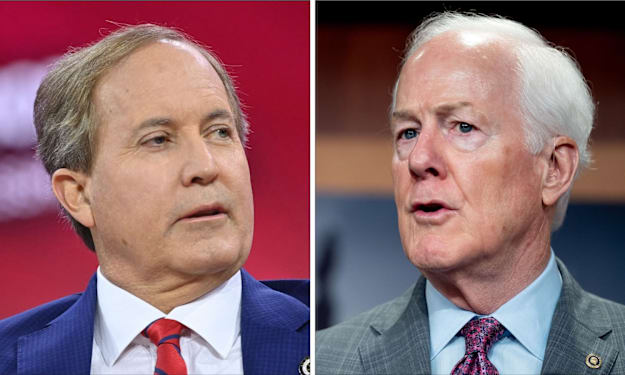
Ken Paxton and the Emotional Divide in Modern Politics
Politics today feels more emotional than ever before. Public figures are no longer viewed only through policy decisions or official speeches. They become symbols of larger political battles, personal beliefs, cultural identity, and national frustration. That is one reason why searches for “ken paxton” continue drawing strong public attention across the United States. Ken Paxton has remained one of the most controversial and discussed political figures in Texas politics for years. Supporters see him as someone willing to fight aggressively for conservative values and state authority. Critics view him as a deeply divisive figure connected to political conflict and legal controversy. These emotional reactions explain why discussions around his career rarely stay calm or neutral.
By Muqadas khan5 months ago in The Swamp
The IRAN Effect
The IRAN Effect The growing conflict involving Iran has become one of the most dangerous geopolitical issues in the modern world. As tensions rise in the Middle East, powerful countries such as the United States and China are becoming deeply involved in diplomatic and strategic discussions. Recent reports show that China has delivered serious warnings to President Donald Trump regarding military escalation, economic pressure, and regional instability connected to Iran.
By Wings of Time 5 months ago in The Swamp
Pakistan and USA Relationships in the Modern World
Pakistan and USA Relationships in the Modern World The relationship between Pakistan and the United States has remained one of the most important and complex international partnerships in modern history. Both countries have worked together in areas such as security, trade, education, technology, and regional stability. However, their relationship has also experienced periods of tension, disagreement, and changing political priorities. In today’s globalized world, international relationships between powerful countries are extremely important because they influence peace, economic development, and global security.
By Wings of Time 5 months ago in The Swamp
Israel's Response to the October 7 Attacks
The events of October 7, 2023, became one of the most significant and tragic moments in recent Middle East history. On that day, Hamas launched a large-scale attack on Israel, leading to the deaths of many people and causing shock across the country. The attacks included rocket fire, armed assaults, and hostage-taking. Following these events, Israel responded with a series of military, political, and security actions. The response quickly became one of the most discussed international issues, attracting attention from governments, media organizations, and people around the world.
By shaoor afridi5 months ago in The Swamp
Immunity and Practical Unaccountability
In theory, no one is above the law. This phrase is repeated often enough that it functions as a civic mantra, a reassurance that power is ultimately constrained and that authority remains accountable to the same moral and legal standards imposed on everyone else. On paper, police officers, prosecutors, and government agents are subject to the law just like any citizen. They can be investigated, disciplined, sued, or prosecuted when misconduct occurs.
By Peter Thwing - Host of the FST Podcast5 months ago in The Swamp
Bad Faith Does Not Deserve Comfort
There is a deeply ingrained belief in modern discourse that civility is always morally required, regardless of context. No matter how dishonest a question is, how manipulative the framing, or how distorted the premise, the expectation is that the response must remain gentle, patient, affirming, and emotionally managed. This belief is often treated as self-evident, as though politeness itself were synonymous with virtue.
By Peter Thwing - Host of the FST Podcast5 months ago in The Swamp
Institutions Fear Inference More Than Lies
Institutions are often willing to tolerate isolated falsehoods, minor inaccuracies, selective framing, and even outright contradictions. A single lie can be corrected, buried, explained away, or isolated from the larger structure. What institutions consistently resist is not merely factual disagreement. They resist inference. They resist the moment when separate observations are connected into a pattern, and the pattern begins to imply responsibility.
By Peter Thwing - Host of the FST Podcast5 months ago in The Swamp
Truth Is Not Obligated to Conform to Your Comfort
Truth does not exist to regulate emotions. It does not exist to protect identity. It does not exist to maintain a person’s sense of safety. Truth describes reality as it is, whether that reality is welcomed, hated, resisted, misunderstood, or completely unprepared for. That is not cruelty. That is simply the nature of truth.
By Peter Thwing - Host of the FST Podcast5 months ago in The Swamp
When Custody Should Be Removed
Any argument that emphasizes the importance of parental presence, structure, and authority becomes dangerous if it does not also specify its limits. Advocating strongly for fathers, shared custody, parental authority, or outcome-based custody standards without defining when custody should be revoked invites a fatal misunderstanding: that parental involvement is always good, regardless of behavior. No serious child-centered framework can allow that ambiguity to stand.
By Peter Thwing - Host of the FST Podcast5 months ago in The Swamp