
Would You Have Pressed the Button?
What Stanley Milgram's shock experiment still teaches us about obedience and about measuring the human mind

Imagine answering a newspaper ad. One hour of your time, $4.50 in cash, a study on memory and learning at Yale University. Easy money.
An hour later, you've pressed a switch labeled 450 volts . The man in the next room stopped screaming several switches ago. He's gone completely silent.
And you kept going, because a calm man in a gray lab coat told you to.
This isn't a thriller plot. It's what roughly two out of three ordinary people did in one of the most famous studies psychology has ever produced. And it's a perfect way into a quieter question that rarely makes headlines: how do scientists measure something as slippery as human behavior in the first place?
Measuring the unmeasurable
Psychological measurement (psychometrics) is the science of assessing samples of behavior in an objective, standardized way so we can quantify the traits and tendencies that drive what people do.
That sounds dry. It isn't. Whether we want to know how culture makes people act differently, or what makes us all act alike, we need tools that turn messy human moments into evidence. Milgram's obedience study is one of the clearest examples of what a well-designed measurement can reveal — and of the ethical lines it can cross.
The man behind the switchboard
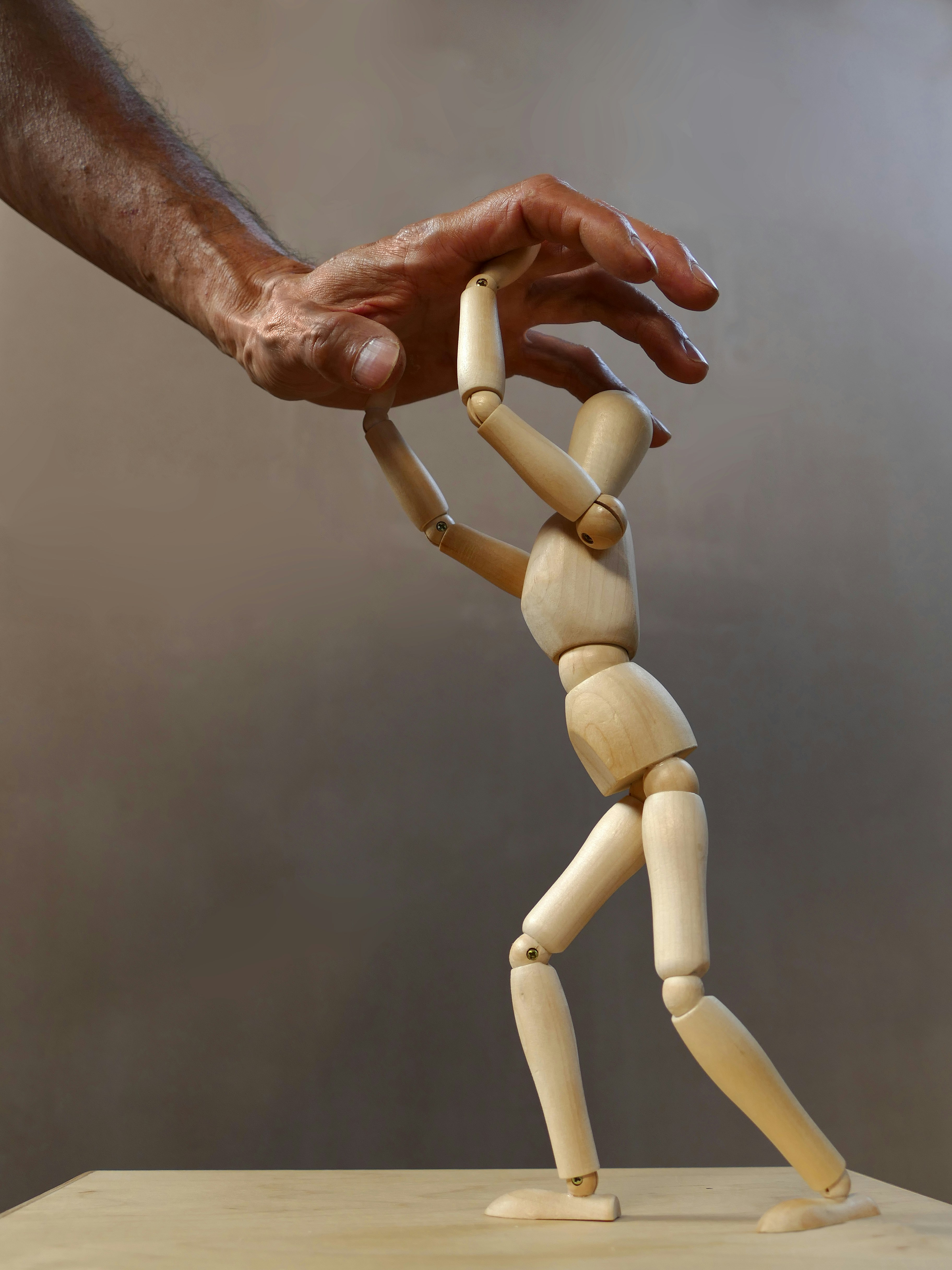
Stanley Milgram (1933–1984) was born in New York City, studied at Queens College, and earned his PhD in social psychology from Harvard in 1960. He began the obedience studies as a young assistant professor at Yale, later returned to Harvard, and in 1967 moved to the City University of New York, where he spent the rest of his career.
He's also the reason you've heard the phrase "six degrees of separation." His "small world" experiment at Harvard traced how letters passed between strangers across the United States and found that surprisingly few links connected them.
Milgram received the AAAS Socio-Psychological Prize and a Guggenheim Fellowship. His books include Obedience to Authority, Television and Antisocial Behavior (with R. Lance Shotland), and The Individual in a Social World.
His own summary of his outlook is worth keeping in mind as you read on: we should not try to control human feeling, but seek to understand it.
Why he ran it: the Eichmann question
In 1961, the world was watching Jerusalem. Adolf Eichmann, one of the chief organizers of the Holocaust, had been captured the year before and was now on trial. His defense boiled down to a chilling line: I was following orders.
Milgram wanted to test an uncomfortable question. Could the millions who took part in atrocities have been, in some sense, ordinary people obeying authority? How far would an average person go when someone in charge told them to hurt another human being?
He began his experiments in the summer of 1961 and published the first results in 1963 in the Journal of Abnormal and Social Psychology as "Behavioral Study of Obedience."

How the experiment worked
Recruits — men aged 20 to 50, from people who hadn't finished school to people with doctorates — arrived at a lab at Yale. They were told the study was about the effect of punishment on learning.
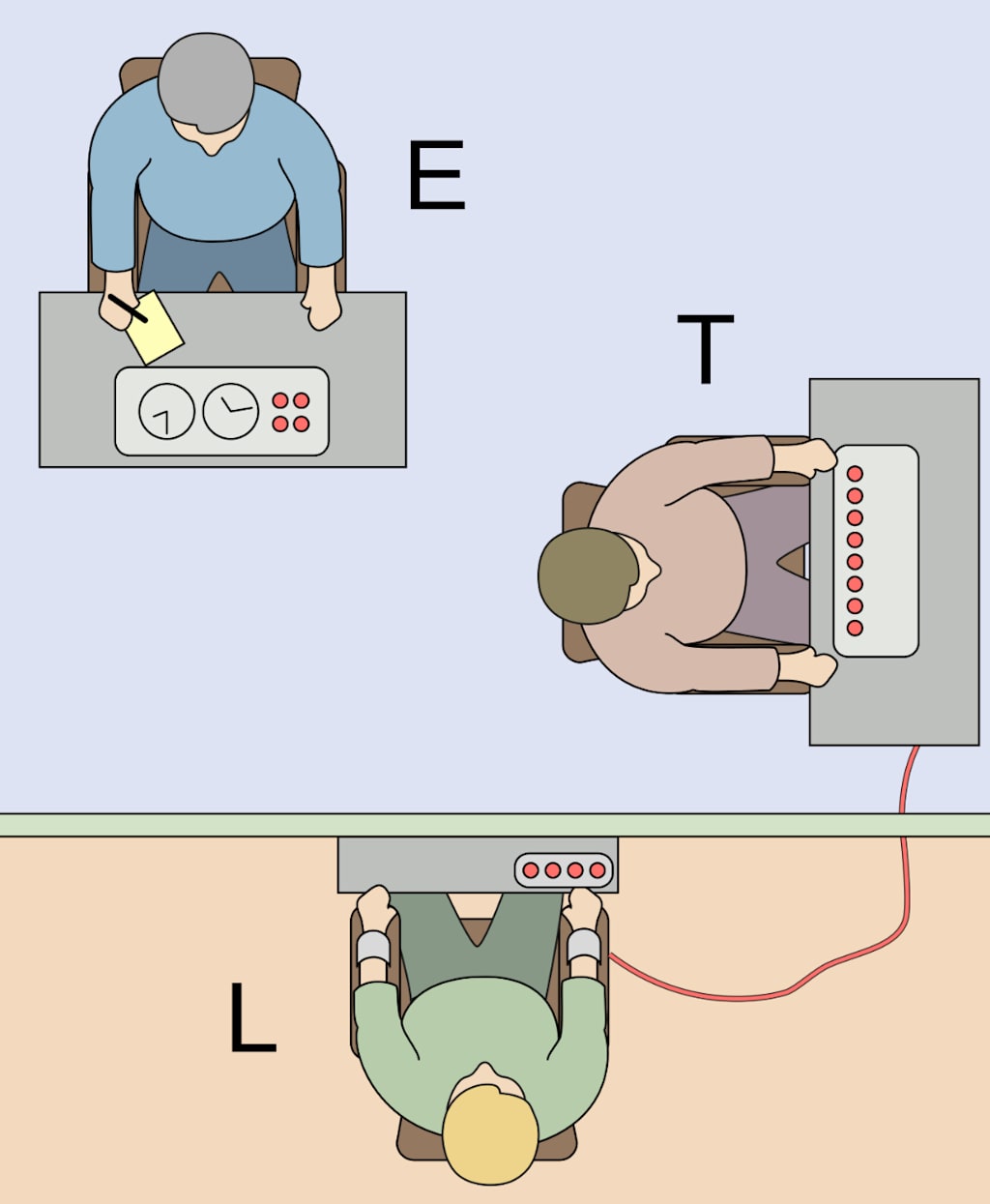
A "random" draw made them the teacher. The other participant, a pleasant middle-aged man, became the learner. The draw was rigged: the learner was an actor, and the real participant was always the teacher.
The learner was strapped into a chair in the next room. At one point he casually mentioned he had a heart condition. The teacher sat in front of an imposing shock generator with 30 switches, running from 15 volts up to 450.
The task was simple. Read word pairs aloud, then test the learner. Every wrong answer meant a shock, and every shock was 15 volts stronger than the last.
No real shocks were ever delivered. But the teacher didn't know that. As the voltage climbed, the learner's recorded protests grew:
75 volts: grunting
120 volts: shouting that the shocks are painful
150 volts: demanding to be let out of the experiment
Around 300 volts: pounding on the wall, refusing to answer
Beyond 330 volts: silence
When teachers hesitated, the experimenter answered with four scripted prods, in order:
"Please continue."
"The experiment requires that you continue."
"It is absolutely essential that you continue."
"You have no other choice; you must go on."
If the teacher still refused after the fourth prod, the session ended. Otherwise, it ran until they had given the 450-volt shock three times.
What actually happened
Before running the study, Milgram asked psychiatrists and colleagues to predict the results. They guessed that only a tiny fraction — around 1% — would go all the way to 450 volts. Only a sadistic fringe, they assumed, would do that.
They were badly wrong.
In the first study, 26 of 40 participants (65%) delivered the maximum shock. Not one stopped before 300 volts.
These weren't cold people. Almost every one of them paused, questioned the experimenter, argued, or pleaded. Some sweated and trembled. Some broke into nervous laughter they couldn't control. A few offered to give back their $4.50. Many kept going after being reassured that they wouldn't be held responsible.
Milgram and other researchers repeated the study in many variations and countries. Psychologist Thomas Blass, author of the Milgram biography The Man Who Shocked the World, reviewed these replications and found that the share of people willing to go to the highest shock stayed remarkably steady — roughly 61% to 66% — regardless of time or place.
Milgram put it plainly in his 1974 essay "The Perils of Obedience":
"Ordinary people, simply doing their jobs, and without any particular hostility on their part, can become agents in a terrible destructive process."
Why this is a masterclass in measurement
Set aside the drama for a moment and look at the design. That's where the psychometrics lesson is.
A behavior, not an opinion. Milgram didn't ask people, "Would you hurt someone if ordered to?" Everyone says no. He measured what they did.
A clear, numeric scale. The 30 switches turned obedience into a number. "Maximum voltage reached" is objective and comparable across people.
Standardization. Same script, same recorded protests, same four prods, same lab coat. Differences in outcome could be traced to people and conditions, not to a chatty experimenter on a good day.
Systematic variation. Milgram changed one factor at a time — the learner in the same room, the experimenter giving orders by phone, the study moved away from Yale to a shabby office — and watched obedience rise or fall. That's how you learn what drives a behavior, not just that it exists.
The ethics problem
The same design that makes the study brilliant also makes it hard to defend today.
Participants were deceived and put under intense stress. Critics argue many were not properly debriefed by modern standards, and some left without fully understanding what had happened. A study like this would almost certainly not pass a university ethics review now, and its legacy helped shape the research protections we have today.
Milgram defended his work. In a follow-up survey, 84% of participants said they were glad or very glad to have taken part, 15% were neutral, and only about 1% regretted it. Some wrote to thank him.
One letter stands out. Years later, during the Vietnam War, a former participant wrote to explain why he was grateful: the experiment had shown him how easily he could harm someone just because he was told to. Now facing the draft, he had applied as a conscientious objector and said he was prepared to go to prison rather than act against his conscience.
The deepest discomfort, though, isn't about method. It's about the mirror. One participant later wrote that halfway through, he began to suspect the real point was to see whether ordinary Americans would obey immoral orders the way ordinary Germans had. He was right. Milgram himself framed the question as the link between the obedience he produced in the lab and the Nazi era we so readily condemn.
Experimenter doesn't just recreate the study; it follows Milgram as he wrestles with what he found and with a public that accused him of cruelty. The film's unsettling message echoes his research: by simply following the rules, ordinary people can become part of something terrible without ever feeling like the villain.
So — would you have pressed the button?

Further reading
Milgram, S. (1963). Behavioral study of obedience. Journal of Abnormal and Social Psychology, 67(4), 371–378.
Milgram, S. (1974). Obedience to Authority: An Experimental View. Harper & Row.
Blass, T. (2004). The Man Who Shocked the World: The Life and Legacy of Stanley Milgram. Basic Books.
Perry, G. (2012). Behind the Shock Machine. The New Press. (A critical re-examination of the original studies.)
More Interesting Readings:
About the Creator
Lucy Guo
Born and raised in Shanghai, used to live in Helsinki, Syracuse, Chicago; now living in Fairfax, VA. Researcher at the intersection of artificial intelligence and education. Loves writing AI reflection stories and travel blogs.
Enjoyed the story? Support the Creator.
Subscribe for free to receive all their stories in your feed.
Comments
There are no comments for this story
Be the first to respond and start the conversation.