
Why You Feel Tired But Not Sleepy (And What Your Body Actually Needs)
A gentle guide to nervous system exhaustion and the rest you didn't know you were missing.

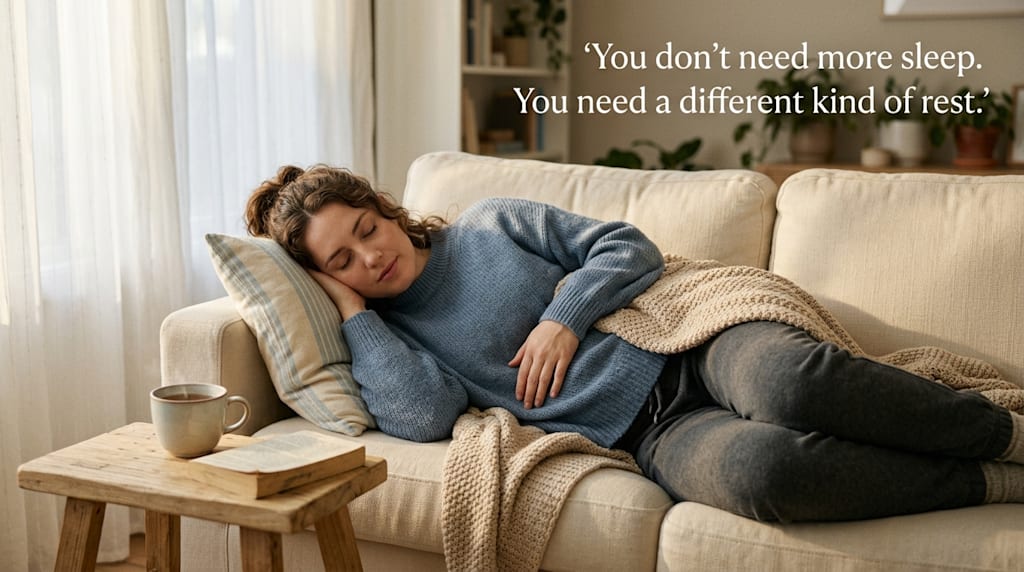
I used to think tired was tired.
You know — heavy eyes, yawning, that lovely feeling of crawling into bed after a long day. Sleepy tired. The good kind.
But somewhere along the way, I developed a different kind of tired.
I'd get eight hours of sleep — sometimes nine — and still wake up feeling like I'd been hit by a truck. My body was there, but my energy wasn't. I could function. I could go to work, make dinner, have conversations. But underneath everything, there was this low hum of exhaustion. Like my batteries were stuck at twenty percent and wouldn't charge no matter what I did.
I remember telling my partner, "I'm so tired," and he said, "Then go to sleep earlier."
And I couldn't explain why that wasn't the answer. Because I wasn't sleepy. I was something else. Something heavier. Something that sleep alone couldn't fix.
If you know this feeling — the tired that isn't sleepy, the exhaustion that lives in your bones no matter how much you rest — let's talk about what's really going on.
1. There's a Difference Between Physical Tired and Nervous System Tired
This was a lightbulb moment for me.
Physical tired is what you feel after a long run, a day of moving furniture, or staying up too late. Your body needs sleep. You fix it with rest.
Nervous system tired is different. It comes from chronic stress, overthinking, people-pleasing, constant notifications, emotional labor, and never truly feeling safe to rest. Your body isn't necessarily sleep-deprived — but your nervous system is fried.
And sleep doesn't fix a fried nervous system. Not completely.
Think of it like this: physical tired is a drained phone battery. Plug it in (sleep), and you're good. Nervous system tired is a phone that's been running too many apps for too long, overheating in your pocket. Even at full battery, it still feels sluggish. It needs something else — a reset, a cooldown, a different kind of care.
Try this: Next time you feel tired, ask yourself: Is this physical exhaustion or nervous system exhaustion? Just naming which one it is can help you figure out what you actually need.
2. You Might Be Stuck in "Fog" Mode, Not Rest Mode
Here's something I noticed about myself.
When I finally had time to rest — a quiet evening, a lazy Sunday — I didn't actually rest. I just collapsed. I'd scroll on my phone for hours. I'd watch TV without really watching. I'd lie on the couch thinking about all the things I should be doing.
That's not rest. That's what I call fog mode. You're not asleep, but you're not present either. You're just… existing. Numb. Halfway between doing and resting, and not really doing either.
Fog mode feels like rest, but it isn't. It doesn't recharge you. It just passes time. And then Monday comes, and you wonder why you still feel exhausted.
Real rest — the kind that actually restores your nervous system — requires presence. It requires actually stopping, not just slowing down. It's harder than collapsing. But it works better.
Try this: The next time you have time to rest, put your phone in another room for twenty minutes. Just sit. Or lie down with no screens. Notice how uncomfortable it feels at first. That discomfort is your nervous system learning to actually settle.
3. Your Body Might Be Stuck in "On" Mode
Here's some biology that helped me understand myself better.
Your nervous system has two main modes: sympathetic (fight or flight — alert, ready, stressed) and parasympathetic (rest and digest — calm, safe, healing).
The problem is, many of us live in sympathetic mode most of the time. Our jobs, our phones, our news feeds, our to-do lists — they all keep us slightly alert, slightly on edge, slightly ready for the next demand.
And after a while, your body forgets how to switch modes. You're not actively stressed, but you're not truly relaxed either. You're just… stuck. Always half-ready for something to go wrong.
That's why you feel tired but not sleepy. Your body is exhausted from being "on" all the time. But your nervous system won't let you fully power down.
Try this: Spend five minutes doing something that signals safety to your body. Warm hands on your belly. Slow, long exhales. Rocking gently side to side. Humming. These small actions tell your nervous system: We're okay. We can rest now.
4. What Looks Like Laziness Is Often Exhaustion
I need to say this gently, because I know how heavy the shame can be.
If you struggle to do things — to clean the house, to reply to messages, to start that project, to even make a phone call — you might have labeled yourself lazy. I did.
But here's what I've learned: laziness feels light. Laziness is choosing to relax when you have energy. Laziness is I could do this, but I don't feel like it.
Exhaustion feels heavy. Exhaustion is I want to do this, but I physically cannot make myself move. It's not a choice. It's a limit.
If you're calling yourself lazy, pause. Ask: Am I choosing rest, or am I running on empty? The answer might change how you talk to yourself.
Try this: For one week, remove the word "lazy" from your self-talk. Replace it with "tired" or "overwhelmed" or "needing rest." Notice if that small shift brings a little more kindness.
5. Different Kinds of Rest for Different Kinds of Tired
Here's a framework that changed my life.
Dr. Saundra Dalton-Smith, a physician who studies rest, identified seven types of rest. Because one kind doesn't fit everyone.
Here are a few that might help with that tired-but-not-sleepy feeling:
Type of Rest What It Helps What It Looks Like
Mental rest Overthinking, decision fatigue A notebook dump, a quiet walk, permission to not plan
Emotional rest People-pleasing, hiding feelings Saying how you really feel, crying, being authentic
Sensory rest Screen fatigue, loud environments Dim lights, no notifications, silence or soft music
Social rest Draining relationships Time alone, or time with people who don't drain you
Creative rest Feeling uninspired Nature, art, beauty, anything that sparks wonder
Sleep won't fix sensory overload. A nap won't heal emotional exhaustion. You need the right kind of rest for the right kind of tired.
Try this: Look at the list above. Which type of rest have you been missing most this week? Give yourself permission to take thirty minutes of that specific rest today.
A Gentle Truth About Your Exhaustion
Here's what I need you to hear.
You're not broken. You're not lazy. You're not failing.
You are a human being living in a world that demands too much of your attention, your energy, and your nervous system. And you've been running on a kind of tired that sleep alone cannot fix.
That doesn't mean something is wrong with you. It means something is wrong with the pace. And the pace can be adjusted — not all at once, not perfectly, but gently and slowly, one small rest at a time.
Start small. Five minutes of doing nothing. A walk without a podcast. A deep breath that you actually feel in your belly. Permission to be still without guilt.
Your body isn't your enemy. It's been trying to tell you something. And now you're finally listening.
That's not failure. That's the beginning of real rest.
Now I'd love to hear from you: Which kind of rest — mental, emotional, sensory, social, or creative — have you been missing most? And what's one small way you could give yourself some of that rest today?
About the Creator
NotesByLiza
Exploring creativity, digital life, and mindful living — so you can feel calmer, stay curious, and grow at your own pace. Stories and visuals for the gently growing soul. 🌿✨
Enjoyed the story? Support the Creator.
Subscribe for free to receive all their stories in your feed.
Comments
There are no comments for this story
Be the first to respond and start the conversation.