
Why I Pretend to Be on My Phone at Parties
A story about hiding in plain sight, the exhaustion of small talk, and the night I finally admitted I was not shy – I was scared.

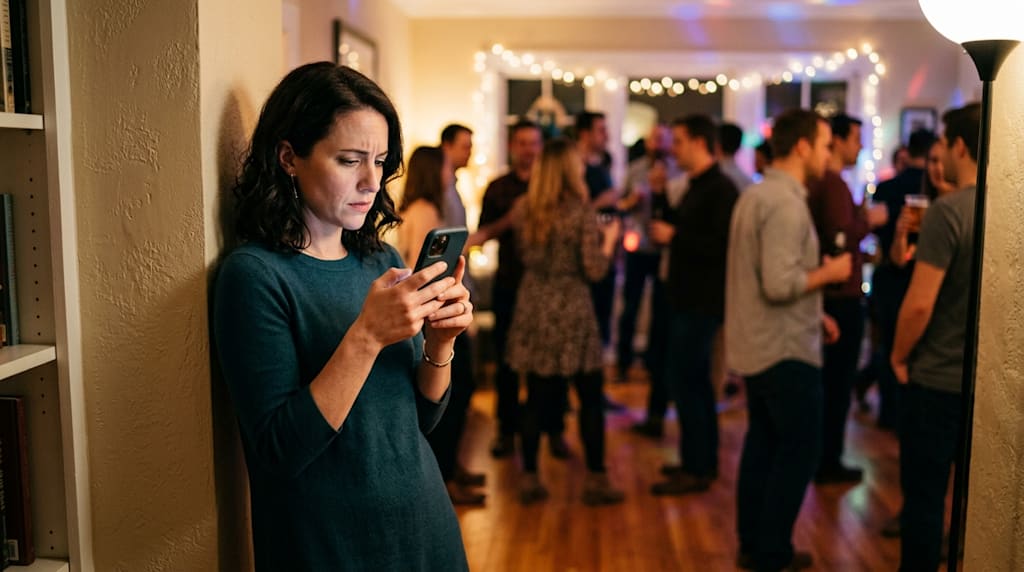
I have a skill. A very specific skill.
I can stand in a room full of people and look completely busy on my phone while doing absolutely nothing.
I scroll through the same three apps. I open and close the same messages. I stare at the weather app for five minutes. I check the time twelve times in one hour.
No one notices. Everyone thinks I am busy. Everyone leaves me alone.
This is how I survive parties.
For years, I told myself I was shy. Shy is cute. Shy is acceptable. Shy means you just need to warm up.
But here is the truth I did not want to admit.
I was not shy. I was terrified.
My heart would start racing the moment I walked into a room. My palms would get sweaty. My stomach would twist into knots. I would forget how to make normal sentences. I would say something weird. Then I would think about that weird thing I said for the next three days.
So I stopped trying. I found my corner. I pulled out my phone. And I hid.
The first time I remember doing this was at a coworker's birthday party. I was 26. I walked in, said hello to two people, and then immediately ran out of things to say.
So I found a spot near the window. I opened my email. I read the same email four times. I stayed there for two hours.
When I got home, I felt relieved. And also ashamed.
Why could I not just talk to people like a normal human?
I tried to fix myself. I read books about conversation skills. I practised open-ended questions. I forced myself to make eye contact.
Nothing worked. I would learn the techniques. Then at the actual party, my brain would freeze. All the techniques would disappear. I would be left standing there, smiling too hard, saying "that's crazy" over and over.
The turning point came at a wedding. My cousin's wedding. I could not hide in a corner. I was family. People expected me to mingle.
For the first hour, I did okay. I talked to my aunt about her garden. I talked to my uncle about his job. I laughed at jokes I did not find funny.
Then someone new sat down next to me. A cousin I had not seen in years. She asked: "So what have you been up to?"
My brain went blank.
I could not remember anything about my life. Not my job. Not my hobbies. Not even what I ate for breakfast.
I said: "Oh, you know. Same old."
She nodded. Then she turned to talk to someone else.
I spent the rest of the wedding in the bathroom. Not because I was sick. Because I could not face going back out there.
That night, I googled "why do I freeze when people talk to me."
I learned a word: social anxiety.
Not shyness. Not awkwardness. Not being broken. Social anxiety.
Social anxiety is not just being nervous around people. It is a fear of being judged. A fear of saying the wrong thing. A fear of being seen as weird or boring or stupid.
Your brain goes into fight-or-flight mode. In a party. With people holding drinks and making small talk.
It sounds ridiculous. But it is real. And it is exhausting.
I started seeing a therapist after that wedding. A real one. Not a book. Not a YouTube video.
The first thing she told me surprised me. She said: "You are not broken. You are just trying too hard."
She explained that people with social anxiety spend so much energy trying to say the right thing that they have no energy left to actually be present.
We are performing conversation instead of having conversation.
She gave me small homework. Not "talk to ten strangers." Small things.
Week one: Make eye contact with one person at the grocery store. Just eye contact. No talking.
Week two: Say hello to the cashier. Just hello. Nothing else.
Week three: Ask one question. Any question. "Do you know what time this store closes?" That counts.
Week four: Have a two-minute conversation with someone I already knew. Not a stranger. Someone safe.
It felt silly. It felt too small. But I did it.
And slowly, very slowly, things started to change.
I stopped rehearsing conversations in my head before they happened. I stopped analysing every word I said after they ended.
I learned that most people are not judging me. Most people are too busy worrying about themselves.
I also learned something else. Something important.
It is okay to be quiet.
For years, I thought I had to be talkative to be likeable. I thought silence was failure. I thought everyone was waiting for me to say something brilliant.
No one is waiting. Most people do not notice. And the ones who notice? They usually do not mind.
I still pretend to be on my phone sometimes. Old habits are hard to break.
At a party last month, I found myself in the corner, scrolling through nothing. I caught myself. I took a breath. I put my phone in my pocket.
I looked around. No one was staring at me. No one was waiting to judge me.
I walked over to the snack table. A woman I did not know was standing there. She looked nervous too.
I said: "These chips are really good."
She smiled. She said: "I was thinking the same thing."
That was it. That was the whole conversation. Two sentences. No pressure. No performance.
And you know what? It was enough.
Here is what I learned.
One. Social anxiety is not shyness.
Shyness fades as you get comfortable. Social anxiety does not care how comfortable you are. It is a fear response. And fear responses can be managed. Not cured. Managed.
Two. Most people are not paying attention to you.
This sounds harsh. But it is actually freeing. Everyone is the main character of their own movie. They are not sitting in the audience watching yours.
Three. Small steps count.
You do not have to become a public speaker. You just have to try one small thing. Eye contact. One hello. One question. That is enough.
If you are the person standing in the corner pretending to be on your phone, I see you.
I have been you. I still am you sometimes.
Here is one small thing you can try next time.
Put your phone down. Just for sixty seconds. Look around. Notice that no one is staring. Notice that you are safe.
Then pick one small thing. Say hello to the person next to you. Or don't. Just stand there without your phone.
No pressure. No performance.
Just you. In the room. Existing.
That is enough. You are enough.
About the Creator
norlizawrites
Real stories about being human. Psyche, travel, food, relationships, and room decor. No perfect endings, just honest ones
Enjoyed the story? Support the Creator.
Subscribe for free to receive all their stories in your feed.
Comments
There are no comments for this story
Be the first to respond and start the conversation.