

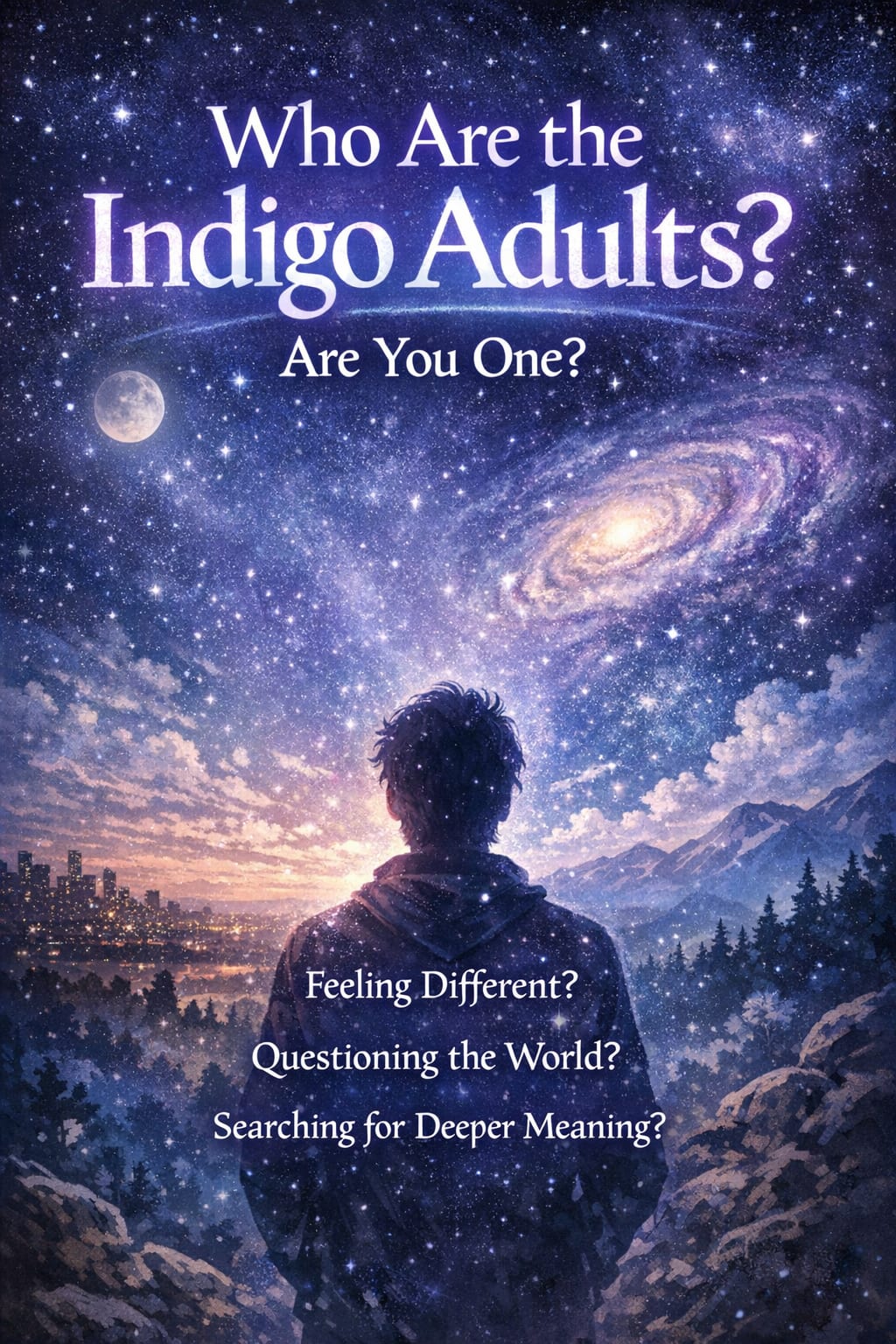
There’s a quiet kind of person who walks through life feeling like they’re slightly out of place—not in a dramatic or obvious way, but in a subtle, persistent sense that something doesn’t quite fit. They follow the same routines as everyone else. They attend the same schools, work similar jobs, and engage in everyday conversations. Yet beneath the surface, they often feel like observers in a world that seems designed for someone else. If you’ve ever felt this way, you may have come across the idea of Indigo Adults.
The Origin of the Concept :
The term Indigo Adults comes from the earlier concept of Indigo Children, which gained attention in the late 20th century. These “Indigo Children” were believed to possess heightened emotional sensitivity, strong intuition, creativity, and a natural tendency to question authority. As those children grew older, many began to identify themselves as Indigo Adults—individuals who still carry those same traits into adulthood. However, it’s important to understand that this idea is not rooted in scientific research or psychology. Instead, it exists in the realm of spirituality and personal interpretation. For many, it serves as a lens through which they can better understand their personality and life experiences.
The Inner World of Indigo Adults :
One of the most defining aspects of Indigo Adults is their rich inner world. These individuals tend to think deeply, feel intensely, and reflect often. They are not satisfied with surface-level explanations or shallow interactions. While others may easily accept “the way things are,” Indigo Adults often find themselves asking: . Why does this system exist? . Is this truly the best way? . What’s the deeper meaning behind this? This constant questioning isn’t about rebellion—it’s about authenticity. They want to understand life, not just go through it.
Common Traits and Experiences :
Although every person is unique, many who resonate with the Indigo Adult idea share similar characteristics.
A Lifelong Feeling of Being Different :
From childhood, there is often a sense of not quite fitting in. Social groups may feel forced, and traditional expectations can seem limiting or confusing.
Heightened Emotional Sensitivity :
Indigo Adults often feel emotions more strongly than others. They may absorb the energy of their environment, making crowded or negative spaces overwhelming.
Strong Intuition :
They tend to trust their gut feelings and instincts. Even when they can’t logically explain something, they often “just know” when something feels right or wrong.
Discomfort with authority :
Blindly following rules or authority figures can feel unnatural. They prefer understanding the purpose behind rules rather than simply obeying them.
Desire for Meaningful Work :
A routine, repetitive lifestyle can feel draining. They often seek careers or paths that align with their values and give them a sense of purpose.
Why So Many People Relate to This Idea :
In today’s fast-paced, hyper-connected world, it’s increasingly common to feel overwhelmed or disconnected. Social media, constant comparison, and societal pressure to follow certain paths can make people question where they truly belong. The concept of Indigo Adults resonates because it offers a simple explanation: You’re not lost—you’re just different. For some, this idea provides comfort and validation. It reassures them that their sensitivity, depth, and questioning nature are not weaknesses, but unique strengths.
A Balanced Perspective :
While the Indigo Adult concept can feel meaningful, it’s important to approach it with balance. There is no scientific evidence that certain people are born with special “indigo” traits or higher levels of consciousness. Human personality is complex and shaped by a wide range of factors, including upbringing, environment, and personal experiences. Feeling different doesn’t necessarily mean you belong to a specific category—it simply means you are an individual with your own way of thinking and feeling. And that, in itself, is completely normal.
The Risk of Labels :
Labels can be helpful—but they can also be limiting. Identifying as an Indigo Adult might help you understand yourself better, but it shouldn’t become something that separates you from others or creates a sense of superiority or isolation. At the end of the day, everyone experiences moments of doubt, sensitivity, and questioning. These are not exclusive traits—they are part of the shared human experience.
So, Are You an Indigo Adult?
The answer depends on how you interpret the concept. If you relate to the traits, it may simply reflect your personality—your depth, your awareness, your emotional intelligence. Rather than focusing on the label itself, it may be more useful to focus on what it reveals about you: . You value authenticity . You seek meaning . You think deeply . You feel strongly These are not signs that you are “different” in a mystical sense—they are signs that you are engaged with life on a deeper level.
Final Thoughts :
The idea of Indigo Adults speaks to something universal: the desire to feel understood. In a world that often rewards conformity, being someone who questions, feels deeply, and seeks meaning can feel isolating. But it can also be a strength. You don’t need a special label to validate your experiences. Your perspective, your emotions, and your thoughts already have value. Whether or not you identify as an Indigo Adult, what truly matters is how you choose to live your life. Do you follow what feels true to you? Do you embrace your curiosity and depth? Do you allow yourself to grow without forcing yourself into predefined roles? Because in the end, it’s not about being “indigo.” It’s about being authentically yourself—in a world that often forgets how important that really is.
About the Creator
Enjoyed the story? Support the Creator.
Subscribe for free to receive all their stories in your feed.
Comments
There are no comments for this story
Be the first to respond and start the conversation.