
What the Heck Is Wrong With Me?! The Wild History (and Reality) of Neurodivergence
Welcome to Episode 1 of 'Chaos and Me'—where we unpack ADHD, evolution, historical absurdity, and why you are definitely not broken.

Hi everyone. Or at least the person reading this right now. Before diving into this piece, I figured it'd be nice to introduce myself. I'm Joanna, but on this journey, you can call me Anastazja—my pen name. At first, I wanted this introduction to be completely perfect. But then it clicked: I'm not perfect. Nor is anyone in this whole world. And since I'm not perfect, neither is this writing. But I promise to make it interesting.
Welcome to Chaos and Me.
(Prefer to listen rather than read? You can stream the audio version of this episode on my podcast, Chaos and Me, right here: open.spotify.com/episode/2kI74Rtu4rYeUpBS1dF6kw.
Quick note: The audio version might be slightly different, wandering off on a few extra unscripted tangents with a bit more detail compared to this written piece—because, well, it's called Chaos and Me for a reason!)
Did you ever talk with someone and notice that you actually didn't hear a word they said even though you wanted to? Or maybe you keep losing everything? Or simply cannot focus no matter how hard you try?
These are just a few out of many things that a person with ADHD faces every single day. And contrary to what some might think, the struggle doesn't just appear after getting a diagnosis. A lot of people struggle in silence trying to answer the loudest internal question of them all: What the heck is wrong with me?!
Let's talk about it.
From Hunter-Gatherers to Miacids: An Evolutionary Detour
Nowadays, we hear a lot about ADHD, autism, and other neurodivergent conditions, with ADHD and autism taking the lead in this mad movie we're all part of. I've watched plenty of videos explaining daily struggles, but I've also been shocked by videos of people mocking those who "pretend" to have ADHD. In my whole life, I've never seen anyone genuinely happy to have these neurological conditions. If people like that exist for real, the world ended a long time ago—so, happy late End of the World, I guess?
I often hear that conditions like ADHD and autism aren't real, and that people just need to "get a grip" and pull themselves together. Hate to break it to you, but what you think isn't real has actually been observed for centuries. How is it that we're only recently learning more? Glad you asked. Let's start from the beginning.
Homo sapiens used to be a hunter-gatherer species. As ages passed, we changed our ways to make life more comfortable, creative, and stable. As we progressed toward farming and settled domestic life, our brains shifted. The more innovative society became, the more certain ancestral brain functions became obsolete. But why do some people struggle with mental health today? Evolution isn't a computer program—it's not perfect. It's a collective challenge. In every group, members share characteristics but aren't identical, meaning people evolve along different branches.
Take cats and dogs, for example. Did you know they share the exact same ancestor? It was called a Miacid—a small, tree-dwelling, weasel-like creature living 50 to 60 million years ago. Over time, they split into Carnivora suborders: Feliformia (cats, hyenas, mongooses) and Caniformia (dogs, wolves, bears, seals, and weasels). Yes, bears are team dog! Mind-blowing, right?
Humans are no different. We evolved on the outside and the inside—especially our brains. Neurodivergence has a massive genetic component; you essentially got it as a family heirloom from your parents or grandparents. People didn't always know about it simply because medicine hadn't given it a name yet. And no name, no problem, right? Thankfully, curious minds always ask the ultimate scientific question: WHY?
A Brief (and Wildly Humorous) History of ADHD
If you still doubt neurodivergence is real, let's look at the historical timeline:
1789 (Alexander Crichton, physician): First described ADHD under the term "mental restlessness."
1845 (Heinrich Hoffman, psychiatrist): Explored behavioral aspects like impulsivity and disruption, creating the children's book character "Fidgety Phil."
1890 (William James, psychologist): Developed the concept of inattention or "distraction." Back then, society was fighting cholera and smallpox, so invisible mental struggles weren't taken seriously.
1902 (Sir George F. Still): Created the first clinical descriptions, famously calling it a "defect of moral control" (cue the universal cringe).
1937 (Charles Bradley): Discovered unexpectedly that Benzedrine calmed "restless" kids and helped them focus.
1954 (Leandro Panizzon): Created Ritalin (initially tested to help him and his wife on the tennis court—definitely illegal today!).
Scientists eventually grew tired of clunky terms and tried out names ranging from weird to downright hilarious. Ranked from bizarre to iconic:
Number 6: Defect of moral control.
Number 5: Kramer-Pollnow syndrome.
Number 4: Minimal brain dysfunction (MBD).
Number 3: Organic drivenness (sounds like a diet preference).
Number 2: Post-encephalitic behavior disorder (sounds like a death sentence).
Number 1 (The Absolute Star): Brain-injured child syndrome. Imagine going to the doctor for focus issues and hearing that you have "Brain-injured child syndrome!"
What Neuroimaging Tells Us
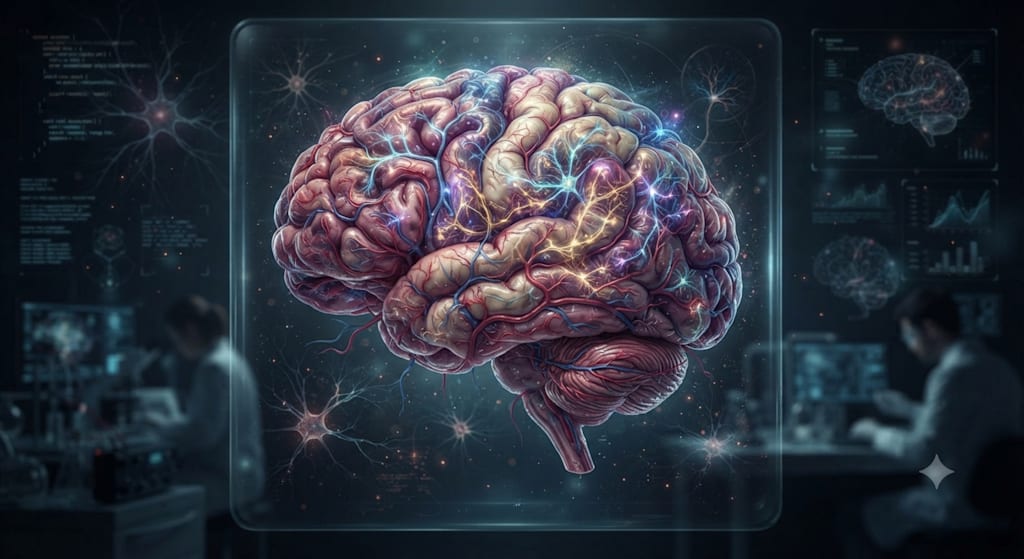
Today, neuroimaging proves ADHD is rooted in our genes and brain wiring. According to research from Columbia Psychiatry:
"People with ADHD have structural differences in two major brain areas: the frontal lobe and the basal ganglia. The frontal lobe plays a key role in executive functions, attention, decision making and impulse control, while the basal ganglia is crucial for reward-processing and movement. These brain areas are typically underdeveloped in people with ADHD. Additionally, the volume of the amygdala, a brain structure involved in emotional processing, is more intense in people with ADHD."
www.columbiapsychiatry.org/
In plain English: your frontal lobe and basal ganglia are wired differently, and your emotional processing center (the amygdala) feels excitement and frustration with incredible intensity. Furthermore, while males are diagnosed more often due to hyperactive traits, females experience ADHD at similar rates—often hidden behind quiet, inattentive symptoms shaped by societal expectations.
Autism Through the Ages: From "Wise Ones" to "Changelings"
Autism, too, was an evolutionary advantage for early humans—driving tool-making, pattern recognition, sensory precision, and deep focus. In ancestral times, autistic traits likely marked you as one of "the wise ones."
Yet, for centuries, neurodivergent individuals were misunderstood, labeled through disciplinary lenses, or blamed on bad parenting (the infamous "refrigerator mother" theory of the mid-20th century). In European folklore, autistic children were sometimes bizarrely labeled "changelings."
The clinical framework took time to evolve:
1911: Eugen Bleuler coined "autism" to describe inward detachment in schizophrenia.
1925: Grunya Sukhareva published groundbreaking descriptions of autistic children, though overlooked by Western psychiatry for decades.
1943 & 1944: Leo Kanner and Hans Asperger published their landmark papers. Asperger notably framed children's traits around vocational utility to protect young patients from Nazi eugenics programs—a dark historical backdrop of incredible survival.
1979–1994: Lorna Wing, Judith Gould, and the APA (via DSM-III and DSM-IV) finally unified autism as a broad spectrum disorder.
The Bottom Line
Autism and ADHD might look like cats and dogs on the surface, but they share a common thread: neurodivergent individuals navigating a world built for neurotypicals, often masking their traits just to fit in.
So, to every neurodivergent reader out there: darling, you are not broken. There is nothing wrong with you. You are simply too beautiful to be described, and too extraordinary to be categorized. Embrace yourself—because yourself is all that matters.
Darling, you are not broken. There is nothing wrong with you. You are just too beautiful to be described.
About the Creator
Enjoyed the story? Support the Creator.
Subscribe for free to receive all their stories in your feed.
Comments
There are no comments for this story
Be the first to respond and start the conversation.