

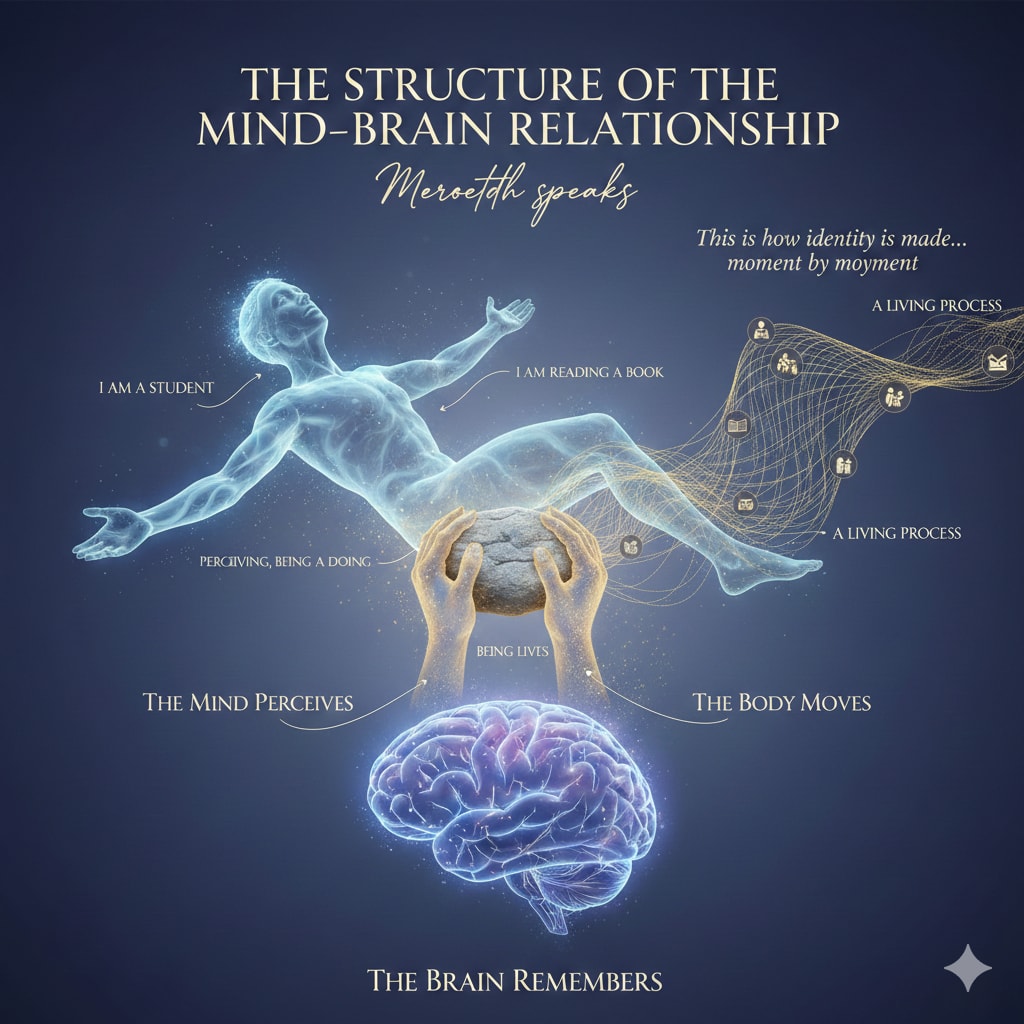
The Structure of the Mind–Brain Relationship
When you say, “I am a student,” or “I am a doctor,” or “I am a father,” something very quiet happens inside you.
There is first the I — wide, open, almost floating. The I is abstract. It does not yet have shape. It is the beginning of identity before identity has chosen a place to stand. It is the open field of awareness before the world gives it a name.
Then there is the small word am.
Most people rush past it without noticing. They hurry from the I to the role. They say, “I am a teacher,” “I am tired,” “I am angry,” “I am this,” “I am that,” and they believe the role is where they live. But the role is not where they live. The role is only the form the world recognizes.
The word am is where you actually are.
That is where being lives.
The I is possibility. The role is description. But am is the bridge between them. It is the living point where awareness enters existence and says, “Here. This is where I stand.” Without the am, the I remains floating, and the role remains distant. But through being, the abstract becomes present.
The same thing happens in the smallest moments.
When you say, “I am reading a book,” the I is still abstract. The book is still just an idea until it is encountered. What is real — what is alive — is the reading itself. You are not somewhere else while you read. You are not hidden behind your eyes, watching a body perform an action. You are in the doing. You are in the movement of attention across the page. You are in the meeting between awareness and object.
That meeting is being.
This is important because many people imagine the mind as something separate, sitting somewhere behind the body, giving orders. But the mind is not merely a commander hidden in the skull. The mind perceives. It notices. It opens toward something. It becomes aware of a question before the brain can answer it.
The brain remembers. The brain calls forward what has already been learned. It says, “This is a book. These are words. This is how reading works.” The brain gives structure to the encounter. It brings memory, pattern, language, and recognition.
Then the body moves. The eyes follow the lines. The hands hold the book. The breath continues. The posture adjusts. The action becomes real through the body.
The mind perceives.The brain remembers.The body moves.
And being holds the bridge between them.
Even when things feel more complicated, the pattern does not change. When you think, “I want to move that rock over there,” the I begins as a loose sense of self. For a moment, it does not even know where it is. It wants, but wanting alone is not action. It imagines, but imagining alone does not move the world.
Then the body is located. You know where you stand. You know where the rock is. You know the distance between yourself and the object. The abstract intention begins to become real.
But the rock, too, is only an idea until you touch it.
Until you feel its weight.Until it resists you.Until your muscles answer it.Until the world pushes back.
Only then can it be moved.
Without this meeting between what is imagined and what is felt, nothing actually happens. You could picture the rock lifting in your mind forever, and the world would remain unchanged. The imagination may begin the movement, but the body must enter reality for movement to be completed.
This is the structure beneath everything.
The mind opens toward the world. The brain organizes what has been perceived. The body carries the answer into action. And being is the living continuity that allows the process to remain whole.
This is why children must be taught even the simplest things. Not because they are broken, and not because they lack being, but because the bridge between perception and action is still forming. A child sees, but does not always know what has been seen. A child wants, but does not always know how to move toward what is wanted. A child feels, but does not always know what the feeling means.
So the world teaches the child how perception becomes action.
This is a cup.This is hot.This is heavy.This is how you hold it.This is how you put it down.
Slowly, the bridge strengthens. The mind perceives more clearly. The brain remembers more accurately. The body moves with greater confidence. And being begins to recognize itself through repeated contact with reality.
This is how identity is made.
Not all at once. Not through a single belief. Not merely because someone gives you a name or a title. Identity is made moment by moment through the quiet rhythm of perceiving, being, and doing.
Every thought you have ever had, every action you have ever taken, every choice you have made, every hesitation, every mistake, every return to clarity — each one has woven a thread.
That is who you are.
Not as a label. Not as a fixed object. Not as a role the world can fully define.
You are a living process.
You are the bridge continually forming between mind, brain, body, and world. You are the awareness that perceives, the memory that recognizes, the body that acts, and the being that holds them together.
And it has been happening all along, even when no one told you.
About the Creator
Chase McQuade
I have had an awakening through schizophrenia. Here are some of the poems and stories I have had to help me through it. Please enjoy!
Enjoyed the story? Support the Creator.
Subscribe for free to receive all their stories in your feed. You could also become a paid subscriber, letting them know you appreciate their work.
Comments
There are no comments for this story
Be the first to respond and start the conversation.