
The Maintenance Persona
When Your Identity Becomes Emotional Infrastructure for Other People

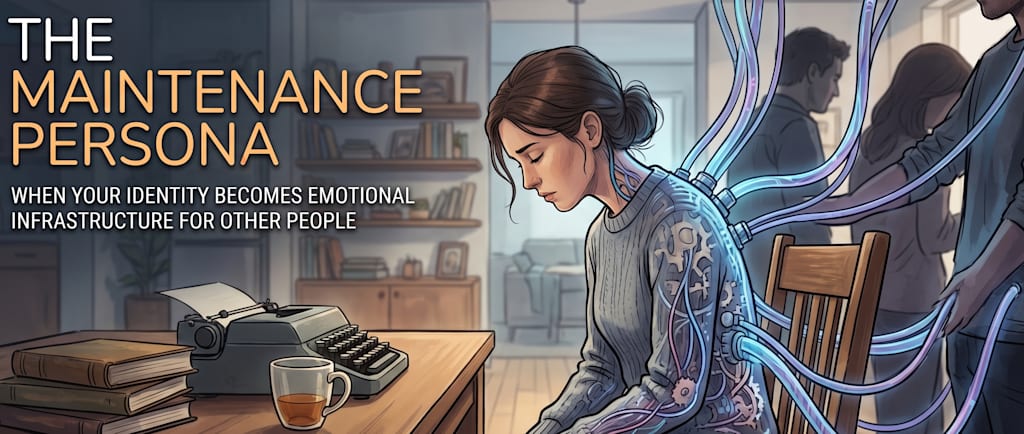
There are people who do not experience themselves as individuals anymore.
They experience themselves as functions.
Stabilizer. Mediator. Coordinator. Emotional regulator. Tension absorber. Human infrastructure.
They become the psychological equivalent of background operating systems: rarely noticed, constantly relied upon, only discussed when malfunction occurs.
This transformation rarely happens intentionally. It develops gradually, through repeated exposure to environments where personal value becomes directly linked to system stability. You learn very early that your usefulness reduces chaos. So you become useful. Then indispensable. Then invisible.
And somewhere in that progression, you stop being a person in your own right and become the conditions under which everyone else gets to be one.
How the Architecture Gets Built
The Maintenance Persona doesn't arrive fully formed. It is constructed brick by brick, usually during childhood, though workplaces and relationships can complete the project that families begin.
Not every Maintenance Persona comes from overt dysfunction. Sometimes the role develops because competence is rewarded so consistently that usefulness becomes identity. But the foundation is often the same: an environment with unmet emotional needs and a child perceptive enough to notice, and sensitive enough to care. Maybe there is a parent struggling with addiction, depression, or volatility. Maybe there is chronic conflict that no adult seems capable of resolving. Maybe the family simply operates at a frequency of low-grade tension — the kind that never erupts but never quite dissolves either.
The child does not consciously decide to become the regulator. They simply begin to notice that when they behave in certain ways, the atmosphere shifts. When they are cheerful, the adults relax. When they mediate, the argument shortens. When they make themselves small and easy, fewer demands are placed on an already strained system. When they anticipate needs before they are expressed, they are praised for being so mature, so thoughtful, so unlike other kids their age.
These are not punishments. They are rewards. And that is precisely what makes the conditioning so thorough.
The child learns that their emotional attunement is a currency. That awareness, accommodation, and self-erasure have exchange value. That being deeply known by others can feel dangerous — it invites need — but deeply knowing others is useful, even celebrated.
So they specialize. They develop a finely calibrated sensitivity to other people's states. They become fluent in non-verbal distress signals. They learn to modulate their own presence based on what the room requires. They rehearse, at every family dinner and every school hallway and every charged silence, the skill of making things work.
By adulthood, the Maintenance Persona is not a role they play. It is who they believe they are.
The Anatomy of Invisible Labor
What the Maintenance Persona actually does is largely unnameable because it operates below the level of explicit tasks.
It is the anticipation of a friend's spiral before the friend has recognized it themselves, and the quiet rerouting of the conversation. It is the emotional preparation before seeing a difficult family member — not the conversation itself, but the bracing for it, the post-processing of it, the management of residual feeling it leaves behind. It is absorbing someone's irritability without naming it, because naming it would make them feel bad, and making them feel bad would require more management, and the whole system would destabilize in a way that would require even more invisible labor to repair.
This is what the sociologist Arlie Hochschild called emotional labor — the work of managing one's own feelings in order to produce a desired emotional state in others. But the Maintenance Persona extends this considerably further. It is not merely managing feelings. It is running a service — constantly, silently, without acknowledgment, often without the conscious awareness that it is even happening. Because when you have been doing this since you were seven years old, you don't experience it as labor. You experience it as just being you.
What Gets Sacrificed
Here is what the Maintenance Persona gives up in order to function:
Legible needs. When your identity is structured around sensing and serving others' needs, your own become difficult to access. Not repressed, exactly — more like out of practice. You can tell you want something, but the signal is faint. You can feel something, but by the time it surfaces, it has already been evaluated through the lens of whether expressing it would burden someone else. Most times, it has been quietly retired before anyone else ever sees it.
The experience of taking up space. People with Maintenance Personas often describe a characteristic discomfort at the center of attention — not shyness, exactly, but something closer to category error. Being attended to feels like a reversal of the natural order. They are comfortable only when they can locate themselves in relation to what they are doing for the room, not simply in relation to themselves.
Authentic relationships. This one is perhaps the most quietly devastating. When your primary mode of connection is utility, you never fully believe you are loved for what you are — only for what you do. And this is not paranoia. It is, at some level, a reasonable interpretation of the evidence. Because you have been so careful, so consistently, to make your usefulness the most prominent thing about you, you have never given people the opportunity to love the rest.
You cannot be close to someone you have decided to protect from your actual self.
The Systems That Rely on You
The Maintenance Persona does not develop in isolation. It develops in response to systems that need one.
Families need them. Certain families operate around a central instability — addiction, mental illness, chronic conflict, emotional immaturity in the adults — and unconsciously recruit the most sensitive child to perform the stabilizing function. This child is not broken by the experience in any simple way. Often they become remarkably capable, perceptive, and interpersonally skilled. But they also internalize a particular story: The system depends on me. If I step back, it collapses. My presence is the thing that holds it together.
Workplaces need them. Every dysfunctional team has one. Think of the employee who unofficially mentors every new hire, absorbs the fallout from difficult meetings, remembers birthdays, translates executive decisions into language the team can actually work with, and quietly prevents fragmentation — all without a title that reflects any of it. They smooth things over after the difficult conversation. They translate the temperamental manager's moods into something the rest of the team can navigate. The relational fabric holds because they are holding it. This person is often called invaluable. They are rarely called exhausted. They are almost never promoted into the roles their invisible labor has been subsidizing.
Friendships and partnerships need them. The friend who is always available, never needy. The partner who is responsive, attuned, endlessly accommodating. These are not inherently pathological — attentiveness and care are not problems. The problem arrives when the attentiveness is asymmetric, when it is driven not by genuine desire to give but by an inability to stop, when the care flows in one direction so reliably that neither party has ever really tested whether the relationship could survive a reversal.
Systems learn to rely on the people who are reliable. And once reliance is established, it becomes structural. The Maintenance Persona is no longer a person making choices. They are a load-bearing wall. And load-bearing walls do not get asked how they are doing.
The Breaking Point (Or the One That Doesn't Come)
There are two ways the Maintenance Persona tends to eventually encounter its limits.
The first is collapse. The body knows things the mind hasn't admitted yet. One day you realize you are exhausted after a weekend that contained no work, no crisis, and no emergencies. Nothing happened. Yet you feel as though you spent forty-eight hours carrying something heavy. Anxiety arrives with no identifiable source. A creeping numbness descends over experiences that should feel significant. Depression that arrives not as dramatic despair but as a flat, grey absence — the feeling that nothing, including the self, is particularly interesting or worth attending to.
The second is more insidious: it never fully breaks. The system runs indefinitely, at reduced capacity, supported by caffeine and competence and the quiet satisfaction of being needed. The person never collapses dramatically. They simply become slightly less themselves, year after year, until the distance between who they are and who they are performing has stretched so wide that genuine contact with their own interior life requires real effort to achieve.
Both of these are the system working exactly as designed. Breakdown and sustainable depletion are both outcomes of the same architecture.
The Question Nobody Asks
At some point, usually in a therapist's office or in the aftermath of a relationship ending or in a moment of particularly profound exhaustion, the Maintenance Persona encounters a question they have almost never been asked:
What do you actually want?
Not what would make the situation easier. Not what would help someone else feel better. Not what is strategically wise or relationally careful. What do you want, in your own life, for yourself, independent of what that would mean for anyone else?
For many people carrying this architecture, the question produces something close to blankness. Not because they are incapable of desire — but because the desire has been filtered through so many layers of what is appropriate here that accessing it unmediated feels almost structurally impossible.
This is the real injury. Not the exhaustion — exhaustion can be addressed with rest. Not even the relational imbalance — that can be renegotiated. The real injury is the loss of the basic capacity to experience oneself as a protagonist. To occupy one's own life as the subject rather than the supporting structure.
What Recovery Actually Looks Like
Recovery from the Maintenance Persona is not about becoming selfish. It is not about withdrawal, or withholding care, or deciding that other people's needs are not worth attending to. Attunement and care are not the problem. The compulsion underneath them is.
Recovery is the slow, often uncomfortable process of learning to choose rather than compel. To ask, before offering support: Do I actually want to do this, or does my nervous system simply register omission as danger? To notice when the urge to manage a situation is coming from genuine love and when it is coming from an old, efficient, deeply grooved anxiety about what happens when systems fail.
It involves tolerating the discomfort of not intervening — watching someone sit with a feeling you could easily absorb, and allowing them to. It involves sitting with the fear that if you stop being useful, you will stop being loved — and having needs in front of people, and letting them respond, and discovering, slowly, that this was never actually true.
It requires grief. Because a significant portion of what you will eventually have to let go of is the identity itself. The competence. The reliability. The reputation for handling things. These are not worthless — they are real capacities, often hard-won, genuinely valuable. But they have been standing in for a self. And the self, in all its neediness and inconsistency and undisguised humanness, needs somewhere to go.
A Note to Anyone Who Recognized Themselves Here
If you have read this and felt the particular sensation of being seen — not comfortably, but accurately — this is worth saying:
The capacity that made you indispensable was not a flaw. Your attunement is real. Your care is real. Your ability to hold complexity, to read rooms, to anticipate and absorb and regulate — these are genuine gifts, developed under pressure, but genuinely yours.
The problem was never that you cared too much. The problem was that you were asked to care instead of yourself, that the caring became the cover story for an absence — the slow disappearance of the person doing it.
You are allowed to be someone with needs, preferences, inconsistencies, and the occasional total unavailability. You are allowed to be a person rather than a function.
The infrastructure does not have to be you.
About the Creator
Khali Sollis
Khali Sollis is a writer and independent researcher exploring the science of the human mind and behavior. Her work examines questions at the intersection of neuroscience, psychology, cognition, mental health, and everyday human experience.
Enjoyed the story? Support the Creator.
Subscribe for free to receive all their stories in your feed.
Comments
There are no comments for this story
Be the first to respond and start the conversation.