
THE ECHO OF AN EMPTY PITCH: THE HEARTBREAKING REALITY OF THE LAST KID STANDING
He is standing in the middle of a playground with a football at his feet, waiting for a game that is never going to happen. We didn't just lose our free time to smartphones and artificial intelligence—we are quietly losing the very biology of what makes us human.

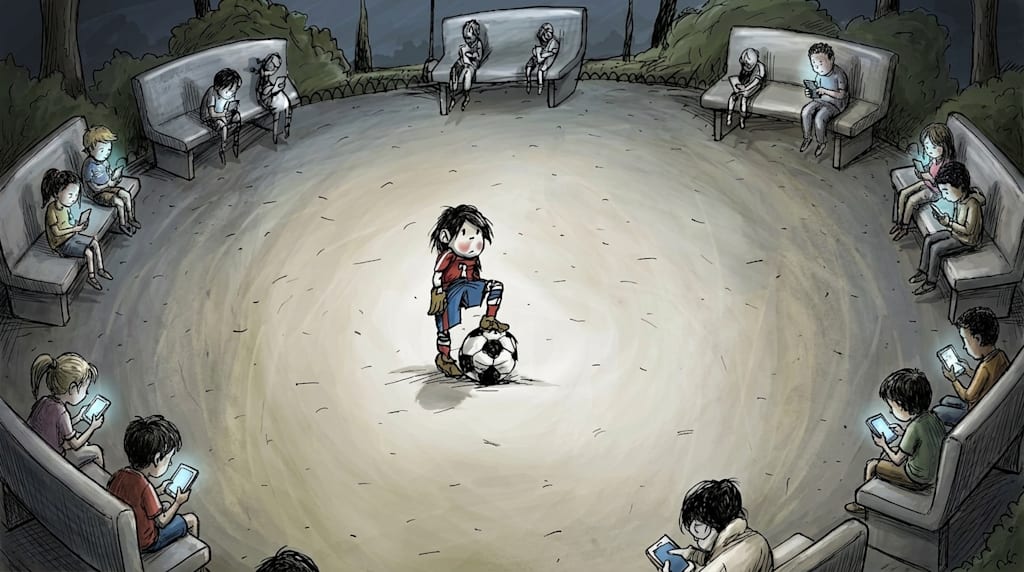
Take a long, hard look at the middle of the playground.
There is a boy standing there. He is wearing a football jersey. His foot is resting lightly on a battered black-and-white ball. His eyes are scanning the benches that surround him—looking left, looking right, searching desperately for something that used to be the most natural thing in the world.
A teammate. An opponent. Just one other person willing to run.
But the park isn't empty. That is the most terrifying part. The benches are completely full of people. But every single head is bowed. Every pair of shoulders is curved inward. Every hand is clutching a glowing rectangle, thumbs endlessly scrolling through a digital abyss.
Nobody looks up.
We Didn't Lose the Game. We Left the Field.
It wasn't even that long ago. Just a few decades back, bringing a football out to the street was a binding social contract. You brought the ball; the neighborhood provided the players. It was simple, and it was sacred.
Kids didn’t need complex group chats or calendar invites to organize a match. They just needed a patch of dirt, a couple of rocks for goalposts, and a few hours of daylight. Physical play wasn't scheduled "exercise" forced upon them by health apps. It was life itself. It was the raw, unfiltered language through which rivalries were born, loyalties were tested, and absolute lifelong friendships were forged. It was scraped knees, furious arguments over whether a ball was out of bounds, and laughter that echoed through the streets until the streetlights flickered on.
That world burned brightly through the 1990s and survived into the 2000s. But by the 2010s, it began to evaporate like mist. And the tragic part? We barely even noticed it was happening, because we were too busy staring down at our hands.
The Silent Theft of the Smartphone
The mobile phone didn't murder childhood overnight. It was a much slower, much more seductive assassination.
At first, it was just a tool to call your parents. Then, it became a camera. Then a gaming console. Then, suddenly, it was a hyper-stimulating alternate reality that offered instant, effortless dopamine.
Playing a real football match requires massive effort. It requires sweat, physical exhaustion, and the very real risk of embarrassing yourself in front of your peers. A mobile game, on the other hand, requires absolutely nothing but a thumb.
The result is devastating. We have inadvertently engineered an entire generation of children who know how to execute a flawless, pixel-perfect combo attack in a virtual arena, but who have literally never learned how to sprint across a field without getting winded. We built the most connected society in the history of human civilization—and we created the loneliest generation to ever walk the earth.
The Arrival of the Frictionless Friend
And now, just as we were finally waking up to the damage the smartphone era caused, a new player has stepped onto the pitch.
Artificial Intelligence.
AI isn't just a screen you scroll through. It is an active companion. It can be a tutor, a therapist, an entertainer, and a friend—available 24 hours a day, without ever asking for a single thing in return. There is no conflict. There is no rejection. It is perfectly, flawlessly calibrated to keep you comfortable.
This is where the image of the lonely boy on the pitch becomes truly haunting. Because the next generation won't even be sitting on the park benches ignoring him. They will be locked inside their bedrooms, talking to AI companions who never get tired, never argue over the rules, and never choose someone else to play with.
The boy with the football will eventually stand in a completely empty park—not because people are distracted, but because humanity simply stopped going outside.
What Are We If We Stop Playing?
This isn't about nostalgia. This isn't just older generations complaining about the youth. This is a fundamental crisis about the architecture of human biology.
Human beings were not designed to be static. We evolved in motion. We are wired to chase, to be chased, to collaborate in physical space, and to feel the sun on our skin. A child who never plays outside doesn't just miss out on burning calories. He misses out on learning how to read a room. He learns how to dominate a global digital leaderboard, but completely lacks the emotional resilience to navigate a face-to-face disagreement. He gathers thousands of virtual followers, but has absolutely no one to call when his real world falls apart.
Before He Walks Away
But look back at the pitch. The boy is still there.
His foot is still on the ball. He isn't angry. He isn't bitter. He is just waiting. Because somewhere deep inside his DNA, he still believes that if he stands there long enough, someone is going to wake up from their digital trance, put the phone down, and remember.
Remember the visceral thrill of running until your lungs burn. Remember the sheer, explosive joy of watching the ball hit the back of the net and screaming together at the top of your lungs. Remember what it feels like to be completely, unapologetically alive.
Technology is never going to stop advancing. The screens will get sharper, and the AI will get smarter. The only question left is whether we have the deliberate, terrifying courage to simply put the device down. To step outside. To look a fellow human being in the eye and kick a ball.
We need to do it soon. Before the playground empties out completely. Before the last kid standing finally gives up, picks up his ball, and walks away forever.
About the Creator
Wellova
I am [Wellova], a horror writer who finds fear in silence and shadows. My stories reveal unseen presences, whispers in the dark, and secrets buried deep—reminding readers that fear is never far, sometimes just behind a door left unopened.
Enjoyed the story? Support the Creator.
Subscribe for free to receive all their stories in your feed.
Comments
There are no comments for this story
Be the first to respond and start the conversation.