support
A solid support system is invaluable for one's recovery from psychiatric illness and mental health issues.
The Emotional Exhaustion of Always Being Alert
I woke up at 3 a.m., heart racing, body drenched in sweat. There was no nightmare. No sound had startled me awake. My brain had simply decided, as it did most nights, that sleep was a luxury I couldn't afford.I lay there in the dark, listening to my partner breathe peacefully beside me, and felt a familiar wave of exhaustion wash over me. Not the kind that sleep could fix. The kind that lived in my bones, that made every day feel like I was walking through water, that came from spending every waking moment on high alert for dangers that rarely came.I was twenty-nine years old, and I was so tired of being tired.The Weight of Invisible ArmorMost people don't understand what it's like to live in a body that never feels safe. They don't know what it's like to walk into a coffee shop and immediately catalog all the exits. To sit in meetings only half-listening because you're too busy reading everyone's micro-expressions for signs of anger or disappointment. To come home after a normal day and feel like you've run a marathon because your nervous system has been in fight-or-flight mode for eight straight hours.I couldn't remember the last time I'd felt truly relaxed. Even on vacation—especially on vacation—I was scanning for problems, planning for disasters, preparing for things to go wrong. My friends would laugh at the beach while I mentally reviewed our emergency contacts and the location of the nearest hospital."You worry too much," they'd say, not unkindly.But it wasn't worry. Worry is a choice. This was a compulsion, a biological imperative, a survival mechanism that had forgotten to turn off long after the danger had passed.Learning to Live in Threat ModeI didn't always live like this. Or maybe I did, and I just didn't notice until it started breaking me.Growing up, my home was unpredictable. Not violent in the traditional sense, but volatile. My father's moods were weather systems I learned to forecast—a certain tone of voice meant a storm was coming, a particular kind of silence meant I should disappear into my room. My mother's anxiety was contagious, her catastrophic thinking a constant background hum that taught me the world was dangerous and disaster lurked around every corner.I became hypervigilant out of necessity. The girl who could sense tension before it erupted. The child who perfected the art of reading rooms and adjusting herself accordingly. The teenager who never fully relaxed because relaxing meant being caught off guard.It kept me safe then. But now? Now it was killing me slowly, one anxious moment at a time.The Thousand Tiny CalculationsPeople don't see the work that hypervigilance requires. They don't see the constant calculations running in the background of my mind:Is my boss's email shorter than usual? Did I do something wrong?Why did my friend take three hours to respond? Are they mad at me?My partner seems quiet. Is this the beginning of the end?Every interaction becomes a puzzle to solve, every silence a threat to decode. I'm exhausted before lunch because I've already survived a dozen imagined catastrophes that never happened.At the grocery store, I'm planning escape routes. At dinner parties, I'm monitoring everyone's alcohol intake in case someone gets aggressive. During normal conversations, I'm three steps ahead, anticipating conflict and preparing my defense.My therapist calls it hyperarousal. My body calls it normal. The rest of the world calls it anxiety.They're all right.The Body That RemembersThe cruelest part of hypervigilance is that it lives in your body, not just your mind. I could intellectually understand that I was safe, that my current life bore no resemblance to my childhood, that most people weren't threats.But my nervous system didn't get the memo.My heart still raced when someone raised their voice—even in excitement. My stomach still dropped when I heard footsteps approaching quickly. My shoulders still tensed when I heard keys in the door, even though it was just my partner coming home from work.Trauma had taught my body that survival meant constant vigilance. And bodies, it turns out, are slow learners when it comes to unlearning fear.I tried everything to calm down. Meditation made me more anxious—sitting still only gave my brain more time to catastrophize. Exercise helped, but only temporarily. Alcohol worked until it didn't, until one glass became three became a problem I didn't want to admit.What I needed wasn't relaxation techniques. What I needed was to convince my nervous system that it was finally, truly safe.The Breaking PointMy wake-up call came on an ordinary Tuesday afternoon. I was driving home from work, and suddenly I couldn't breathe. My vision tunneled. My hands went numb. I pulled over, certain I was having a heart attack.At the emergency room, after hours of tests, the doctor gave me the diagnosis I'd been avoiding: panic attack. Severe anxiety. Chronic stress."Your body is in a constant state of crisis," she explained gently. "You're running on adrenaline and cortisol all the time. Eventually, something has to give."I nodded, unable to speak around the lump in my throat. Because she was right. Something had given. My body, after years of being ignored, had finally screamed loud enough to get my attention.
By Ameer Moavia11 months ago in Psyche
My Experience on Silencing Autism
I wanted to do an educational article on something that has recently come up in my attention. I was having lunch with some of my peers - and one of the ladies spoke briefly about someone she provides care for: "You know, so-and-so still is so loud and needs to learn to not make everyone miserable just because she is miserable." The so-and-so is an autistic individual and I wanted to say something then, but bit my tongue.
By Adora Hooper11 months ago in Psyche
The Night I Understood Football
I didn’t go to the game expecting hope. It was a cold November Thursday. My brother had just lost his job. My nephew hadn’t spoken in days after a school incident. The world felt heavy, and the last thing I wanted was to watch a mismatch—our hometown team facing a dynasty that hadn’t lost in months.
By KAMRAN AHMAD11 months ago in Psyche
Society Often Teaches Us to Suppress Our Sad Feelings, Branding Them as Negative.. Top Story - January 2026. Content Warning.
Allow yourself the time to feel, process, and let go. What a journey we’ve traveled together. You can relate to that pain that appears out of nowhere and wants to linger in our minds. Once fear moves in, it takes root—spreading doubt, loneliness, and confusion It’s that kind of pain that overtakes your mental health, gradually making a home within you. Your thoughts can create a space filled with fear, a feeling that we often cling to because it’s the one our minds use against us—leading to a fierce battle between your thoughts and your feelings. It’s a struggle no one wants to lose, yet losing yourself feels like an ever-present threat. Isn’t that a trick life plays on us?
By Johana Torres11 months ago in Psyche
Watch Out Wednesdays! (New Year's Eve Edition) - Opinion. Content Warning.
Happy New Year's Eve to everyone! Here is what to watch out for as we head into 2026! 1. Look for vengeance. For 2026, seek to avenge yourself of all of your enemies. Please be 100% in reaching your goal. Please make sure that they cry long into the night. Those who have plotted against you will be in misery when they see you being successful anyway.
By Adrian Holman11 months ago in Psyche
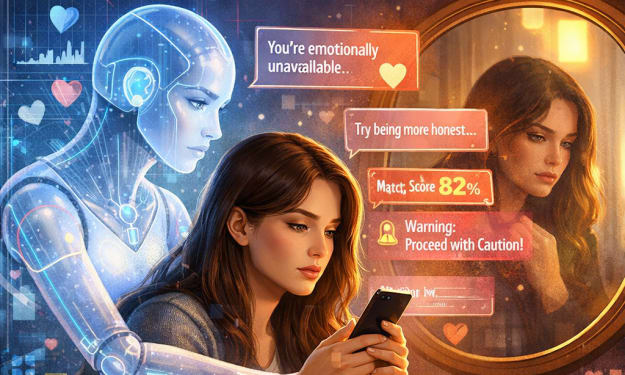
I Let AI Help Run My Love Life in 2025 — And It Got a Little Too Honest
If you’ve been single in 2025, you already know: the dating apps are starting to feel less like apps and more like ecosystems. Profiles are written by AI, photos are filtered by AI, and now, if you want, your whole “compatibility journey” can be guided by an algorithm that claims to understand you better than you understand yourself.��
By The Insight Ledger 11 months ago in Psyche
Home Is Not a Place—It’s a Nervous System
I carry home in my shoulders. In the way they tighten when voices rise. In how my breath shortens before my mind can name the danger. Home, for me, has never been a place you could pin on a map. It has never been an address that stayed long enough to memorize the cracks in the walls. Home learned to move when I did. It adapted. It folded itself into muscle and memory, into reflexes I didn’t choose but inherited from moments that taught me how to survive. As a child, I thought home was where you returned at night. A door. A bed. A familiar ceiling. But even then, my body knew better. It knew that walls don’t promise safety. Silence doesn’t always mean peace. And love, when inconsistent, teaches vigilance faster than trust. So my nervous system became the house. It learned the language of footsteps. It memorized tone shifts. It developed an instinct for reading rooms before my eyes fully entered them. While others were taught to relax at home, my body learned to stay alert everywhere. This wasn’t anxiety at first. It was intelligence. It was adaptation. It was the quiet brilliance of a system that decided, without consulting me, that it would never be caught unprepared again. Modern identity doesn’t begin with who we are. It begins with what our nervous systems learned when no one was explaining things. Long before we chose values or careers or aesthetics, our bodies made decisions. About closeness. About conflict. About rest. Some people carry home in their chests — expansive, warm, forgiving. Others, like me, carry it in our shoulders, lifted slightly as if bracing for impact. Not dramatic enough to be noticed. Not relaxed enough to forget. This is what psychologists call regulation. Or dysregulation. Or trauma, depending on who is speaking and how clinical the room feels. But in lived reality, it’s simpler and more intimate than terminology allows. It’s the difference between entering a space and feeling your breath drop into your belly — or hovering somewhere near your throat, unsure. I used to think I was bad at settling down. Bad at belonging. Bad at staying. But the truth is more precise: my body never learned that staying was safe. So it learned movement instead. It learned how to pack quickly, emotionally. How not to leave fingerprints on relationships. How to be present without being exposed. It learned to treat even good moments as temporary — not out of pessimism, but out of habit. This is where modern psychology meets identity. Not in labels, but in patterns. In the way we mistake survival strategies for personality traits. We say we are “independent,” when really, we learned early that asking for help did not always end well. We say we are “low-maintenance,” when in truth, we learned not to need too much out loud. And somewhere along the way, we start believing these adaptations are who we are — not what happened to us. Home, then, becomes something we try to build externally. A relationship. A city. A routine. We move apartments hoping the next set of windows will finally teach our bodies to exhale. We curate spaces with plants and soft lighting, hoping comfort will arrive through design. Sometimes it does. Briefly. But the body remembers faster than the mind forgets. It remembers raised voices, even when none are present. It remembers abandonment, even in crowded rooms. It remembers inconsistency like a native language. And until it is taught something new — gently, repeatedly — it will continue to act as if danger is just around the corner. Healing, I’ve learned, is not about finding the right place to live. It’s about retraining the nervous system to believe that safety can exist without conditions. This is slow work. It looks like learning to unclench your jaw without being prompted. Like noticing when your shoulders rise — and choosing to lower them, even if nothing obvious is wrong. Like letting good moments stay good, instead of scanning them for exit signs. It is the quiet revolution of teaching your body that rest does not require permission. I am still learning this language. Still negotiating with a system that kept me alive when it had to, and doesn’t yet trust that it can stand down. I thank it now, instead of resenting it. I tell it we are no longer where we once were. I tell it, sometimes out loud, that this moment is safe. Home, I am discovering, is not a destination. It is a sensation. It is the moment your breath deepens without effort. The moment your shoulders drop without instruction. The moment your body stops asking, “What’s about to happen?” and starts saying, “I am here.” And maybe one day, I won’t have to carry home in my shoulders anymore. But until then, I hold them gently. Because they’ve been holding me for a very long time.
By Jhon smith11 months ago in Psyche