recovery
Your illness does not define you. It's your resolve to recover that does.
Facebook Was My Safe Place—Until It Became a Memory Trap
For most of my twenties, Facebook felt like home. It was where I documented everything that mattered. Birthday dinners, weekend getaways, friend drama (with vague statuses, of course), inside jokes, heartbreaks, and rebounds. It was my personal archive, my social stage, my comfort scroll.
By Kamran Zebabout a year ago in Psyche
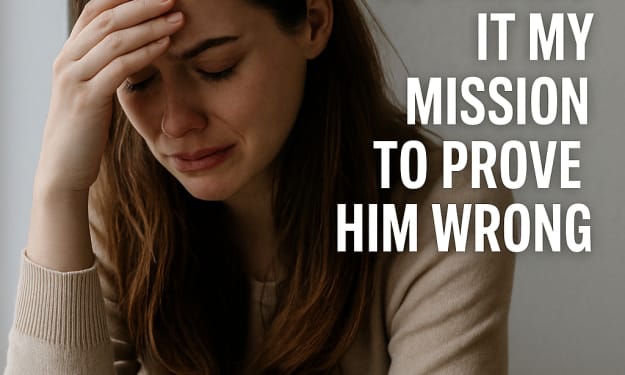
“He Told Me I Was Too Broken to Be Loved—So I Made It My Mission to Prove Him Wrong”
I remember the exact moment the words left his mouth. We were standing in the living room of the apartment we had shared for nearly two years. It was supposed to be just another fight — one of many that week — but this time, he didn’t hold back. He looked me dead in the eyes, as if what he was about to say would somehow free him of responsibility. “You’re too broken to be loved,” he said. “And honestly, I’m tired of trying to fix you.” Time stopped. My ears rang. My breath caught in my throat. Too broken to be loved. He didn’t yell it. He didn’t even say it with malice. He said it like it was a fact, like telling someone the sky is blue or that winter follows fall. Like he was doing me a favor by finally admitting what he “knew” all along. What he didn’t know is that those words would stay with me—not to haunt me, but to drive me. The Girl Who Survived Long before I met him, life had taught me how to survive. I was raised in a house where silence was louder than screams and love had conditions. My father left when I was eight. My mother battled addiction and depression, often leaving me to parent myself. I learned early how to stay small, unnoticed, and how to fake a smile so adults wouldn't ask too many questions. By the time I turned 18, I’d been through more than most people twice my age. I wore my trauma like invisible armor—never asking for help, always pretending I was fine. But the cracks were there. You just had to look closely. He did. When I met him, he made me believe I could finally take that armor off. He told me I was strong, mysterious, and deep. He said he saw light in me. And I wanted so badly to be seen that I let myself believe he was the one person who could handle my chaos. In the beginning, he was gentle. Patient. Kind. He asked questions no one had ever asked before. He held me during panic attacks and whispered promises of forever. I mistook all of it for unconditional love. But love, I’ve learned, doesn’t vanish when things get hard. His did. The Shift Things changed slowly. Subtly. First came the sighs when I cried. Then the eye rolls. Then the subtle jabs masked as jokes. “You’re always so dramatic.” “Why can’t you just be normal?” “If you didn’t have so many issues, maybe I’d be happier.” Eventually, his warmth turned cold. He stopped holding me. He stopped asking how I was. He grew distant, emotionally unavailable—until one night, when I brought up how lonely I felt, he dropped the sentence that would become a turning point in my life. “You’re too broken to be loved.” And with that, he walked out of my life. Hitting Rock Bottom I won’t lie and say I immediately bounced back. I didn’t. For weeks, I replayed that sentence in my mind like a toxic mantra. I started to believe it. Maybe he was right. Maybe I was too broken. Too complicated. Too much. I isolated myself. Skipped work. Ate almost nothing. I’d wake up and wonder how I could fill the hours until sleep would take me away again. My therapist called it situational depression. I called it drowning. But somewhere in that fog, something inside me stirred. It wasn’t rage. It wasn’t revenge. It was something quieter. It was hope. The Rebuild I decided I was going to do the one thing he never believed I could: I was going to love myself. Not the Instagram version of self-love—the bubble baths and positive affirmations. I mean real, painful, deep work. The kind that requires staring your demons in the face and refusing to let them define you. I went back to therapy, this time not just to survive, but to heal. I unpacked my childhood trauma. I journaled. I cried. I screamed. I forgave my parents—not because they deserved it, but because I did. I built a morning routine that grounded me. I filled my apartment with plants and poetry and anything that made me feel alive. I cut out people who only saw my flaws, and surrounded myself with those who saw my fight. Slowly, I stopped seeing myself as someone who needed fixing. I wasn’t broken. I was rebuilding. Love, Unexpected A year later, I met someone new. He wasn’t flashy or full of grand gestures. He was soft-spoken, with kind eyes and a quiet strength. From the beginning, I was honest about my past. I told him about my trauma, my therapy, my journey. I held nothing back. I expected him to flinch. He didn’t. One night, as we sat on my couch eating takeout, I told him about the man who said I was too broken to be loved. He looked at me, shook his head gently, and said, “That man didn’t know what love was.” It hit me then—true love doesn’t fix you. It holds space for all your pieces. It doesn’t run from your pain; it learns how to hold it with you. The Mission Today, I live not to prove that man wrong, but to prove myself right. I am not broken. I never was. I was bruised. Wounded. Hurt by people who didn’t know how to love what they didn’t understand. But I’ve learned that healing isn’t about becoming perfect—it’s about embracing yourself exactly as you are and finding peace in your own skin. If you’ve ever been told you’re too much, too emotional, too complicated—let me tell you something: You are not too broken to be loved. You are human. You are worthy. You are the story someone else needs to hear. And sometimes, the most beautiful love story is the one you write with yourself. This story is personal, but it isn’t just mine. It’s for every person who’s ever been made to feel unlovable. It’s for the survivors, the fighters, the ones still finding their way. You are not alone. And you are never, ever too broken to be loved.
By Soul Draftsabout a year ago in Psyche
Effective Ways to Overcome Anxiety Today
Are you feeling overwhelmed by daily life? Anxiety can be tough, but there are ways to relieve it. You don't have to let anxiety control you. By learning to calm your mind and body, you can reduce anxiety and take back control. There are simple yet powerful ways to manage anxiety. From mindfulness to lifestyle changes, we'll cover the best methods. This article aims to help you overcome anxiety and boost your well-being. Key Takeaways Understand the root causes of your anxiety Learn effective techniques to calm your mind and body Discover simple lifestyle changes to reduce anxiety Explore mindfulness practices for anxiety relief Develop a personalized plan to overcome anxiety Understanding What Triggers Your Anxiety Knowing what makes you anxious is key to managing stress and boosting your mental health. By figuring out what causes your anxiety, you can find ways to deal with it. Identifying Common Anxiety Symptoms
By Shoaib Afridiabout a year ago in Psyche
Therapy Didn’t Heal Me — It Helped Me Start Over
I used to believe that healing meant going back to who I was before everything broke. That somehow, through therapy, I would find a way to become her again—the girl who laughed easily, trusted quickly, and didn’t wake up every morning with a knot in her stomach. But therapy didn’t give me that. What it gave me was something much harder, much messier, and—eventually—so much more honest. It gave me a blank slate. --- I started therapy because I hit a wall. The kind of wall you don’t just crash into—you become it. I was twenty-seven, recently out of a toxic situationship, and working a job that drained me so deeply I forgot what weekends were supposed to feel like. On paper, everything looked “okay.” That word—okay—was a lie I told myself at least ten times a day. When I walked into my first session, I wasn’t looking to start over. I was looking to fix myself. “Make me functional,” I told my therapist. “I just want to stop crying in the bathroom stall at work.” She nodded. No judgment. Just curiosity. “Okay. Let’s figure out where that’s coming from.” What I didn’t realize at the time was that I hadn’t just lost control of my emotions—I’d never really had it. I was a master of survival, of faking calm, of molding myself into whatever version of “fine” someone else needed. And that’s what therapy unwrapped. Not just the heartbreaks or the burnout, but the core lies I had built my life around: – That love should hurt before it feels good. – That boundaries make you selfish. – That if you’re not useful, you’re disposable. No worksheet or breakthrough moment changed me overnight. What did change me were the long silences. The pauses where I had no words to answer a simple question like, “What do you want?” I didn’t know. I hadn’t known for years. --- One of the most powerful moments in therapy wasn’t a dramatic revelation. It was a quiet Tuesday, maybe session eleven, when I found myself saying something I’d never said before. “I don’t think I like the person I’ve been pretending to be.” My therapist didn’t try to fix it. She just asked, “What would it look like to stop pretending?” It shattered me. Because I realized: I didn’t just need to heal—I needed to rebuild. Not go back to some idyllic “before.” That version of me wasn’t real either. I needed to start from scratch. --- That was the beginning of what I call my "emotional excavation." I stopped trying to silence my sadness and started listening to it. I traced my people-pleasing tendencies back to a childhood where I earned affection through performance. I realized my anxiety wasn’t random—it was my body screaming for rest in a world that told me rest = laziness. And slowly, I gave myself permission: – To say no without guilt. – To rest without proving I earned it. – To be messy, loud, needy, and whole. This wasn’t healing in the neat, inspirational-quote sense. It was grieving. Letting go of versions of myself I had performed for survival. Mourning the lost years. Accepting that I might never be fully “healed,” but I could be honest. I could be real. --- Therapy didn’t save me. It handed me the tools and stood back while I did the demolition. There were weeks I walked out feeling worse than when I walked in. There were times I hated my therapist—not because she was unkind, but because she asked me to look at the parts of myself I’d spent decades avoiding. But those parts? They needed to be seen. And once I saw them, I could finally start over—not as a fixed version of myself, but as a truer one. --- Starting over didn’t mean quitting my job or moving across the country (though I did both, eventually). It meant choosing different in the tiny, day-to-day ways: – I unfollowed people who made me feel small. – I started journaling what I felt instead of what I thought I should feel. – I let friendships fade that were built on old versions of me. – I looked in the mirror and saw someone I didn’t fully know—but wanted to meet. --- If you’re reading this and therapy hasn’t “healed” you—good. That’s not what it’s for. It’s not a magic spell. It’s a mirror. And sometimes, the most loving thing you can do for yourself is admit that you don’t want to go back—you want to build something better. And that begins when you stop asking therapy to erase your pain and start letting it teach you how to carry it, speak to it, learn from it. I’m not healed. But I’m building something real. And that’s more than I ever thought I deserved. Thank you for reading ❤️.
By Azmat Roman ✨about a year ago in Psyche
Soul, Mind, Body: Finding the Real Center of Gravity.
I used to think of the soul, the mind, and the body as parallel tracks. Close, maybe touching at points, but still running separately. That idea worked for a while. It felt clean. But reality didn’t agree.
By Beyond The Surfaceabout a year ago in Psyche
Self-Love Is Not Selfish
I used to think self-love was indulgent. You know, those social media posts that say, “Put yourself first,” or “You can’t pour from an empty cup”—they felt like empty phrases. I was raised to believe that strength meant sacrifice, that love meant putting others ahead of yourself, even if it hurt. Especially if it hurt.
By Mehtab Ahmadabout a year ago in Psyche