recovery
Your illness does not define you. It's your resolve to recover that does.
it’s okay to disappear
Ghosting everyone because you’re lost inside yourself—and why that doesn’t make you a bad friend. There are seasons in life when you suddenly find yourself slipping away from everyone. Not out of spite, not because you stopped caring, but simply because you don’t know what’s happening inside you anymore.
By Zakir Ullahabout a year ago in Psyche
Behind the Smile: The Hidden Faces of Suicide
Every 40 seconds, somewhere in the world, a life is lost to suicide. By the end of the year, that adds up to nearly 800,000 people. For every life taken, there are countless others who attempt it—some estimates say over 20 million attempts each year. These are not just numbers; they represent mothers and brothers, best friends and neighbors. They represent stories cut short, futures never lived, and ripples of grief that travel through families and communities.
By Annie Edwards about a year ago in Psyche
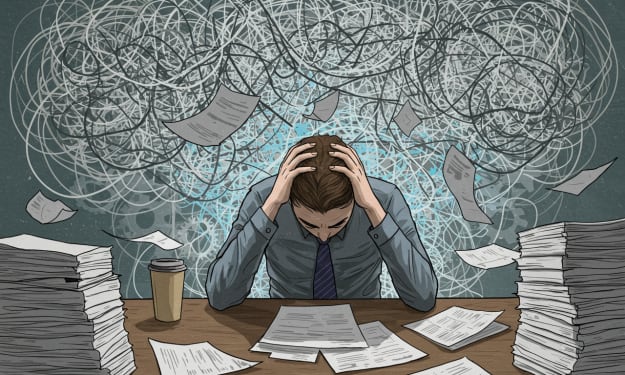
Why You're Burning Out: The Hidden Cognitive Factors That Are Draining You
When we hear the word "burnout," our first instinct often is that it's about working too hard or being overwhelmed with too many tasks. But burnout doesn’t always result from doing too much. In fact, sometimes burnout happens because the task you’re working on stops adapting to your cognitive needs. It’s not about adding more breaks to your schedule; it’s about addressing a mismatch between your mental system and the task you're facing.
By Nikesh Lagunabout a year ago in Psyche
So, Whose Responsibility is Burnout Anyway?
In today’s fast-paced, hyper-connected world, burnout has become a global catastrophe, silently eroding the foundations of our workforce and society at large. As we navigate the complexities of modern work life, a pressing question emerges: who bears the responsibility for combating this depressingly ever-worsening threat?
By Bianca Bestabout a year ago in Psyche
Who Supports the Support System?
For as long as I can remember, I’ve been the one people turn to. The listener. The problem-solver. The “strong” one. At first, it felt good. There’s a kind of pride that comes with being dependable—the person who can carry other people’s pain without flinching. Friends called me their “rock.” Family relied on me to keep things together. At work, I was the one who could handle the pressure without breaking.
By Nadeem Shah about a year ago in Psyche
I Was the Strong One Until It Broke Me
For as long as I can remember, people have seen me as “the strong one.” The dependable friend. The sibling who always listens. The co-worker who steps up when things fall apart. I carried that title like a badge of honor, proud that others trusted me, proud that I could be the one who held everyone together.
By Nadeem Shah about a year ago in Psyche
What Happens during a Court-Ordered Mental Health Evaluation?
When a legal case is going on, sometimes the court wants to know more about a person’s mental health before concluding. In such situations, a judge can ask for a court-ordered mental health evaluation.
By Ankita Deyabout a year ago in Psyche
The Girl Who Slept On A Newspaper
Anxious attachment is a thing we hear a lot about these days. Attachment theory is a buzzword bingo selection. Like narcissism and gaslighting. But the story of how I learned to chase avoidant men like a defective compass needle that only pointed toward storm systems is one in a million. And yet, the dynamic may be the most common model of all relationship issues today.
By Suburban_Disturbanceabout a year ago in Psyche
Chains of the Brothel: Part 7 Silent Walls
The Prison Disguised as a Home The place where Anita now lived was not a home. It was a forgotten prison pretending to be a sanctuary. The villagers called it the Old House, but its name was a cruel lie. It wasn’t a shelter for the elderly or a place of care. It was where society abandoned those it no longer wished to see—the “incurable,” the “dangerous,” the “inconvenient.”
By Shehzad Anjumabout a year ago in Psyche
Good Luck Understanding This. Content Warning.
I thought I knew myself pretty well. I mean, I had spent years in my own head, which should count for something, even if the place is badly managed. I knew how I got when things started slipping. I was already so used to doubting myself that I thought I would notice if someone else started joining in. Well, safe to say - I didn’t. I was nineteen when we met, twenty when the relationship started, and twenty-one when I left, which feels worth mentioning because apparently that still made me old enough to be blamed for not immediately understanding a man fifteen years older than me. I was not as impossible to influence as I wanted to believe. Being with him made that obvious in ways I only really understood after I got out. At the time, though, I mistook having opinions for having boundaries. I knew what made me uncomfortable; I was just remarkably easy to convince that the discomfort was my problem. With no real experience to compare it to, whatever happened often became “normal” simply because he said it was. Normal was him treating anything I objected to as proof that I was insecure, then presenting his own behaviour as some universal truth about men I was apparently too inexperienced to grasp. Normal was him asking why I’d lost interest while telling me my boobs would be sagging to my knees by the age I’m forty, then defending himself by pointing out that I had mentioned wanting a breast lift first, as though vulnerability came with a waiver. Normal was my body being discussed like an inconvenience whenever it failed to make him feel wanted, attractive, or in control. Normal was being presented with a small jury of friends and relatives I had never spoken to, all somehow agreeing that I was the problem. Normal was him expecting reassurance from me while I was still trying to recover from whatever he had just said. Normal was all of that and more, and it left me stunned at the casualness of cruelty, wondering how someone could make your life feel like a set of examples in a lesson you didn’t ask to attend. The hardest part wasn’t realising I’d been manipulated - it was how slowly it had happened. Nothing arrived all at once, no neon sign lit up “this is bad,” at least from where I was standing. It came as little comments, jokes I supposedly took the wrong way, “honesty” that somehow always landed on my body or my character, and conversations where every disagreement ended the same way: he was experienced, I was naive; he was rational, I was crazy. To nobody’s surprise, other people saw what was happening to me before I did. The massive age gap was obvious, and so was the imbalance that came with it. Stress has never done especially elegant things to my grip on reality. During the relationship, I started having hallucinations I could still recognise as hallucinations, which sounds almost reassuring until you are sitting there fully aware that something is not real and still terrified of it anyway. A remarkably useless distinction. That was when the fear changed. I wasn’t just having a hard time anymore. I could feel my mind getting less reliable, and I knew enough about my own diagnosis to understand where that could lead. The fear of becoming more unwell and slipping further along the schizophrenia spectrum didn’t feel dramatic - it felt uncomfortably realistic. Somehow, even my illness became part of the cover story. The worse I got, the easier it was to point at my diagnosis instead of the relationship making me deteriorate. It’s a very convenient little trick: make someone less stable, then use the instability as proof that nothing they say can be trusted. By that point, I was barely holding myself together, and my brother’s addiction was pulling at whatever was left. I wish I could say I responded to it with endless patience and concern, but I didn’t. Addiction in a family is not some noble exercise in empathy. It’s watching someone you love keep making life worse for everyone around them, and then feeling guilty because apparently saying that out loud makes you the cruel one. My brother and I have never had some clean, sweet bond. It’s very complex. I resent the lies, the apologies nobody really believes anymore, and the same promises being wheeled out every time like this time is somehow going to be different. Then he makes another stupid decision, and the rest of us get stuck with the fallout. Suddenly everyone’s on the phone, plans are ruined, nobody sleeps, and the whole family is dragged into figuring out what the hell he’s done now. I love him, but I hate what his addiction has done to us, and sometimes I hate him for it too. That sounds awful because it is awful. None of this is noble or clean, and I’m not interested in making any of this easier to swallow for people who have never had to live through it. That is exactly why I wanted to keep it private. Not because I was ashamed - but because privacy is not the same as stigma. It was none of anyone else’s damn business. It was my brother’s life, my family’s damage and my own grief, and I had no interest in handing any of it over so somebody else could isolate the least flattering parts of how I coped and use them to make himself easier to sympathise with. On my brother’s birthday, I went to visit him because, no matter how angry I can be with him, I still loved him enough to go. He was in the worst state I had ever seen him in, and I had a panic attack and left. Before I had even processed any of it, I was expected to explain when I was coming back and reassure someone who had somehow found a way to need comforting too. Of course, once you remove the brother, the birthday, the addiction, the panic attack and the fact that I had gone because I loved him, I suppose what remains afterwards can be arranged into a fairly tidy story about my selfishness. Context is wonderfully cooperative when you cut away enough of it. It takes a remarkable amount of confidence to pass moral judgement on the uglier parts of loving an addict when addiction has never even entered your own family and demanded anything from you, but confidence was never exactly in short supply, I guess. By then, I was exhausted in a way that made everything very quiet. Not peaceful, just empty. I had put an embarrassing amount of effort into being fair to someone who treated fairness as an opening bid and my worst moments as future reference material. Every explanation became another surface for him to argue with. Every boundary became proof that I was cold, irrational, ungrateful, argumentative, or whatever word made him innocent that day. At some point, you end up leaving not because you are angry. You leave because there’s nothing left to hand over. No more context, no more patience, no more translating yourself into simpler and simpler language for someone who understood perfectly well when it benefited him. So it ended like a memo: packed my things, typed the text the next day, and sent it. A ridiculously long, overexplained text, because obviously it takes a novel to make someone hear what you’ve been saying for months. Leaving did not make me instantly free. That would’ve been ideal, obviously, but not realistic, unfortunately. It was over, but I wasn’t magically fine. I would wake up from nightmares unable to catch my breath and then lie there replaying everything. I kept thinking of when I should’ve said no, walked out, refused to let him make me feel ashamed for falling apart after being pushed that far. The more I remembered, the more I hated myself. I hated that I had stayed long enough to learn how to apologise while crying. I hated that I had become grateful when an argument finally ended, even if it ended with me agreeing that I was the problem. I hated how familiar it all became. I knew how every conversation would go and still kept thinking there had to be one where he would finally hear me properly. There never was. For the longest time, I kept judging myself in his voice without realising I was doing it. I thought the relationship had simply exposed what I had always been: difficult, unstable, unattractive, and impossible to love. I was also made to believe, at some point, that I would never find better - which is hilarious in hindsight. The belief had very little to do with his actual desirability and quite a lot to do with the extraordinary talent for mistaking his opinion of himself for a widely shared one. Life has been rather educational since, I must say. I can laugh at the arrogance now. I could not laugh at what believing him had done to me. Hearing my psychiatrist call it trauma was the first time I understood that the state I was in was not proof of my character. I was struggling because I had been hurt, not because he had finally uncovered some terrible truth about me. This was especially interesting because, during the relationship, he had already begun treating my psychiatrist as a suspicious influence. Once therapy started helping me notice things he preferred I did not notice, the explanation was apparently that my psychiatrist was manipulating and brainwashing me. It seems my illness could be invoked whenever I disagreed with him, but the treatment for it became untrustworthy as soon as it gave me a little perspective. So yes, therapy mattered. Shocking development: the place where I wasn’t being cross-examined turned out to be useful. It gave me somewhere to bring the whole mess without first preparing a defence, a timeline and several supporting documents. The nightmares still come back sometimes, and so does the shame. The difference is that I don’t believe the shame as easily now. Somewhere in all of it, I found enough clarity to understand that the damage was not proof I deserved it. I feel proud I gave myself time to get there.
By Suzanne B.about a year ago in Psyche
Toxic Reflection
I always thought I was the victim. In every failed relationship, every misunderstanding, every fight—I told myself I was the one who gave too much and received too little. I’d vent to friends, post vague quotes online, and cry quietly at night.
By Shehzad Anjumabout a year ago in Psyche
I Didn’t Know These Common Habits Were Signs of Mental Health Issues
“I thought I was just being careful, just being tired, just being introverted. But it turns out the little habits I brushed off as harmless were quiet signals my mind had been sending all along.”
By Zakir Ullahabout a year ago in Psyche