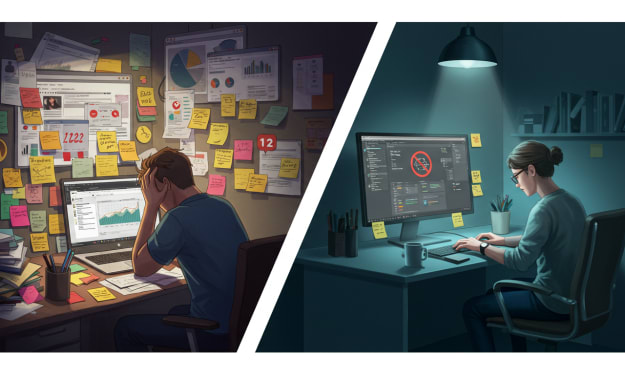
panic attacks
Sudden periods of intense fear. But remember, you're not alone.
Psychology of Fight or Flight. Content Warning.
I was getting ready to record a paranormal podcast. Upon speaking with my spirit friends, I found this and decided to re-write and edit this prose story. We spoke about the bullies in DC and everywhere. We agreed this should be re-written, created, and published. 2025, a year of bullies, hate, greed, craziness, destruction, and genocide. Other than that, I am eating lollipops and singing in the rain in Southern California.
By Vicki Lawana Trusselli about a year ago in Psyche
The Last Dreamcatcher
In a dim-lit room cluttered with dream journals and incense, Dr. Kael Mora prepared his mind for another descent into someone else’s hell. “Next,” he called, voice flat but practiced. His assistant ushered in a trembling teenager with hollowed eyes and a sketchpad clutched to her chest. Her name was Miri, and for the last three weeks, she hadn’t slept longer than an hour. Her nightmares weren't just vivid; they were aggressive. Monsters with her father’s voice. Floods with her mother’s face. Unrelenting guilt in symbolic, surreal terror. Kael gestured to the dreambed. “You understand the rules?” Miri nodded silently. Her mother, waiting by the door, pleaded with her eyes. Everyone who came to Kael’s dream practice had tried everything else: meds, meditations, shamans, science. All had failed. Kael was their final gamble, their last dreamcatcher. Once she was settled in, Kael attached the neural web to her temples and slipped on his own. Inhaling the minty-vinegar scent of lucid root—a substance banned in most countries—he activated the DreamSync. The world around him evaporated. --- He landed in Miri’s nightmare like stepping into a storm mid-howl. The walls bled ink. The sky burned paper. She was already there, age-shifted to a child, cornered by a giant marionette version of her father. “You never said sorry!” the puppet boomed, arms flailing. “You let it happen! You watched her die!” Kael whispered a command. A shield materialized in his hand—a relic from his own trauma, forged over years of nightmare-trading. He ran between Miri and the puppet. “I’m taking this,” he said, pushing her behind him. “You don’t need it anymore.” The marionette shrieked as Kael absorbed its essence through the neural link, storing it inside a mental vault built brick by agonizing brick from other people’s pain. As the puppet crumbled to dust, Miri's dreamscape softened. The ink turned to rain. The flames gave way to dawn. She opened her mouth to thank him, but the dream evaporated before she could. --- Back in the waking world, Miri sobbed into her mother’s arms, and Kael stumbled to his chair, ashen and sweating. His assistant offered water. He waved it away. “How much longer can you keep doing this?” she asked. Kael stared at the ceiling. “As long as they need me.” What he didn’t say: each nightmare he stole became a whisper in his own mind. Some, he could lock away. Others... not so much. --- Kael lived alone in a fourth-story apartment above an abandoned bookstore. His walls were lined with dreamcatchers—not traditional ones, but digital memory drives designed to trap synthetic dream code. Each one hummed faintly, like bees in glass jars. That night, one of them burst. Kael bolted upright in bed, drenched in sweat, lungs clawing for air. The room spun. He heard Miri’s father’s voice again—louder, angrier, inside his head now. You think you’re saving them? You’re just borrowing their demons. Kael hurled the broken drive against the wall. It shattered. The room fell silent. But inside, the noise grew. --- The next day, a woman came in clutching a worn photo of her son. “He hanged himself after three weeks of night terrors,” she said. “I’ve been having his dreams ever since. Please. Take them.” Kael agreed. Her dream was a mosaic of unbearable sorrow. The boy’s silhouette leaped from a thousand cliffs. In one loop, he tried to climb out of a coffin. In another, he simply dissolved into ash. Kael couldn’t even find the source—just echoes, metaphors, recursive loops. After an hour inside, he surfaced weeping. “You didn’t just lose your son,” he whispered. “He lost himself.” The mother sobbed with gratitude. Kael added another nightmare to his collection. Another voice in his head. Another crack in the dam. --- A week later, Kael collapsed mid-session. He awoke in a hospital bed, the nurse calling him a miracle. “You flatlined,” she said. “But your brain never stopped... dreaming.” He didn’t respond. He could still hear them—every voice, every monster, every tear-soaked scream. His mind had become a museum of horrors. A psychiatrist visited later, suggesting a break. Maybe even retirement. Kael asked, “And when the next Miri walks in? What happens to her?” “You’re not God, Dr. Mora.” Kael smiled sadly. “Tell that to the parents.” --- That night, Kael returned to his office, alone. He stared at the remaining dreamcatchers, half of them blinking erratically. He chose one. Then another. Then five. Plugging in, he did what he swore he never would: he entered his own vault. It was worse than he imagined. Hundreds of nightmares swirled like a psychic storm. He saw Miri again, older now, thanking him. He saw the boy who hanged himself—this time sitting by Kael’s side, whispering, You carry us so we don’t fall again. He saw a mirror—and in it, himself, eyes red, hands shaking, asking why. “I’m not your savior,” Kael said aloud. “I’m just tired.” But the ghosts inside whispered, You’re more than tired. You’re proof that empathy isn’t weakness. It’s the only power left. He stood for hours in that dreamscape, one final time, confronting every voice, naming every fear. Then he let go. --- Kael’s office never reopened. But months later, people began reporting strange dreams—dreams of a quiet man with tired eyes, walking calmly through their nightmares, touching monsters and turning them to mist. They woke lighter, freer. None of them ever met Kael. But they spoke of him like legend. The Last Dreamcatcher.
By Syed Kashif about a year ago in Psyche
Social Anxiety Explained Simply: What to Do When Your Heart Races Too Fast
Social Anxiety Explained Simply: What to Do When Your Heart Races Too Fast Imagine this: You’re about to speak in front of a small group, or maybe just enter a room full of acquaintances. Your chest tightens. Your heart begins to pound—not gently, but like a drum echoing in your ears. Your mouth goes dry, your hands tremble, and your thoughts scatter. This is not just nervousness. This is social anxiety.
By Siria De Simoneabout a year ago in Psyche
Focus Isn't About Trying Harder: It's About Friction
In the age of constant notifications, open tabs, background noise, and infinite scrolling, we've come to believe that focus is a matter of willpower. If we just tried a little harder, eliminated laziness, and summoned more discipline, we could finally sit down and get things done. But what if this assumption is wrong?
By Nikesh Lagunabout a year ago in Psyche
How to Manage Anxiety in Just 5 Minutes: A Psychological Guide to Rapid Relief
Introduction Anxiety is a universal human experience. Whether it's the anticipation of a major life event, social situations, or even seemingly minor day-to-day concerns, anxiety can become overwhelming and disruptive. According to the World Health Organization (WHO), anxiety disorders affect an estimated 301 million people globally, making them among the most prevalent mental health conditions.
By Siria De Simoneabout a year ago in Psyche
Signs of Stress in Body Language
Body movements and facial expressions that an individual makes may help to know his thoughts and feelings, including tension, fear, admiration, and others. The following is a group of signs of tension in body language:
By Uchenna Cosmas Nwokafor about a year ago in Psyche
Is AI Your Secret Weapon for Mental Peace? 5 Apps to Save Your Mind
Mental health isn’t just a buzzword—it’s a journey we’re all navigating, sometimes in silence. I remember a rainy evening stuck in traffic with my wife, the kind where the world feels heavy and words don’t come easy. A random memory of a road trip—us laughing over a torn map under a flickering flashlight—broke the silence and reminded us who we were. That moment was a lifeline, but what if you could have a lifeline in your pocket every day? Enter AI: not just for sci-fi movies or chatbots, but for real, tangible mental health support. These tools aren’t here to replace therapists; they’re like quiet companions, helping you process emotions, track moods, or just feel less alone.
By F. M. Rayaanabout a year ago in Psyche
Boss Fight Strategies for Panic Attacks
Panic attacks are the ultimate rogue boss of mental health—they ambush you when you least expect it, hit like a truck, and leave you wondering "What the hell just happened?" But unlike video game bosses, you can’t just rage-quit and reload. (Though if you could, we’d all have a save file from before the attack started.)
By Just One of Those Thingsabout a year ago in Psyche
The ‘Ring of Power’ Problem: When Coping Mechanisms Turn Toxic
There comes a time in every fantasy hero’s journey when they realize the artifact they’ve been relying on is actually whispering dark thoughts into their mind. For Frodo, it was the One Ring. For you? It might be that ”harmless” habit you swear helps you cope—but is slowly turning you into a gaunt, obsessed shell of yourself.
By Just One of Those Thingsabout a year ago in Psyche
The ‘Dungeon Master’s Guide’ to ADHD Brain
Imagine your brain as a tabletop RPG session where: You’re the DM (supposedly in charge) Your thoughts are chaotic NPCs (all talking over each other) Your focus is that one player who keeps getting distracted by shiny loot
By Just One of Those Thingsabout a year ago in Psyche