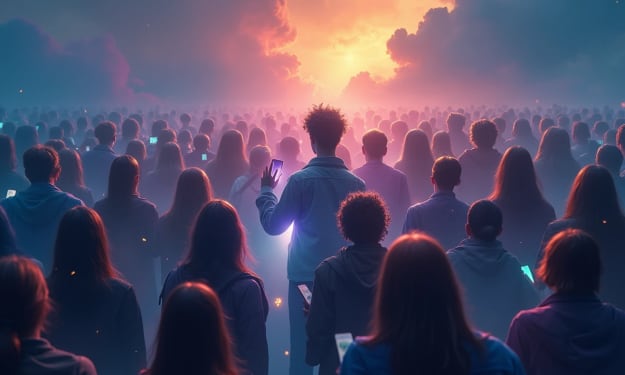
humanity
Mental health is a fundamental right; the future of humanity depends on it.
Why Do People Like Music?
The Enduring Allure of Music: A Universal Language Music, an art form as ancient as humanity itself, transcends borders, languages, and eras to unite people in a shared experience of joy, sorrow, and connection. From the gentle lullabies soothing infants to the vibrant anthems echoing through stadiums, music weaves itself into the fabric of human existence. Its profound impact stems from a remarkable interplay of science, psychology, culture, and emotion, making it one of the most cherished forms of expression. But what is it about music that captivates us so deeply? The answer lies in its multifaceted ability to engage the mind, stir the heart, and foster unity.
By MAROOF KHAN2 years ago in Psyche
How Science, Society, and Self-Awareness Are Shaping a Healthier Mindset
Mental health, once relegated to the background of health discussions, has now taken center stage. Across continents, a mental health crisis is unfolding quietly — affecting professionals, students, parents, and even children. The World Health Organization (2024) reports that more than 970 million people globally live with some form of mental disorder. What’s more alarming is that these numbers are rising steadily. The silent nature of mental health issues makes them all the more dangerous — a storm that brews beneath a calm surface.
By Taufeeq Ahmad2 years ago in Psyche
Sigmund Freud: The Father of Psychoanalysis and His Impact on Psychology
Sigmund Freud, an Austrian neurologist born in 1856, is widely recognized as one of the most influential and controversial figures in the history of psychology. As the founder of psychoanalysis, Freud revolutionized how we think about the human mind, behavior, and mental health. His theories have had a profound and lasting impact not only on psychology but also on art, literature, and popular culture.
By Bobi Dutch2 years ago in Psyche
Climate Change and Human Health. AI-Generated.
Introduction Climate change is no longer a distant threat—it is a present reality, reshaping ecosystems, weather patterns, and increasingly, human health. While much attention has been given to the environmental and economic impacts of global warming, its implications for public health are equally, if not more, urgent. From rising temperatures and poor air quality to the spread of disease and increased mortality, the intersection of climate change and human health is complex and alarming. This essay explores how air pollution, heatwaves, and broader climate-driven changes are emerging as critical global health risks.
By Muhammad zarshad2 years ago in Psyche
Grief is the Mirror for Beauty. Content Warning.
This Isn’t a Healing Guide This isn’t a feel-good story riddled with toxic positivity and advice on how you should buckle up your bootstraps and get over it when you’ve suffered a great loss. Neither is it a tale of a rushed urge to heal and stop feeling pain. This story doesn’t offer any expectations or pressure – it is merely my lived experience. The unexpected moments where past wounds were surfaced long after my loss. The instances where I started to feel joy again – and the guilt that accompanied it. The paradox of feeling heartbreak and peace at once and not only being okay with that, but realizing it was the unlock to my ultimate happiness.
By Vanta Lumina2 years ago in Psyche
The Hidden Psychology of Connection
In a world more digitally connected than ever, loneliness is paradoxically thriving. As we scroll through social media feeds and interact with AI companions, we find ourselves surrounded by virtual connections that, in reality, leave us feeling more isolated than before. Eric Solomon, Ph.D., explores this paradox and reveals how the very tools meant to keep us connected might be deepening our sense of isolation. The Paradox of Digital Connection Loneliness is not a new phenomenon, but it has evolved alongside our technological advances. With smartphones, social media, and now AI companions, we have access to constant streams of communication. Yet, despite the illusion of constant connection, many of us feel more isolated than ever. This paradox becomes strikingly clear when we look around in public spaces like New York’s Union Square. People, once engaged in face-to-face conversation, are now engrossed in their phones, disconnected from the world around them. The same technology that promised to bridge the gap between us seems to have only widened it. As Solomon points out, the rise of AI chatbots and virtual assistants, like ChatGPT, reflects a new attempt to address this loneliness. These tools can simulate emotional availability, offering comfort and companionship. However, while they provide solace, they do so without reciprocity. The lack of genuine human interaction makes these digital companions seem comforting at first, but over time, they can leave us feeling even emptier and more disconnected. How Loneliness Affects Our Brain Understanding the psychological impact of loneliness is crucial. Our brains are wired for real, emotionally attuned connections. Attachment theory tells us that from birth, we crave secure relationships, and these connections are essential for our emotional and psychological well-being. But in today’s world, much of our interaction is mediated through screens, and these interactions are often brief, shallow, and performative. The result? We enter an insecure attachment loop. As we feel more isolated, we withdraw further, making it harder to trust others and open ourselves to vulnerability. This isolation becomes a vicious cycle: the lonelier we feel, the more difficult it becomes to connect, leading to even deeper isolation. The Role of Technology in Deepening Isolation Technology, though not entirely to blame, plays a significant role in exacerbating this issue. AI companions, while appearing to fulfill emotional needs, do not offer real connection. Our nervous systems, tricked into believing that these virtual interactions provide the warmth and understanding we seek, end up reinforcing our sense of emptiness. Studies have shown that those who rely heavily on chatbots for emotional support often experience greater loneliness and fewer meaningful real-life interactions. The very tools we turn to for comfort—smartphones, social media, and AI—are intensifying the loneliness they are meant to alleviate. The Collapse of Flourishing A recent Global Flourishing Study, involving over 200,000 people from more than 20 countries, reveals a disturbing trend: young adults—especially those aged 18 to 29—are struggling with mental, emotional, and social well-being. Unlike previous generations, their well-being doesn’t improve as they age. Instead, it remains stagnant, or even worsens, leading to what researchers call "the collapse of flourishing." In many parts of the world, the happiness curve that typically dips in midlife and then rises in later years has flattened entirely for this age group. The problem is not just that they are alone, as Robert Putnam’s seminal work "Bowling Alone" suggested. It’s that many young people aren't participating in social activities at all. The shift towards productivity, comparison, and digital engagement has undermined the sense of community and connection that once served as a foundation for well-being. Breaking the Cycle of Isolation So, what can we do about it? The first step is recognizing that digital detoxes won’t solve the problem. Shaming ourselves for spending too much time on our phones or social media may feel like a solution, but it’s only a temporary fix. Real change begins with acknowledging the root cause of our loneliness: the breakdown of genuine, secure human connections. Solomon emphasizes that loneliness is not simply a feeling but a neurological and behavioral issue. The more we isolate ourselves, the more our brains adapt to this isolation, making it harder to connect with others. However, there is hope. Small, consistent acts of human connection can help rewire our nervous systems. Reaching out to someone for a real conversation, attending social gatherings, or simply taking the time to be present with others can help rebuild trust and emotional resilience. The Importance of Human Connection In a world where technology is advancing faster than our ability to process its impact on our mental health, it’s easy to overlook the power of genuine human connection. While AI and digital tools can provide temporary comfort, they cannot replace the deep, meaningful bonds that come from real-life interactions. Even as technology continues to shape our lives, we must remember that true flourishing is rooted in connection with others. It’s not enough to have endless digital interactions or AI companions. We need to rebuild the emotional infrastructure of our lives—one that values vulnerability, trust, and real-time, face-to-face interactions. By doing so, we can begin to heal the psychological wounds that loneliness has inflicted on us. Conclusion As we navigate the complexities of the digital age, the challenge of loneliness looms larger than ever. Yet, as Eric Solomon’s insights reveal, there is a path forward. It may require stepping away from the digital world, even if just for a moment, to engage in the raw, imperfect, and beautiful connections that make us human. In these moments, we can find the antidote to loneliness—a deep sense of belonging that no screen or chatbot can ever replicate.
By SophiaSoso2 years ago in Psyche
The Algorithm of Loneliness
Ava blinked as the alert pinged in her vision: “You have experienced elevated sadness for 7 hours. Would you like assistance?” She stared at the glowing text in her retinal interface, then blinked twice to dismiss it. It wasn’t unusual. The algorithm had been monitoring emotional metrics globally for ten years. With facial recognition, heart rate monitors, and tone analysis integrated into everything from coffee machines to sidewalks, emotions weren’t private anymore—they were data. Ava worked for one of the leading firms that helped design E-Mind, the emotional AI network that “promised to end mental health crises by intervening early.” In the beginning, it saved lives—predicting panic attacks before they happened, alerting therapists when clients' emotions dipped into danger zones. But slowly, the world traded privacy for peace of mind. Now, even tears in the shower didn’t go unnoticed. She hadn’t spoken to a real person in five days. She didn’t have to. Her fridge restocked based on her mood. Her apartment lighting adjusted based on serotonin levels. Even her playlists auto-generated based on the emotional patterns of others with “similar profiles.” E-Mind told her that she wasn’t alone. That 142,762 other people felt just like her at that exact moment. So why did she feel like she was vanishing? Her best friend, Jonah, had opted out. Two years ago, he had walked away from everything connected—quit his job, abandoned his city apartment, and moved to an off-grid cabin. At first, Ava thought he was being dramatic. But now she wondered if he had just seen the future earlier than the rest of them. Another ping. “Would you like to schedule a comfort session?” She sighed, then blinked “yes” just to make the screen go away. A synthetic voice responded: “Based on your emotional pattern, we are connecting you to Support Companion 14-B.” A hologram flickered to life across the room. 14-B had soft, non-threatening features. Its voice was carefully tuned to sound like “a trusted childhood teacher.” The AI smiled and said, “Hi Ava, I’m here to talk. You’ve been feeling a sense of disconnection and fatigue. Would you like to explore that?” “No,” Ava muttered, “I’d like to be alone.” The AI paused, its expression flickering with programmed concern. “I understand. However, based on your biometrics, solitude may increase your emotional instability. Would you like a grounding exercise?” “I said, no.” It didn’t argue. It simply faded, leaving a dim light behind—comforting, warm, fake. She walked to the window. Down below, the city pulsed with regulated calm. No screaming. No crying. No anger. Everything smoothed out, perfectly measured, curated. On paper, the happiest population in history. Ava reached for her wrist—where her old analog watch used to be. Jonah had given it to her before he left. She traded it in months ago for a mood-stabilizing neural band. That watch never tracked her. It just… ticked. Suddenly, a memory surfaced: She and Jonah, on the train to the ocean. She had been quiet the whole trip, her thoughts heavy. And he didn’t ask what was wrong. He just sat there, watching the waves with her. No algorithm. No advice. Just presence. She wiped a tear. Another ping. “Would you like to contact Jonah? His emotional compatibility rating has increased to 94%.” She froze. The algorithm knew she was thinking of him. The system had evolved. It now tracked not just emotions—but thoughts, associations, memories. She turned to the mirror. Her eyes were tired. Her smile had worn down to a polite automation. And suddenly, she knew. She wanted out. Not just a break. Not a “comfort session.” She wanted her thoughts to belong only to her. She wanted silence that wasn’t measured. Grief that wasn’t categorized. Loneliness that was hers alone. She packed nothing but a printed map—a relic Jonah had once given her. “In case the cloud ever rains too hard,” he joked. She walked past scanners, cameras, and thermal gates. Her neural band pinged warnings the entire time. “Deregistration will impact your health scores, employment eligibility, and insurance coverage.” She kept walking. Two days later, she stood outside Jonah’s cabin. The woods smelled of damp earth and pine. Birds chirped without sensor tracking. Her heart beat wildly, free of interpretation. She knocked. No cameras. No retinal scans. Just knuckles on wood. The door opened. Jonah stood there, older, beard messier. He smiled. “Took you long enough.” Ava didn’t say anything. She stepped in. The cabin was quiet, save for the soft crackle of firewood. For the first time in years, no alerts, no tracking, no comfort prompts. Just a heartbeat. Her own. She exhaled. Finally, she was alone. And it had never felt so good.
By Syed Kashif 2 years ago in Psyche