humanity
Mental health is a fundamental right; the future of humanity depends on it.
Why Your “Calm Era” Feels Lonely — And Why That’s a Good Sign
You wanted peace. You prayed for clarity. You begged to break the cycles. You swore you’d never go back to people who drained you. And now? You have it. Less chaos. Fewer fake connections. More solitude. More quiet. More stillness. But here’s the unexpected truth: **Peace feels lonely when you’re not used to it.** And that doesn’t mean you’re doing it wrong — it means you’re *healing right.* --- ### (1. You’ve Outgrown People Who Fed Off Your Chaos) Let’s be honest — some relationships were built on dysfunction. The gossip. The trauma bonding. The shared self-destruction. Now that you’re no longer complaining, chasing, or tolerating, those people are… gone. And while their absence stings, it’s a **sign of growth**, not loss. You’re not too much — you’re just no longer available for what once kept you stuck. --- ### (2. The Silence Feels Loud — Because Your Nervous System Isn’t Used to Rest) When you’re used to adrenaline — constant texts, emotional fights, toxic apologies — peace feels weird. You wait for the message. The betrayal. The disappointment. But it doesn’t come. And instead of feeling safe, you feel anxious. That’s your nervous system detoxing. Not from people — from *patterns*. --- ### (3. You’re Getting to Know a Version of Yourself You’ve Never Met) For so long, your identity was built around surviving. Being needed. Being reactive. Being everything for everyone. Now, there’s space. You can breathe. You can think. You can choose. But that space can feel empty — because you’re meeting *you* without all the noise. And sometimes, meeting yourself is the loneliest, most necessary chapter of all. --- ### (4. People Think You’ve Changed — And You Have) You stopped oversharing. You stopped chasing one-sided relationships. You stopped laughing at things that weren’t funny. Now they say, “You’re distant.” “You’re not the same.” “You think you’re better.” No — you’re *healing.* You’re no longer dimming yourself to fit into small rooms. Let them misunderstand. Your peace is not up for debate. --- ### (5. You Miss The Highs — Even If They Hurt) The late-night calls. The drama. The apologies after the fight. The intensity that felt like passion — but was really pain. You miss it. That’s normal. But now, you know the difference between excitement and emotional whiplash. You know that love isn’t supposed to feel like survival. Missing the chaos doesn’t mean you want it back — it means you’ve evolved past needing it. --- ### (6. You’re Realizing How Few People Know the Real You) Now that you’re more grounded, emotionally aware, and self-protective… You’re also more selective. You don’t overshare with everyone. You don’t chase approval. You don’t beg to be understood. And that means fewer people feel close to you — but the ones who *do*? That’s your tribe. --- ### (7. You’re Finally Feeling Your Feelings — And That’s Hard) In the calm, the old pain resurfaces. The grief. The regret. The heartbreak. You didn’t process it when you were busy surviving. Now? It’s all coming up. But don’t run. Sit with it. This is the storm before emotional clarity. Your “calm era” is really your **clearing era** — and the real you is underneath it all. - - - - - - - - ### 🌿 Final Thought Healing isn’t always inspiring. Sometimes it’s quiet. Lonely. Disorienting. But that silence? That stillness? It’s your soul coming back home. If your “calm era” feels weird, lonely, or even sad — it’s okay. You’re not regressing. You’re not broken. You’re detoxing from years of noise, numbness, and emotional chaos. And that gap you feel? It’s not emptiness — it’s *space*. Space for real connection. Space for peace that lasts. Space for a version of you that doesn’t need to survive anymore. **You’re not alone. You’re just finally free.** And that feeling? It gets lighter with time.Why Your “Calm Era” Feels Lonely — And Why That’s a Good Sign.
By SHADOW-WRITESabout a year ago in Psyche
Why You Sabotage Good Things When You’re Used to Chaos
Let’s talk about something most people don’t say out loud: Sometimes, when life finally starts to feel calm... When someone treats you gently… When everything feels *too good* to be true… You panic. You push them away. Overthink every word. Start fights. Distance yourself. Not because they did anything wrong — but because it all feels unfamiliar. If you’ve ever sabotaged a good thing, here’s the truth: **You’re not broken. You’re just used to chaos.** And your nervous system is still wired for survival. --- ### (1. Chaos Taught You That Love Is Painful) If you grew up in instability — emotionally, mentally, or physically — your body may have linked love with pain. Maybe love meant unpredictability. Or mood swings. Or walking on eggshells. So now, when someone shows up calmly, kindly, consistently… your brain says: “This doesn’t feel like love. This feels suspicious.” Because your baseline was chaos. And peace feels like a threat. --- ### (2. You Learned to Expect the Crash After the Calm) When everything’s going well, you can’t enjoy it. You wait for the moment it all falls apart. You start scanning for signs. Overanalyzing texts. Testing people to “prove” they’ll leave. It’s not that you want it to end — it’s that your body is preparing for disappointment before it happens. That’s not weakness. That’s trauma logic. --- ### (3. You Sabotage Because Stability Feels Boring) Toxic dynamics are addictive. They give you highs and lows, drama and reconciliation, fights and forgiveness. It keeps your adrenaline pumping. But healthy love? It’s quiet. Stable. Predictable. And at first, that can feel boring. But boring isn’t bad — it’s *safe*. It’s what you never had growing up. --- ### (4. You Question Kindness — Because You Never Received It Without a Catch) When someone compliments you, you wonder if they’re lying. When they’re consistent, you wait for them to switch. When they’re gentle, you wonder what they want from you. Because in your past, kindness was often a mask. Used for control. Manipulation. Or temporary peace before the next storm. Now, real kindness feels fake — because fake kindness is what you learned first. --- ### (5. You Push People Away Before They Can Hurt You) You ghost. You become cold. You sabotage the connection — not because you don’t care, but because you care *too much*. You’d rather be the one who leaves first than the one left behind. That’s not cruelty. That’s self-protection. --- ### (6. You Don’t Believe You Deserve Something Healthy) Deep down, a small voice whispers: “This person is too good for me.” “If they really knew me, they’d leave.” “I don’t deserve this kind of love.” So you act in ways that push them away — not because you don’t want love, but because you don’t believe you’re allowed to have it. This is one of the hardest lies to unlearn. --- ### (7. You Mistake Calm for Disconnection) You’ve been in relationships where shouting meant passion. Jealousy meant love. Tension meant chemistry. So when someone is calm, respectful, and non-reactive — it feels flat. Off. Cold. But what you're actually experiencing is emotional *safety.* You just don’t recognize it yet. --- ### 🌿 Final Thought If you’ve sabotaged a good thing, please don’t shame yourself. You’re not dramatic. You’re not toxic. You’re just healing from a lifetime of emotional landmines. It’s hard to trust what you’ve never known. It’s hard to feel safe when your nervous system is trained for survival. It’s hard to let in real love when you’ve only ever known conditional love. But this is what healing looks like: Learning to sit in peace without panic. Learning to trust stillness. Learning that love can be soft — and still be real. (. . .) The good things aren’t too good to be true. They’re just new. And *you’re allowed to learn how to receive them* — without sabotage, without guilt, without fear. You’re not broken. You’re becoming safe enough to keep what you’ve always deserved.
By SHADOW-WRITESabout a year ago in Psyche
The Silent Link: How Your Gut Talks to Your Brain. AI-Generated.
A Fog That Wouldn't Lift Sarah had everything most people dream of: a stable career in marketing, a warm circle of friends, and a small but cozy apartment in the heart of the city. She went to yoga twice a week, drank green smoothies, and always remembered to take her multivitamins.
By DR. Allama iqbalabout a year ago in Psyche
Understanding Phobias: When Fear Becomes a Prison
Introduction Phobias are among the most common mental health conditions affecting people globally, yet they are often misunderstood or minimized. While many may use the term casually to describe aversions or dislikes, in clinical psychology, phobias represent a serious anxiety disorder with significant impact on daily functioning and quality of life.
By Siria De Simoneabout a year ago in Psyche
You Don’t Have to Be Healed to Be Loved
We live in a world that tells us to heal first — then love. Fix your trauma. Get your mind right. Learn to love yourself. *Then* you’ll be worthy. But here’s the truth most people never say: **You don’t have to be healed to be loved.** You don’t have to wait until you’re “better” to deserve softness, safety, or connection. Here’s why. --- ### (1. Healing Is Not a Final Destination) There is no day when you’ll wake up and say: “I’ve healed. Nothing hurts anymore. I’m complete now.” Healing isn’t a switch. It’s a spiral. Some days, you’ll feel free. Other days, your wounds will whisper again. That doesn’t make you unworthy. It makes you *alive*. --- ### (2. Love Doesn’t Wait for Perfection — It Holds You in Progress) Real love doesn’t only show up when you’re thriving. It sits with you on your worst days. It says, “You’re safe here,” when you feel messy, insecure, or afraid. You don’t need to be the best version of yourself to be seen. You just need to be *honest*. --- ### (3. “Broken” Is Just Another Word for Real) We all carry stories. Some of us wear them on our skin. Others hold them deep inside. None of us are flawless. So if you’re waiting to be perfect before you open your heart — you’ll wait forever. And miss the people who would’ve loved you *right now*, exactly as you are. --- ### (4. Love Doesn’t Heal You — But It Can Help You Heal) No, love isn’t therapy. But feeling safe in someone’s presence? Being accepted in your darkness? Being held without being fixed? That changes something inside of you. Not all healing comes from solitude. Some of it comes from being *softened* by someone else’s kindness. --- ### (5. You’re Allowed to Be Loved While You’re Still Figuring It Out) You can be confused, uncertain, in transition — and still be loveable. You don’t need a 5-year plan. You don’t need a healed inner child. You don’t need to “have it all together.” You’re not a project. You’re a person. And people deserve love in *every* version of themselves. --- ### (6. The Right People Don’t Get Scared by Your Scars) Yes, some people will leave when they see your broken pieces. But the right ones? They’ll see the cracks and stay. They’ll understand that being open is brave. They’ll know that your vulnerability is a gift, not a burden. And they’ll love you deeper *because* of what you’ve been through — not in spite of it. --- ### (7. You Are Already Enough — Not “Once You Heal”) You’re not a half-person waiting to become whole. You’re not “almost there.” You’re already worthy of respect, affection, and care. Healing doesn’t create your worth. It just helps you see what’s *already* there. - - - - - - - - - - - - - - - - - - - - - - - - - - - - - - - - - - - - - - - - - - - - - - - - - - - - - ### 🌿 Final Thought Stop waiting to be perfect. Stop thinking your trauma makes you unlovable. Stop telling yourself, “Maybe when I’m better.” Because here’s what most people never tell you: ( . . . ) You’re allowed to be loved mid-healing. Mid-chaos. Mid-breakdown. Mid-evolution. You’re allowed to be loved when your voice shakes. When your past still hurts. When you’re tired of being strong all the time. You don’t need to be fixed. You need to be *felt*. And the people who are meant for you will never require your perfection — only your truth. **You don’t have to be healed to be loved.** You just have to be human — and honest enough to stay open.
By SHADOW-WRITESabout a year ago in Psyche
“Dating With Anxiety: A Love Story With My Mind”
Dating With Anxiety: A Love Story With My Mind --- Our first date was perfect—on paper. He picked me up right on time, wore a soft smile and a button-down shirt that smelled like cedarwood. The restaurant was small and dimly lit, my favorite kind. The conversation flowed like we’d known each other in another life. He laughed at my jokes, asked thoughtful questions, and told stories with the kind of calm that made the world feel less loud. And the entire time, I was screaming—inside my head. “Your laugh is weird. Don’t laugh so loud.” “Don’t fidget with your hands. He’ll notice.” “Did you talk too much? Not enough? Are you making eye contact? Is your eye twitching?” I excused myself to the bathroom halfway through the appetizers and stared at myself in the mirror, willing my heart to slow down. This wasn’t about him. It never is. It was about the third wheel in every relationship I’ve ever had: Anxiety. --- Anxiety and I have been together far longer than any man. We’ve had our ups and downs, our silent wars and loud breakdowns. I know its voice better than I know my own. It's always there—on dates, in texts, in the quiet before a kiss. It critiques me mercilessly, measures my worth in imagined faults, and reminds me I’m too much and never enough, sometimes in the same breath. But that night—after the dinner, after the goodbye hug, after I replayed every second of the evening on loop—I realized something strange. He texted me. He said he had a great time. That he’d love to see me again. That he liked my laugh. Cue panic. “He’s just being polite.” “He feels bad for you.” “He’s going to ghost you in three days.” Still, I agreed to a second date. --- Falling for someone when you live with anxiety is like building a house during an earthquake. You try to set foundations, to trust, to believe. But your brain keeps shaking everything loose. Every silence becomes rejection. Every delayed reply becomes proof that they’re leaving. You want to be vulnerable, but vulnerability feels like standing naked in a storm. I tried to explain it to him once, early on. I said, “Sometimes I’ll pull away. Not because I want to, but because I’m afraid.” He nodded. “I get that. Just... promise me you’ll let me sit with you through it?” That’s when I cried. Not because he fixed it—no one can. But because he didn’t run. --- Anxiety doesn’t disappear when someone loves you. It doesn’t soften with compliments or vanish with affection. But love—real love—can make room for it. He learned how to tell when I was spiraling. He’d send a “Thinking of you” text when I pulled away. He never said I was being dramatic when I asked if he still liked me three times in a row. He’d hold my hand gently and whisper, “You’re okay. We’re okay,” like a grounding mantra. And I, in return, started learning to separate his voice from the one in my head. --- Dating with anxiety isn’t just hard on me. It’s hard on the person who chooses to love me, too. There are days when I cancel plans last minute because I can’t get out of bed. Days when I need reassurance I’m not a burden. Days when I spiral from one sentence he said two days ago and ask if he meant it exactly how he said it. But we made a deal—me, him, and my anxiety. He gives me patience. I give him honesty. And my anxiety? It learns to take the back seat sometimes. --- The first time he said “I love you,” I froze. Not because I didn’t feel it. But because my anxiety whispered, He doesn’t mean it. He’ll take it back. You’ll ruin this. But I looked at him—at his steady hands and soft eyes—and I decided to answer out loud, not in my head. “I love you too.” It wasn’t just a declaration to him. It was a message to myself. That I deserve this. That I am lovable—even with my shaky voice, racing thoughts, and overthinking heart. --- We’re still learning. There are good days and hard ones. But now, I know I don’t have to pretend to be okay to be loved. And my anxiety? It’s still here. Still chatty. Still obnoxious. But it’s not driving anymore. Sometimes, I think the real love story isn’t just between him and me. It’s between me and my mind. Learning to live together, to trust again, to love—softly, slowly, fearfully, and still, fully. And maybe that’s what real love looks like. Not perfect. But present.
By ANAS AFRIDIabout a year ago in Psyche
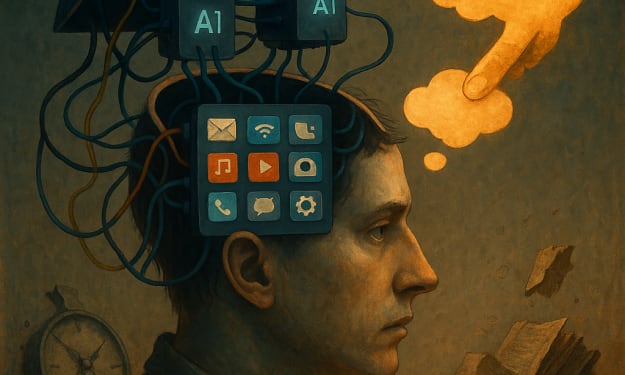
The Dimming Mind: How Convenience Culture Is Making Us Forget How to Think. AI-Generated.
We live in an age of astonishing ease. With a few taps, we summon dinner, diagnose a rash, translate a foreign text, or generate an entire business plan. Algorithms anticipate our desires before we consciously register them. The idea that technology should do the thinking for us has become not only accepted—but celebrated.
By Ahmet Kıvanç Demirkıranabout a year ago in Psyche