how to
How to cope with your emotions, maintain mental health, deal with life's stressors and help others do the same.
You Don’t Have to Be Healed to Be Loved
We live in a world that tells us to heal first — then love. Fix your trauma. Get your mind right. Learn to love yourself. *Then* you’ll be worthy. But here’s the truth most people never say: **You don’t have to be healed to be loved.** You don’t have to wait until you’re “better” to deserve softness, safety, or connection. Here’s why. --- ### (1. Healing Is Not a Final Destination) There is no day when you’ll wake up and say: “I’ve healed. Nothing hurts anymore. I’m complete now.” Healing isn’t a switch. It’s a spiral. Some days, you’ll feel free. Other days, your wounds will whisper again. That doesn’t make you unworthy. It makes you *alive*. --- ### (2. Love Doesn’t Wait for Perfection — It Holds You in Progress) Real love doesn’t only show up when you’re thriving. It sits with you on your worst days. It says, “You’re safe here,” when you feel messy, insecure, or afraid. You don’t need to be the best version of yourself to be seen. You just need to be *honest*. --- ### (3. “Broken” Is Just Another Word for Real) We all carry stories. Some of us wear them on our skin. Others hold them deep inside. None of us are flawless. So if you’re waiting to be perfect before you open your heart — you’ll wait forever. And miss the people who would’ve loved you *right now*, exactly as you are. --- ### (4. Love Doesn’t Heal You — But It Can Help You Heal) No, love isn’t therapy. But feeling safe in someone’s presence? Being accepted in your darkness? Being held without being fixed? That changes something inside of you. Not all healing comes from solitude. Some of it comes from being *softened* by someone else’s kindness. --- ### (5. You’re Allowed to Be Loved While You’re Still Figuring It Out) You can be confused, uncertain, in transition — and still be loveable. You don’t need a 5-year plan. You don’t need a healed inner child. You don’t need to “have it all together.” You’re not a project. You’re a person. And people deserve love in *every* version of themselves. --- ### (6. The Right People Don’t Get Scared by Your Scars) Yes, some people will leave when they see your broken pieces. But the right ones? They’ll see the cracks and stay. They’ll understand that being open is brave. They’ll know that your vulnerability is a gift, not a burden. And they’ll love you deeper *because* of what you’ve been through — not in spite of it. --- ### (7. You Are Already Enough — Not “Once You Heal”) You’re not a half-person waiting to become whole. You’re not “almost there.” You’re already worthy of respect, affection, and care. Healing doesn’t create your worth. It just helps you see what’s *already* there. - - - - - - - - - - - - - - - - - - - - - - - - - - - - - - - - - - - - - - - - - - - - - - - - - - - - - ### 🌿 Final Thought Stop waiting to be perfect. Stop thinking your trauma makes you unlovable. Stop telling yourself, “Maybe when I’m better.” Because here’s what most people never tell you: ( . . . ) You’re allowed to be loved mid-healing. Mid-chaos. Mid-breakdown. Mid-evolution. You’re allowed to be loved when your voice shakes. When your past still hurts. When you’re tired of being strong all the time. You don’t need to be fixed. You need to be *felt*. And the people who are meant for you will never require your perfection — only your truth. **You don’t have to be healed to be loved.** You just have to be human — and honest enough to stay open.
By SHADOW-WRITESabout a year ago in Psyche
The Commander Within
*Title:* *The Commander Within* *Subtitle:* *Mastering the mind to lead the body* In a quiet village nestled between forests and hills, lived a young boy named *Raheel*. He was known for his short temper, restless habits, and impulsive actions. If he was angry, he would yell. If he was scared, he would freeze. If he was bored, he’d fidget endlessly. People liked him, but often said, “Raheel acts before thinking.” One day, an old sage named *Peer Zaman* visited the village. He was known across the land for helping people unlock their true potential by teaching them one powerful secret: *how to control the body through the brain*. Raheel, curious and restless, went to see him. Peer Zaman asked him a simple question, “Raheel, who controls your body?” Raheel replied, “Of course, I do.” The sage smiled. “Then why do your hands move without reason when you're nervous? Why do your eyes cry when you're angry, and your mouth shouts before your mind can decide?” Raheel was silent
By Ibrahim physicistabout a year ago in Psyche
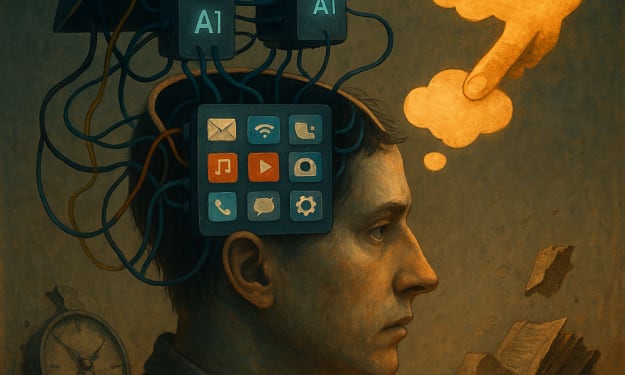
The Dimming Mind: How Convenience Culture Is Making Us Forget How to Think. AI-Generated.
We live in an age of astonishing ease. With a few taps, we summon dinner, diagnose a rash, translate a foreign text, or generate an entire business plan. Algorithms anticipate our desires before we consciously register them. The idea that technology should do the thinking for us has become not only accepted—but celebrated.
By Ahmet Kıvanç Demirkıranabout a year ago in Psyche
Trapped in Loops: Making Sense of Obsessive-Compulsive Disorder
Introduction Obsessive-Compulsive Disorder (OCD) is one of the most misunderstood and often misrepresented mental health conditions in modern discourse. Though the term is frequently tossed around casually to describe someone who likes cleanliness or order, true OCD is far more complex and debilitating. It is a chronic mental disorder marked by intrusive thoughts (obsessions) and repetitive behaviors or mental acts (compulsions) that an individual feels driven to perform. These symptoms can significantly interfere with a person’s daily life, relationships, and emotional wellbeing.
By Siria De Simoneabout a year ago in Psyche
Why Park Homes South West Is the Perfect Place to Call Home
If you're dreaming of a lifestyle that blends comfort, community, and countryside charm, Park Homes South West could be the perfect place to call home. Nestled in some of the most scenic areas of South West England, these homes offer a unique way to enjoy modern living without the stress or cost of traditional property ownership.
By Willowbrook Park Homesabout a year ago in Psyche
Sensory Toys and Spaces
As more awareness about neurodiversity becomes available, so too does understanding and acceptance of places and things to accommodate it. As an autistic person, I have watched places grow and develop new programs and services for the neurodivergent community as I have grown up. They were rare to unheard of when I was growing up in rural California. Particularly libraries were pioneers in creating these spaces or allowing check-outs of fidget and sensory toys. But as time progresses and I'm seeing more and more acceptance, I have started to see such spaces pop up in festivals and conventions as well. There will, in these cases, usually be a quiet room filled with sensory toys and/or weighted blankets.
By Minte Staraabout a year ago in Psyche
Silent Hands, Loud Truth
In a small town wrapped in foggy mornings and quiet streets, lived a boy named Haris. He was eight years old, with soft brown eyes and a silence deeper than the sea. No one really knew him. His classmates barely noticed his presence. Teachers marked his attendance, but he was just a shadow in the corner—always quiet, always watching, always hiding.
By ArshNaya Writesabout a year ago in Psyche
The Psychology of Bullying: What Drives Aggression and How We Can Break the Cycle
Introduction: Why Understanding Bullying Matters Bullying is more than just a series of isolated incidents of aggression or cruelty. It is a psychological, social, and sometimes systemic phenomenon that has lasting effects on both the victims and the perpetrators. While often associated with childhood and adolescence, bullying can persist into adulthood and manifest in workplace dynamics, online interactions, and social hierarchies.
By Siria De Simoneabout a year ago in Psyche