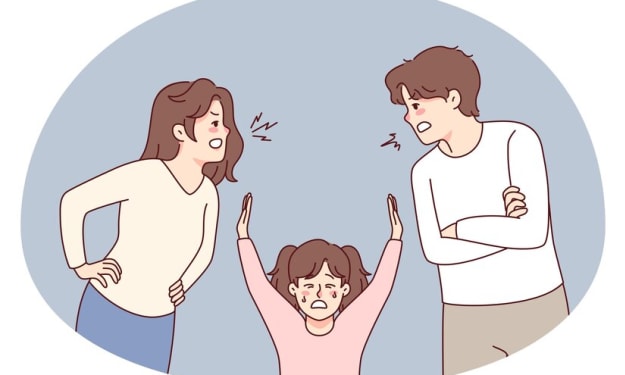
family
Family can be our support system. Or they can be part of the problem. All about the complicated, loving, and difficult relationship with us and the ones who love us.
When I Finally Stood Up For Myself
For most of my life, I was the quiet one. The agreeable one. The one who said "yes" even when I meant "no." I wore my silence like armor—polite, helpful, easy to be around. I thought it made me lovable. And maybe it did, but only to people who benefited from my silence.
By Muhammad Sabeelabout a year ago in Psyche
The Eldest Daughter Syndrome: I Was the Second Mom, Not the Sister
There’s something funny about being the eldest daughter in a brown household — you’re not just the firstborn. You’re the test run, the third parent, the role model, and somehow, the family’s unofficial emotional manager.
By Tavleen Kaurabout a year ago in Psyche
The Illusion of the Snake: A Lesson on Mind, Perception, and Healing
It is said that a man once visited the great philosopher Rumi. The philosopher warmly welcomed him and invited him to join him for a meal. As they sat together, Rumi served soup to his guest. When the man began to drink the soup, he suddenly noticed something strange. In the bowl, he saw what appeared to be a small snake-like creature floating in the broth. Shocked and disturbed, he froze for a moment. However, out of embarrassment and respect for the philosopher, he chose not to say anything. He didn’t want to offend Rumi or seem rude by rejecting the food. So, he gathered his courage and continued drinking the soup, pretending as if everything was normal. Although he forced himself to finish the meal, a deep sense of discomfort remained in his heart. Later that evening, the man returned home. But he couldn't shake off the feeling that he had consumed something dangerous. The image of the snake-like figure in the bowl haunted him. The more he thought about it, the more distressed he became. By nightfall, he started feeling a severe pain in his stomach. He couldn't sleep due to the intensity of the discomfort. Thoughts swirled in his mind: What did I eat? Was it really a snake? What if I’ve been poisoned? As soon as the sun rose, he rushed back to Rumi, desperately seeking help or a cure. Holding his stomach and visibly anxious, he told the philosopher about the pain and what he had seen in the soup. Rumi listened calmly and smiled gently. Then he said, “There was no snake in the soup. What you saw wasn’t real—it was merely a shadow.” The philosopher then invited the man to sit again. He took the same bowl and poured soup into it once more. As the man looked inside, he again saw the same snake-like figure. But this time, Rumi pointed upward toward the ceiling. The man looked up and saw a painted image of a snake on the roof of the room. When he realized it, everything became clear. What he had seen was not a real snake but merely the reflection of the ceiling painting in the soup. This discovery left the man stunned. At that very moment, his stomach pain vanished completely. The fear and stress that had caused his physical illness disappeared instantly. It became evident that his suffering was not caused by any physical poison, but by his own thoughts—by the illusion that had taken root in his mind. This story powerfully illustrates the influence of perception and the human mind on physical well-being. The snake never existed in reality—it was entirely a creation of the man's imagination. And yet, it had the power to cause genuine physical pain. The mind believed it to be real, and the body reacted accordingly. This phenomenon is known as psychosomatic illness, where the mind, overwhelmed by anxiety, fear, or stress, influences the body so strongly that it begins to exhibit symptoms of actual disease. The man believed he had consumed something harmful, and that belief alone triggered a physiological response—pain, anxiety, insomnia—all without any real cause. Such is the power of imagination and fear. They can turn harmless situations into terrifying experiences and even make a healthy person feel ill. It also teaches us a broader life lesson: not everything we perceive is necessarily true. Often, what we consider threats or problems are just illusions created by our own minds. That’s why the great Muslim philosopher and physician Ibn Sina (Avicenna) wisely said: "Wahm aadha marz hai, itminaan aadhi dawa hai, aur sabr shifa ki pehli seedhi hai." "Illusion is half the disease, reassurance is half the cure, and patience is the first step toward healing." His words carry timeless wisdom. Many illnesses begin in the mind. If a person allows fear, worry, or negative assumptions to grow unchecked, they can manifest in physical form. On the other hand, calmness, reassurance, and patience can be as powerful as medicine in bringing healing. We often underestimate the effect of emotional and mental well-being on our physical health. Anxiety and stress can weaken the immune system, disturb digestion, affect sleep, and lead to numerous ailments. Conversely, a peaceful mind, supported by faith and positive thoughts, can accelerate recovery and strengthen resilience. This story also emphasizes the importance of clarity, communication, and observation. If the man had simply asked Rumi about what he saw, the misunderstanding could have been cleared immediately. But social pressure, embarrassment, or assumptions often keep us silent, making problems worse. In our daily lives, how often do we jump to conclusions without verifying the facts? How many times do we suffer in silence simply because of assumptions or fears that may not even be true? Therefore, this tale is more than just a short moral story—it is a deep reflection on human psychology. It encourages us to challenge our assumptions, seek clarity, communicate openly, and learn to manage our thoughts with wisdom. Ultimately, it reminds us that true healing begins not just with medicines, but with understanding, belief, and peace of mind.
By Ikram Ullahabout a year ago in Psyche
Crying Is for Girls: How Brown Boys Are Taught to Shut Down Emotion
If you’re a brown kid, you’ve probably heard it. “Don’t cry. Be strong.” “Stop acting like a girl.” “Boys don’t cry.” It’s subtle, but constant. The message is clear: vulnerability is weakness, and weakness is not for men. Especially not brown men.
By Tavleen Kaurabout a year ago in Psyche
When You Miss Someone, Do They Feel It Too?
When You Miss Someone, Do They Feel It Too? Have you ever sat alone, thinking about someone, and suddenly your heart feels heavy? Like a strange pull in your chest… and you wonder, "Are they thinking of me too?" You’re not alone in this feeling. So many people around the world feel the same at different moments. And you know what? Maybe right now, someone out there is missing you without even knowing why.
By Umar Khattakabout a year ago in Psyche
Respect Your Elders (Even If They’re Toxic): Decoding the Unspoken Rules in Brown Families
"Don’t talk back." "Say sorry first, even if you didn’t start it." “Keep your head down." If you grew up in a brown household, you know these phrases like the back of your hand. You probably didn’t even need to hear them out loud — the look in your mom’s eyes, the slight shift in your dad’s tone, the awkward silence after a family argument — said it all.
By Tavleen Kaurabout a year ago in Psyche