bipolar
Bipolar disorder; understanding the highs, the lows and the in between.
I Was Chasing Success Until I Realized I Was Already Happy
We all want to be successful. We scroll through Instagram and see others with expensive cars, perfect bodies, and dream vacations. We feel behind. So, we push harder—longer hours, more stress, less sleep.
By Umar Farooqabout a year ago in Psyche
The Complex Role of Dopamine in Our Lives: Understanding the Science Behind Pleasure and Motivation
*The Complex Role of Dopamine in Our Lives: Understanding the Science Behind Pleasure and Motivation* Dopamine is a neurotransmitter that plays a crucial role in our brain's reward and pleasure centers. It is often referred to as the "feel-good" hormone, and for good reason. Dopamine is released in response to pleasurable activities, such as eating, exercise, or social interactions, and it helps to motivate us to repeat those behaviors. However, when dopamine is released in excess or in response to artificial stimuli, such as social media or pornography, it can have negative consequences for our mental and physical health. *The Science Behind Dopamine* Dopamine is a chemical messenger that transmits signals between neurons in the brain. When we experience something pleasurable, dopamine is released, and it binds to dopamine receptors in the brain, producing a feeling of pleasure and satisfaction. This process is known as the brain's reward system, and it is essential for motivating us to engage in behaviors that are necessary for survival, such as eating and reproduction. However, the brain's reward system can be hijacked by artificial stimuli, such as social media, video games, or pornography. These stimuli can cause a rapid release of dopamine, leading to feelings of pleasure and addiction. Over time, the brain becomes accustomed to these artificial stimuli, and it requires more and more dopamine to feel the same level of pleasure. This can lead to a vicious cycle of addiction, where individuals become increasingly dependent on these stimuli to feel good. *The Consequences of Excessive Dopamine Release* Excessive dopamine release can have negative consequences for our mental and physical health. Some of the potential consequences include: - Addiction: Excessive dopamine release can lead to addiction, as individuals become dependent on the pleasurable feelings associated with dopamine release. - Decreased motivation: When dopamine is released in response to artificial stimuli, it can decrease motivation and interest in activities that do not provide a rapid dopamine release. - Decreased pleasure: Over time, the brain becomes accustomed to the artificial stimuli, and it requires more and more dopamine to feel the same level of pleasure. - Negative impact on mental health: Excessive dopamine release can contribute to mental health issues, such as depression, anxiety, and obsessive-compulsive disorder. *How to Manage Dopamine Levels* Fortunately, there are ways to manage dopamine levels and reduce the negative consequences of excessive dopamine release. Some strategies include: - *Dopamine detox*: Taking a break from artificial stimuli, such as social media or video games, can help to reset the brain's dopamine system. - *Engage in natural pleasures*: Engaging in natural pleasures, such as exercise, reading, or spending time with friends and family, can help to increase dopamine levels in a healthy way. - *Set clear goals*: Setting clear goals and working towards them can help to increase motivation and provide a sense of purpose. - *Practice self-care*: Practicing self-care, such as getting enough sleep, eating a healthy diet, and engaging in regular exercise, can help to support overall brain health. *The Importance of Self-Awareness* Self-awareness is critical in managing dopamine levels and reducing the negative consequences of excessive dopamine release. By being aware of our own behaviors and motivations, we can take steps to manage our dopamine levels and reduce our dependence on artificial stimuli. *Conclusion* Dopamine is a complex neurotransmitter that plays a crucial role in our brain's reward and pleasure centers. While dopamine is essential for motivating us to engage in behaviors that are necessary for survival, excessive dopamine release can have negative consequences for our mental and physical health. By understanding the science behind dopamine and taking steps to manage our dopamine levels, we can reduce the negative consequences of excessive dopamine release and improve our overall health and well-being. *The Role of Dopamine in Motivation* Dopamine plays a critical role in motivation, as it helps to reinforce behaviors that are necessary for survival. However, when dopamine is released in response to artificial stimuli, it can decrease motivation and interest in activities that do not provide a rapid dopamine release. *The Impact of Dopamine on Mental Health* Dopamine has a significant impact on mental health, and excessive dopamine release can contribute to mental health issues, such as depression, anxiety, and obsessive-compulsive disorder. By understanding the role of dopamine in mental health, we can take steps to manage our dopamine levels and reduce the risk of mental health issues. *The Importance of Balance* Balance is critical in managing dopamine levels and reducing the negative consequences of excessive dopamine release. By finding a balance between artificial stimuli and natural pleasures, we can reduce our dependence on artificial stimuli and improve our overall health and well-being. *Conclusion* In conclusion, dopamine is a complex neurotransmitter that plays a crucial role in our brain's reward and pleasure centers. By understanding the science behind dopamine and taking steps to manage our dopamine levels, we can reduce the negative consequences of excessive dopamine release and improve our overall health and well-being. By finding a balance between artificial stimuli and natural pleasures, we can reduce
By Ikram Ullahabout a year ago in Psyche
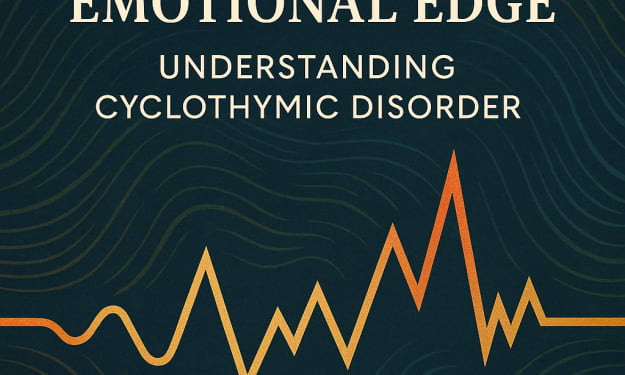
Living on the Emotional Edge: Understanding Cyclothymic Disorder
Introduction Everyone experiences emotional ups and downs. A burst of excitement one day, a dip in motivation the next — it's part of being human. But for some, these fluctuations are more than just ordinary mood shifts; they form a persistent, confusing rhythm that quietly shapes their entire life. When your inner world feels like a never-ending ride between minor emotional highs and unexpected lows — without ever tipping fully into mania or deep depression — it might not just be personality. It might be Cyclothymic Disorder.
By Siria De Simoneabout a year ago in Psyche
From I Think Therefore I Am to I Scroll, Therefore I Am
The New Mirror of the Self At 2 AM, eyes blurry and thumb sore, you’re still scrolling. But why? Another meme. Another perfect face. Another video of someone you laugh, you like, you swipe—but somewhere inside, a question flickers;
By Yasar Ahmad about a year ago in Psyche
"The Interpretation of Dreams" by Sigmund Freud: A Journey into the Unconscious Mind
"The Interpretation of Dreams" by Sigmund Freud: A Journey into the Unconscious Mind "The Interpretation of Dreams" is not just a book; it is the foundation of modern psychology and a journey into the mysterious world of the unconscious. First published in 1899, this book revolutionized our understanding of dreams. Dreams are no longer seen as random or meaningless images; instead, they are glimpses into our hidden desires, fears, and experiences. Freud's writing is a blend of science, philosophy, and personal discovery. This book explains how dreams are formed, their connection to the unconscious mind, and how they reveal hidden truths through symbols. Although it can be challenging, for those interested in understanding the human mind, it is a feast for the intellect.
By Ikram Ullahabout a year ago in Psyche
Best
Measuring sticks are useful, but don't account for everything. Lately, I have been hearing people talk about being the best. The first, was an immigrant in the food industry, explaining how he wanted to come to the USA and prove he is the best chef. The second, was a teacher talking about teaching students to be their best. The third, was generic sayings about being your best self and being the best in the business. I couldn't help but think, what is this obsession with being the best. Then I checked myself by thinking of F1 racing and other sports. There needs to be the best, to win. Having the best doctor in a complicated specific surgery may be the difference between life or death. Clearly there are times when being the best should happen, and others when it should be less important. It got me wondering if the problem for me is more with the kinds of individuals with this mentality, to always be the best. The competative nature. I have never been very competitive. I like to joke as if I am at times, but when it comes down to it, I am not at all competative. In fact, as a person with anxiety and at times known to faint from being nervous, I have spent most my life trying not to be the best. This is not to say I don't try or don't like to learn to my fullest potential. Not being the best always seemed to allow for more; More fun, more growth, more anonymity. The best always seemed constricting. Is it possible to be the best at not being the best? I also find that if someone I love is really good at something, I don't want to out do them. Id prefer to work with them, but let them have their thing. People may not be the best at something outside of a specific group, but someone can be the best to someone else. For me it was an appreciation of my moms sewing tips that brought me to her level faster than she was able to. Her tips from years of teaching herself, helped me. Her mom, disliked sewing. In my eyes she was the best. Most impressive. I could do what she did, but I wanted her to always be better. The best is so easily loved and liked. There are some individuals that are so difficult, but still very much loved or accepted in a field of work or study because they are the best. The best seems like a challenging measuring stick to use, one where the measurements are constantly changing. So much so, no measurement can be trusted. So why and where did this obsession with the best come from? In ancient times, survival most likely fueled this concept and allowed competative nature to be an important motivator. This lead to leadership and status. Those who were stronger, smarter, most resourceful or the "best" for the times. The middle ages emphasized the divine. Religious and pious individuals were divinely ordained and righteous. Chosen ones, helping humanity. Romans believed in 'virtus'. It included the concept of excellence. Romans also had ideas about beauty relating to excellence. Renaissance lead towards humanism and individualism. Human achievements began to take the stage. It progressed from here. The best is a concept tied to progress. Inventors and critical thinkers are the best because they progress humanity in a given time period. At this point the concept of the best seems critical to our existence and progress. A necessary evil or good. However, could the concept of "Best" be becoming outdated? I would argue it hinders the population instead of progressing it. An obsession with the best keeps us from our potential of being the best. There are too many factors: start in life, family, environment, income, health, life events, education, friends, etc. The true best, the ones it comes naturally to, don't have time or energy to care about being the best. It's hard work. It's all of us who are not, who have grand ideas and dreams of being the best. And why? Because the best, in today's world, equals more recognition meaning more money, and more power. That, we all probably need and want. Money and power buys a better life for one, who can then choose to help society or a themselves and family. In a population with so many bests, so many talented achievers, so many entertainers, so many measurements, it forms a negative competition for yourself and others. It seems opposite to progress. But! how can I think this and not be a socialist I began to think. Around this time, my dog walked in. I looked at her cute face, walked to her, kissed her nose and told her "you are the best dog for me". I meant it as the ultimate compliment for how much I love her. Ultimately it is irrelevant because I don't know every dog in the world and who cares. There was that word "Best" being highlighted again. The truth is, we need people to want to be the best. We need people to actually be the best. We even need people to think they are the best (maybe even unrealistically). Maybe the concept of "BEST" will never disappear. Maybe it exists because we all need and want it to. Maybe we are more saying, we want special things to exist in the world. Special gets us through.
By simplicityabout a year ago in Psyche
The Peace Within Accountability
There is peace in accountability. If you’d met me several years ago, you couldn’t have paid me to admit that. The truth is, several years ago, I myself was oblivious to this notion. I’d been in conflict after conflict and not one time had I come out on the bottom of it, even if I truly had. If I said it was so, you couldn’t convince me otherwise. And oh, honey I would die on that hill. There was something powerful about lacking any control for much of my life, eventually learning that I can build my own narrative beautifully crafted in any way that I want. What did I want? Control. How did I get it? By being right. Ultimately, I spent over twenty seven of the twenty-eight years on this Earth failing at what I now know as gaslighting. Crafting weak fairytales in a vain attempt to keep what little control I had over my life.
By The Darkest Sunriseabout a year ago in Psyche