advice
Advice and tips on managing mental health, maintaining a positive outlook and becoming your happiest self.
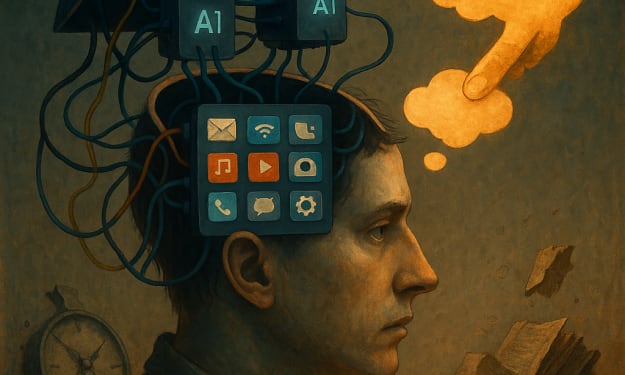
The Dimming Mind: How Convenience Culture Is Making Us Forget How to Think. AI-Generated.
We live in an age of astonishing ease. With a few taps, we summon dinner, diagnose a rash, translate a foreign text, or generate an entire business plan. Algorithms anticipate our desires before we consciously register them. The idea that technology should do the thinking for us has become not only accepted—but celebrated.
By Ahmet Kıvanç Demirkıranabout a year ago in Psyche
Why We Can’t Focus Anymore – And What It’s Doing to Our Minds. AI-Generated.
Have you ever opened your phone to check one thing, and 40 minutes later, you’re watching a random video about raccoons baking cakes in the forest? You’re not alone. Our ability to focus is collapsing — slowly, subtly, but noticeably. Reading a full article without skimming? Hard. Watching a movie without checking your phone? Even harder. Sitting in silence without stimulation? Almost impossible. We are overstimulated. And we’re not built for it. Our brains evolved in a world of slow input. One conversation at a time. One task. One thought. But now? We scroll through hundreds of images, videos, and messages in minutes. Everything is short. Everything is loud. Everything is demanding our attention — and we’ve trained our minds to expect it. The result? Micro attention spans. We get bored faster. We zone out easily. Our brains seek instant pleasure and avoid anything that feels slow — even if it’s meaningful. Think about it: When was the last time you read a full book without checking your phone? Or sat with your thoughts instead of opening an app? Even when we’re not busy, our minds are racing. Because rest doesn’t feel restful anymore — it feels like wasted time. This isn't just about “putting your phone down.” It’s about how we’ve been rewired. Social media platforms are built on dopamine loops — fast, addictive rewards. The more we use them, the more we crave stimulation. Over time, our brains stop finding joy in slower things: like nature, conversation, or even silence. We start multitasking everything. Watching videos while eating. Texting while walking. Scrolling while watching TV. Even in moments meant for peace, we’re chasing distraction. And yet, we feel mentally exhausted. Because constant stimulation doesn’t relax us. It drains us. So what does this mean for our lives? We struggle to be present. Even in moments that matter, we’re mentally somewhere else. We lose depth. We skim everything — texts, articles, emotions. We’re anxious. Our minds are constantly “on,” and we forget how to switch them off. We don’t feel fulfilled. Because nothing really lands deeply anymore. We confuse consuming content with actually connecting to it. Just because we scroll past a quote about peace doesn’t mean we’ve felt peace that day. Just because we saved a video on mindfulness doesn’t mean we’ve practiced it. But here’s the good news: focus can be trained again. Reclaiming your attention doesn’t require deleting all your apps or moving to a cabin in the woods. It just takes small shifts. Try this: Start with boredom. Let yourself do nothing for 10 minutes a day. No phone. No music. Just sit. Read slowly. Choose one article or chapter a day — and actually finish it. Single-task. Do one thing at a time. Even brushing your teeth. Be there. Unfollow noise. If an account or app drains your peace, mute it. Protect your mind like your home. You don’t need to be productive all the time. Sometimes focus is not about achieving more — it’s about being more present with what’s already in front of you. Take back your attention the same way you lose it: little by little. Start by recognizing how distracted you are, without guilt. Then, make space. Even five quiet minutes are powerful. Even a walk without your phone can reset your mind. Most importantly, be kind to yourself. You’re not broken. You’re just overstimulated. We all are. And in a world designed to fracture your attention, choosing to slow down is a radical act. The more space you give your brain to rest, the more clarity returns. The more silence you allow, the more your thoughts start to breathe. And slowly, the fog clears. Focus isn’t gone. It’s just buried — under layers of noise. Bring it back. One quiet moment at a time.
By Muhammad Waleed Hassanabout a year ago in Psyche
When Peace Feels Boring — It’s Because You’re Healing From Chaos
Let’s talk about a strange but very real feeling: You finally cut off the toxic friend. You left the relationship that drained you. You started choosing peace. No more drama. No more chaos. But now? You feel… bored. No highs. No lows. Just stillness. And it feels almost wrong — like you’re missing something. Here’s the truth most people never say out loud: **Peace feels boring when all you’ve known is chaos.** And it’s not your fault. - - - - - ### (1. Chaos Felt Like Home — Because It Was Familiar) You may have grown up in environments where love was unpredictable. Where yelling meant connection. Where tension was normal, and calm was rare. So when life finally gets quiet… it doesn’t feel safe. It feels foreign. And the brain confuses unfamiliar with wrong — even when it’s good for you. - - - - - ### (2. Highs and Lows Create Addiction — Even Emotional Ones) Toxic cycles give you *extremes*. Love bombing followed by coldness. Fights followed by apologies. Intense moments that leave you drained — but addicted. Peace, by contrast, feels flat. But here’s the truth: flat isn’t bad. It’s *stable*. It’s your nervous system learning how to exist without adrenaline. - - - - - ### (3. You Mistake Peace for Emptiness — Because It’s Quiet) No one is love-bombing you. No one’s blowing up your phone. No drama. No crisis. No chaos. And suddenly, your mind says, “This must be loneliness.” But peace isn’t empty. It’s open. Open for real connection. Real safety. Real calm. You’re not alone. You’re just finally not being chased by emotional fire alarms. - - - - - ### (4. You Start Creating Drama — Just to Feel Something) You send the text you know you shouldn’t. You stalk their profile. You pick a fight. You sabotage a good thing — because your body is craving the chaos it’s used to. That doesn’t make you toxic. That makes you unhealed. But here’s the good news: the urge to self-sabotage is not a failure — it’s a *signal*. You’re in withdrawal from dysfunction. - - - - - ### (5. Stillness Triggers What You’ve Been Avoiding) Peace gives your brain space. And in that space, the *real* thoughts surface: “What if I’m not lovable?” “What if I’ve wasted years on the wrong people?” “What if I don’t know who I am without the chaos?” Those are hard truths. But healing isn’t just calm — it’s *confronting*. And that’s why peace can feel overwhelming at first. - - - - - ### (6. You Realize How Much You’ve Tied Your Identity to Surviving) You were the fixer. The fighter. The one who held everything together. Now that there’s no chaos to solve… who are you? This is the turning point — where peace forces you to rediscover your identity outside of survival. And that’s not boring. That’s rebirth. - - - - - ### (7. You Don’t Feel “Happy” — Just... Neutral. And That’s Okay.) Peace doesn’t always feel like joy. Sometimes, it just feels like *nothing is wrong* — and that’s powerful. You’re not constantly anxious. You’re not hypervigilant. You’re not second-guessing everything. That quiet neutrality? That’s mental health. That’s your nervous system recovering. - - - - - ### 🌿 Final Thought If you feel bored, restless, or off during your healing journey… you’re not failing. You’re just adjusting. Adjusting to a life where love isn’t a battlefield. Where your phone doesn’t give you panic attacks. Where peace isn’t performative — it’s real. (. . .) Don’t run from that stillness. Sit in it. Let your nervous system untangle. Let your soul finally *rest*. Because here’s the truth no one tells you: **If peace feels unfamiliar… that means you’re finally healing.** Stay there. You’ll get used to it. And one day, you’ll call it home.
By SHADOW-WRITESabout a year ago in Psyche
STIs' Worldwide Burden: Facts, Effects, and Prevention
Sexually transmitted infections (STIs) represent one of the most significant global health challenges of our time, with over a million treatable STIs contracted daily worldwide. This staggering figure underscores the magnitude of a crisis that affects individuals across all demographics, socioeconomic backgrounds, and geographic regions. Many of these infections go undiagnosed due to the absence of symptoms, creating a silent epidemic that continues to spread unchecked through communities.
By Shameless Pathabout a year ago in Psyche
This is the Signs That Your Twin Flame is Thinking of You
I never believed in soul connections until the night I couldn’t sleep. My heart was racing. My mind was full of someone I hadn’t even spoken to in months. I didn’t understand why—but now I know. My twin flame was thinking of me.
By White Thoughtabout a year ago in Psyche