advice
Advice and tips on managing mental health, maintaining a positive outlook and becoming your happiest self.
Boss Fight Strategies for Panic Attacks
Panic attacks are the ultimate rogue boss of mental health—they ambush you when you least expect it, hit like a truck, and leave you wondering "What the hell just happened?" But unlike video game bosses, you can’t just rage-quit and reload. (Though if you could, we’d all have a save file from before the attack started.)
By Just One of Those Thingsabout a year ago in Psyche
The ‘Ring of Power’ Problem: When Coping Mechanisms Turn Toxic
There comes a time in every fantasy hero’s journey when they realize the artifact they’ve been relying on is actually whispering dark thoughts into their mind. For Frodo, it was the One Ring. For you? It might be that ”harmless” habit you swear helps you cope—but is slowly turning you into a gaunt, obsessed shell of yourself.
By Just One of Those Thingsabout a year ago in Psyche
The ‘Dungeon Master’s Guide’ to ADHD Brain
Imagine your brain as a tabletop RPG session where: You’re the DM (supposedly in charge) Your thoughts are chaotic NPCs (all talking over each other) Your focus is that one player who keeps getting distracted by shiny loot
By Just One of Those Thingsabout a year ago in Psyche
Anxiety’s Boggart: What Your Brain Turns Into a Monster
There’s a shape-shifting creature lurking in the shadows of your mind—one that takes your deepest fears and morphs them into full-blown catastrophes. No, it’s not a Dementor (though the emotional drain might feel similar). It’s your brain’s own personal Boggart, and it’s been having way too much fun turning minor worries into soul-crushing horrors.
By Just One of Those Thingsabout a year ago in Psyche
The Illusion of the Snake: A Lesson on Mind, Perception, and Healing
It is said that a man once visited the great philosopher Rumi. The philosopher warmly welcomed him and invited him to join him for a meal. As they sat together, Rumi served soup to his guest. When the man began to drink the soup, he suddenly noticed something strange. In the bowl, he saw what appeared to be a small snake-like creature floating in the broth. Shocked and disturbed, he froze for a moment. However, out of embarrassment and respect for the philosopher, he chose not to say anything. He didn’t want to offend Rumi or seem rude by rejecting the food. So, he gathered his courage and continued drinking the soup, pretending as if everything was normal. Although he forced himself to finish the meal, a deep sense of discomfort remained in his heart. Later that evening, the man returned home. But he couldn't shake off the feeling that he had consumed something dangerous. The image of the snake-like figure in the bowl haunted him. The more he thought about it, the more distressed he became. By nightfall, he started feeling a severe pain in his stomach. He couldn't sleep due to the intensity of the discomfort. Thoughts swirled in his mind: What did I eat? Was it really a snake? What if I’ve been poisoned? As soon as the sun rose, he rushed back to Rumi, desperately seeking help or a cure. Holding his stomach and visibly anxious, he told the philosopher about the pain and what he had seen in the soup. Rumi listened calmly and smiled gently. Then he said, “There was no snake in the soup. What you saw wasn’t real—it was merely a shadow.” The philosopher then invited the man to sit again. He took the same bowl and poured soup into it once more. As the man looked inside, he again saw the same snake-like figure. But this time, Rumi pointed upward toward the ceiling. The man looked up and saw a painted image of a snake on the roof of the room. When he realized it, everything became clear. What he had seen was not a real snake but merely the reflection of the ceiling painting in the soup. This discovery left the man stunned. At that very moment, his stomach pain vanished completely. The fear and stress that had caused his physical illness disappeared instantly. It became evident that his suffering was not caused by any physical poison, but by his own thoughts—by the illusion that had taken root in his mind. This story powerfully illustrates the influence of perception and the human mind on physical well-being. The snake never existed in reality—it was entirely a creation of the man's imagination. And yet, it had the power to cause genuine physical pain. The mind believed it to be real, and the body reacted accordingly. This phenomenon is known as psychosomatic illness, where the mind, overwhelmed by anxiety, fear, or stress, influences the body so strongly that it begins to exhibit symptoms of actual disease. The man believed he had consumed something harmful, and that belief alone triggered a physiological response—pain, anxiety, insomnia—all without any real cause. Such is the power of imagination and fear. They can turn harmless situations into terrifying experiences and even make a healthy person feel ill. It also teaches us a broader life lesson: not everything we perceive is necessarily true. Often, what we consider threats or problems are just illusions created by our own minds. That’s why the great Muslim philosopher and physician Ibn Sina (Avicenna) wisely said: "Wahm aadha marz hai, itminaan aadhi dawa hai, aur sabr shifa ki pehli seedhi hai." "Illusion is half the disease, reassurance is half the cure, and patience is the first step toward healing." His words carry timeless wisdom. Many illnesses begin in the mind. If a person allows fear, worry, or negative assumptions to grow unchecked, they can manifest in physical form. On the other hand, calmness, reassurance, and patience can be as powerful as medicine in bringing healing. We often underestimate the effect of emotional and mental well-being on our physical health. Anxiety and stress can weaken the immune system, disturb digestion, affect sleep, and lead to numerous ailments. Conversely, a peaceful mind, supported by faith and positive thoughts, can accelerate recovery and strengthen resilience. This story also emphasizes the importance of clarity, communication, and observation. If the man had simply asked Rumi about what he saw, the misunderstanding could have been cleared immediately. But social pressure, embarrassment, or assumptions often keep us silent, making problems worse. In our daily lives, how often do we jump to conclusions without verifying the facts? How many times do we suffer in silence simply because of assumptions or fears that may not even be true? Therefore, this tale is more than just a short moral story—it is a deep reflection on human psychology. It encourages us to challenge our assumptions, seek clarity, communicate openly, and learn to manage our thoughts with wisdom. Ultimately, it reminds us that true healing begins not just with medicines, but with understanding, belief, and peace of mind.
By Ikram Ullahabout a year ago in Psyche
The Soul of Raskolnikov as a Mirror of Human Contradiction
Over 150 years ago, Fyodor Mikhailovich Dostoevsky published one of the best-known works of Russian literature: Crime and Punishment. First serialised in a literary magazine in 1866, the novel tells the story of Rodion Romanovich Raskolnikov, a young law student in Saint Petersburg. Since then, readers have repeatedly returned to its central, haunting questions: What drives someone to kill in cold blood? What goes through the mind of a murderer? And what kind of society breeds such individuals? These questions have remained controversial and unanswered for generations, ever since humans began to explore philosophy, logic, and psychology.
By Sergios Saropoulosabout a year ago in Psyche
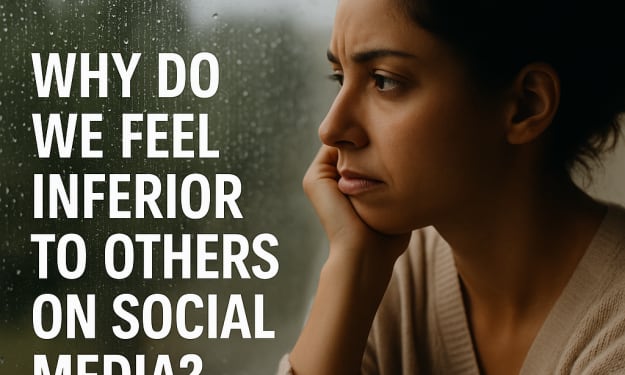
Why Do We Feel Inferior to Others on Social Media?
Introduction Have you ever scrolled through Instagram, TikTok, or Facebook and suddenly felt like your life isn’t good enough? Maybe someone posted about their new car, perfect relationship, fancy vacation, or successful job — and you instantly felt small, less important, or even jealous.
By Umar Khattakabout a year ago in Psyche
Rest Is Not Laziness: Breaking the Hustle Mentality We Grew Up With
There’s a particular kind of guilt that creeps in when you’re doing... nothing. The kind where you’re lying in bed on a Sunday afternoon, phone in hand, sunlight pouring in — and instead of feeling peace, your chest tightens. You start thinking about your to-do list. You wonder if you’re wasting time. You feel like you should be doing something.
By Tavleen Kaurabout a year ago in Psyche
The ‘Resurrection Stone’ of Self-Compassion: How to Talk to Past-You
Think back to the most cringe-worthy version of yourself—the one with questionable haircuts, bad crushes, and a staggering lack of life experience. Now imagine if that younger you appeared in front of you right now. Would you:
By Just One of Those Thingsabout a year ago in Psyche
The ‘Respawn Point’ Guide to Bad Mental Health Days
We’ve all been there—staring at the ceiling at 3 PM, wondering how basic human functions suddenly feel like expert-level tasks. The mental to-do list mocks you, motivation has glitched out of existence, and even your sweatpants feel like too much commitment. This isn’t just a bad day; it’s your brain blue-screening.
By Just One of Those Thingsabout a year ago in Psyche