addiction
The realities of addition; the truth about living under, above and beyond the influence of drugs and alcohol.
When the Task Feels Wrong: There’s Nothing Wrong With You; It Just Doesn’t Fit Yet
That sensation, the strange friction between a clear task and your inability to begin, is not failure. It’s not laziness. And it’s not about skill. It’s a structural misfit. What you’re experiencing is what I call a shape problem.
By Nikesh Lagunabout a year ago in Psyche
Ctrl+Alt+Del: Reset Your Heart
The whir of the CPU fan was the only sound keeping Leo company at 3:17 a.m. He stared at his screen through smudged glasses, the blue light casting ghostly shadows across the walls of his cluttered apartment. Empty coffee mugs. Wires snaking over code-stained notebooks. His hoodie hung from the back of the chair like a flag of surrender. Leo was brilliant. A senior AI engineer at one of Silicon Valley’s top firms, he had written algorithms that predicted emotional responses with 93% accuracy. But he couldn’t predict his own breakdown. Three months ago, Camila—his girlfriend of four years—walked out of their shared loft with nothing but a suitcase and a tear-streaked face. “You don’t feel, Leo. You fix,” she’d said, her voice trembling. He hadn’t argued. She wasn’t wrong. In his world, everything had a logic path. Feelings didn’t. And when Camila had started crying more often than laughing, Leo’s response was to debug her, not comfort her. Tonight, though, was different. Leo had built something in secret—HEART.RESET—a neural interface application that replayed key emotional moments through synaptic stimulation. Not for clients. For himself. He strapped on the sleek headset and took a deep breath. “Ctrl. Alt. Del,” he whispered. The world dissolved. He found himself standing inside a memory—their kitchen, February 14th, two years ago. Camila was laughing, her curls wild as she tried to flip a pancake midair. The smell of cinnamon. The soft jazz in the background. Her joy—it was alive here. The interface wasn’t just visual; it recreated emotions based on brainwave patterns tied to past experiences. For the first time, Leo didn’t just remember Camila’s smile. He felt how much he loved her. He jumped to another moment—June, the beach. Her shivering shoulders under a shared blanket. The warmth of her fingers interlocked with his. And the last one—December. Her walking out. This time, he didn’t stand back. He walked up to the projection of Camila and said, “I didn’t know how to be what you needed. I’m sorry.” The projection didn’t respond. It was a memory. But the truth in the words cracked something open inside him. Leo pulled the headset off, breathless. Heart pounding. He sat for a moment, letting the silence settle. The next morning, Leo did something radical. He posted on a private message board where Camila still lurked: “If you could Ctrl+Alt+Del one moment between us, what would it be? I’ll go first: The night I made you feel small for crying.” To his surprise, she responded. “I’d delete the day I gave up on you too soon.” What followed was a slow, honest conversation. Over weeks, then months. No grand gestures. No promises. Just rebuilding. Leo never offered her the headset. She didn’t need simulations. She needed a human being who could sit with pain, not bypass it. One rainy afternoon, they met at the coffee shop where they had their first date. Camila looked older. Stronger. So did Leo. She held out her hand. “No resets this time?” He smiled. “No resets. Just reboots.” As they sat in silence, watching the world blur through the window, Leo realized something. The best tech could only reflect what you were willing to confront. It couldn't feel for you. Only you could choose to show up, day after day, to feel the whole messy spectrum—love, regret, hope. He had spent years writing code to fix the world. But it took losing her to learn how to fix himself.
By Syed Kashif about a year ago in Psyche
The Silent Room
The Silent Room Dr. Maya Ellis had spent the better part of her career studying memory—how it worked, how it failed, and how it could deceive. But nothing in the textbooks prepared her for the moment she stood in front of Room 212, the locked chamber at Evermore Psychiatric Institute. They called it the Silent Room.
By Asia khanomabout a year ago in Psyche
"Dopamine Hijacked: Why You Can’t Focus Anymore—And How to Fix It"
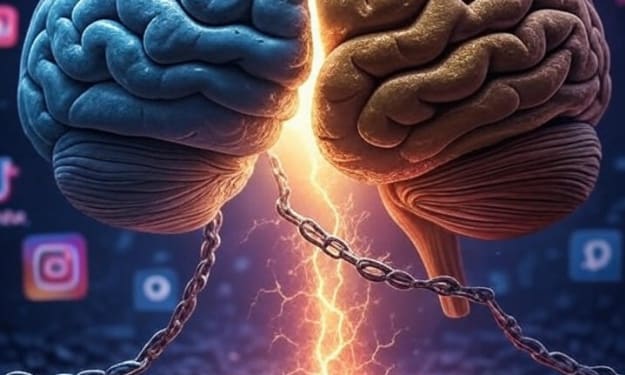
We live in an age where attention is currency—but most of us are broke. We start our mornings with a screen. We end our nights scrolling. Somewhere between Instagram reels, endless notifications, and YouTube rabbit holes, we’ve lost something critical: our ability to focus. Ever wondered why you can’t stop checking your phone? Why you feel restless even on days you’ve done nothing? Why you’re always tired but still can’t sleep? It’s not just modern life. It’s not just you. It’s your brain chemistry—hijacked. And the culprit? Dopamine. --- The Hidden Chemical Running Your Life Dopamine is often labeled the “feel-good hormone.” But it’s more than that—it’s the reason humans climbed out of caves, discovered fire, built civilizations, and sent rockets to space. It’s the fuel behind ambition, curiosity, exploration, and learning. Thousands of years ago, dopamine surged when we hunted food, built shelter, or solved problems for survival. The brain would say, “This helped you. Do more of it.” Every effort, every challenge followed by reward—this cycle wired us for growth. Even today, the feeling you get after finishing a workout, completing a project, learning a skill, or creating something meaningful—that glow of inner pride? That’s slow dopamine, the natural, earned kind. But we’ve traded it. --- Welcome to the Age of Instant Gratification The world has changed—but our brains haven’t. That’s the real problem. In the past, you had to work for your rewards. Now? Swipe. Scroll. Tap. Repeat. Our phones give us dopamine on demand. Notifications, social media likes, messages, videos, trending memes—each one delivers a little jolt of pleasure. And like lab rats pressing a button for sugar, we keep coming back for more. But this isn’t real pleasure. It’s fake dopamine. It fades fast, leaving you feeling anxious, unfocused, and empty. It’s why we feel drained after “resting” for hours online. It’s why we procrastinate but still feel guilty. It’s why our goals feel harder and harder to chase. We’re overstimulated, under-satisfied, and quietly addicted. --- Dopamine Isn’t the Enemy. Our Habits Are. Let’s get one thing straight: dopamine isn’t bad. In fact, it’s essential. But like anything powerful, it must be understood—and mastered. Here’s what’s happening inside you: 1. Your Brain’s Seesaw: Pleasure vs. Pain Every action tips this balance. Push through discomfort (like exercise or deep work), and you’re rewarded with deep, lasting peace. That’s slow dopamine—the kind that makes life meaningful. But chase quick hits (like junk food, endless scrolling, binge-watching), and the balance tips toward pain—leaving you anxious, numb, or restless. The more you indulge, the less joy you feel from real life. 2. You’re Weakening Your Mental Muscles There’s a brain region—the anterior mid-cingulate cortex—that helps with willpower and discipline. Every time you resist a craving, delay gratification, or choose purpose over pleasure, you strengthen it. But the more you give in to distractions, the weaker it becomes. And soon, you don’t choose your habits—they choose you. 3. You’re Training Your Brain to Be Bored Constant stimulation lowers your threshold for interest. If you can’t go 10 minutes without checking your phone, your brain has forgotten how to be present. That’s why reading feels “hard,” meditation feels “boring,” and goals feel “too big.” You’re not broken. Your brain is just rewired. --- But There’s Good News: You Can Rewire It Back This isn’t doom and gloom. Neuroscience has shown again and again: your brain is plastic—it can change, heal, and rewire itself at any age. Here’s how to get your dopamine system back under control: --- 6 Ways to Reclaim Your Focus and Find Real Joy Again 1. Detach from Dopamine Drips Turn off non-essential notifications. Keep your phone out of reach during work, meals, and conversations. Try a 24-hour digital detox once a week. You’ll be shocked at how calm you feel. 2. Move Your Body, Every Day Exercise releases natural dopamine—but more importantly, it re-teaches your brain to earn pleasure through effort. Even a 20-minute walk counts. 3. Delay Gratification, Consciously When you crave your phone, wait five minutes. When tempted to binge, pause and drink a glass of water. Small acts of control rebuild massive self-respect. 4. Get Bored on Purpose Sit in silence. Watch nature. Journal. Your mind needs boredom to spark creativity and clarity. 5. Read and Reflect Books are slow dopamine in ink. They teach your brain to slow down, absorb, and think deeply again. 6. Find Your Flow Flow is that state where time vanishes. Whether it’s painting, running, gardening, or building—find your passion and immerse yourself in it regularly. You don’t need to monetize it. You just need to feel alive doing it. --- Final Thoughts: The Fight for Your Mind We weren’t made for constant stimulation. We were made for growth, purpose, love, and peace. And yes—your brain can heal. Your focus can return. Your joy can come back. But it starts with one decision: to reclaim your attention. Each time you choose a book over your phone… Each time you take a walk instead of scrolling… Each time you embrace boredom instead of avoiding it… You are becoming stronger. More peaceful. More you. So start today. Take back your dopamine. Take back your life.
By Muhammad Ilyasabout a year ago in Psyche
Notifications Are the New Cigarettes
You might think addiction is something reserved for substances—alcohol, nicotine, caffeine. But addiction today wears a new face. It's not wrapped in a cigarette or poured into a glass. It’s tucked into your pocket, buzzing gently, lighting up with a red dot, whispering: “Check me.” Every ping, buzz, and badge on your phone isn’t just a convenience—it’s a carefully engineered hook. And much like the tobacco industry of the 20th century, the tech world has learned how to profit off our compulsions.
By shoaib khanabout a year ago in Psyche
Why Do We Always Feel Tired, Depressed, Anxious, and Overthink?
In today’s fast-paced, hyperconnected world, an alarming number of people find themselves constantly feeling exhausted, mentally drained, anxious, and trapped in loops of overthinking. You might wake up feeling tired despite a full night’s sleep or experience a deep sense of emptiness even when life seems “fine” on the surface. Anxiety creeps in, overthinking follows, and you end up stuck in a cycle that feels impossible to break.
By Umar Khattakabout a year ago in Psyche
Fromm’s Legacy in 2025: Freedom, Anxiety, and the Modern Soul
Back to Fromm: The Humanist Thinker We Desperately Need Now In a world torn by anxiety and division, his call for human connection and ethical responsibility feels urgent once again. In an era overwhelmed by political disillusionment, technological overload, and emotional numbness, revisiting the ideas of Erich Fromm feels not only relevant—it feels necessary. A psychoanalyst and philosopher who lived through the rise of fascism and the trauma of world wars, Fromm saw more clearly than most how the modern world strips individuals of connection, meaning, and moral clarity. What he offered wasn’t just critique—it was a deeply human vision for how we might live better, fuller, more connected lives. Alienation in the Age of Connection Fromm warned that modern societies create “automatons” rather than fully alive individuals. We are taught to conform, to compete, to consume—but rarely to feel deeply or think independently. In The Sane Society, he argued that the emotional alienation produced by capitalism and bureaucracy leads to a dangerous form of apathy. People become disconnected not only from one another but from themselves. Fast forward to 2025, and this warning reads like a description of our daily lives. Despite an endless stream of digital communication, we’re lonelier than ever. Social media amplifies division while masquerading as community. Mental health crises surge globally, particularly among youth. Even in the face of global challenges like climate change and war, many people retreat into numbness, distraction, or polarized ideologies. Fromm's diagnosis: we’ve lost the ability to live authentically, and in doing so, we've surrendered our capacity to love, to reason, and to act with moral courage. The Ethical Act of Being Human What sets Fromm apart from many modern commentators is that he believed in human potential—not as a given, but as a responsibility. He saw freedom not simply as the absence of restraint, but as the ability to choose one's own path with awareness and care. Freedom, in Fromm’s view, required maturity, ethical development, and the courage to stand apart from the herd. In Man for Himself, he argued that we must create an ethical framework rooted in human needs and values, rather than in obedience to authority or pursuit of profit. “The task we must set for ourselves is not to feel secure, but to be able to tolerate insecurity,” he wrote. In a world increasingly shaped by fear—fear of others, of economic instability, of cultural change—Fromm’s message is a counterbalance: grow up, look inward, and choose love over fear. At the core of his thinking was the conviction that love, responsibility, and self-awareness are acts of will and discipline. They are practices we must learn, nurture, and defend—not just for ourselves, but for the health of society as a whole. In that sense, Fromm offers not just an analysis of what’s wrong, but a roadmap for how we might begin to heal. Why We Need Fromm Now Erich Fromm’s ideas help explain why we see rising authoritarianism, growing extremism, and widespread social withdrawal in many parts of the world today. When people feel isolated, powerless, and afraid, they don’t often respond with compassion—they seek security in the form of rigid belief systems, charismatic leaders, or the deadening comfort of distraction. Fromm understood that well before the internet, smartphones, or the rise of populist politics. What he offers us now is a challenge: to rehumanize our world. That means fostering relationships that are built on real understanding, not transactional gain. It means rethinking education to cultivate empathy and ethical reflection, not just technical skills. And it means holding our political systems accountable not just for results, but for their effect on the soul of society. In many ways, Fromm’s legacy is one of hope—but not an easy or naïve one. It is a hope grounded in work: the work of becoming fully human in a world that constantly tempts us to become less.
By Kaleem Ullahabout a year ago in Psyche