addiction
The realities of addition; the truth about living under, above and beyond the influence of drugs and alcohol.
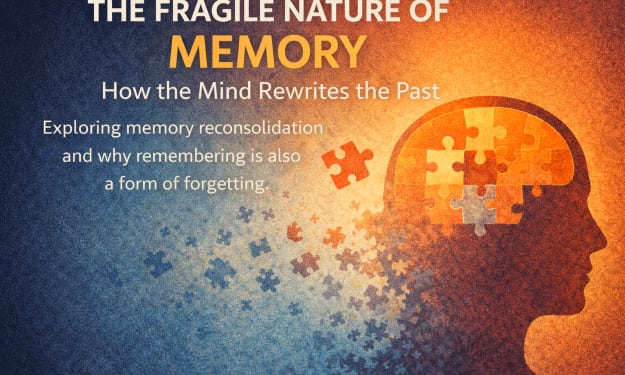
The Fragile Nature of Memory: How the Mind Rewrites the Past
We often view memory as a recording device. Something happens, and the brain stores it. Later, we recall it unchanged, like opening a file. Psychology presents a different picture. Memory is not fixed; it is fluid, reconstructive, and surprisingly fragile. One interesting aspect of cognitive psychology is memory reconsolidation, which is the process that alters our memories every time we recall them. This instability is not a flaw; it shows how our minds adapt, protect themselves, and reshape our identity over time.
By Kyle Butler9 months ago in Psyche
When Thinking Feels Like Action
There is a particular satisfaction that comes from understanding something clearly after wrestling with it for a long time. The mind settles. Tension releases. Pieces line up. In that moment, it can feel as though real movement has occurred, as though something meaningful has been accomplished. That feeling is not imagined. Cognitive resolution is a real event. The danger appears when that internal resolution is quietly mistaken for external change, and thinking begins to substitute for action rather than prepare the way for it.
By Peter Thwing - Host of the FST Podcast9 months ago in Psyche
What fentanyl users want you to know. Top Story - February 2026.
There are dozens of people at Fusion Studios, the homeless hotel in Denver where I live, who use fentanyl. But even hardcore meth users judge them. The fentanyl users are the most stigmatized group in the building.
By David Heitz9 months ago in Psyche
How Alcohol Detox Programs Work in North Carolina Near You. AI-Generated.
Alcohol dependence affects both physical health and emotional wellbeing, making it difficult to stop drinking without support. For many individuals, the first step toward recovery is alcohol detox. Detox programs help the body safely adjust to the absence of alcohol while managing withdrawal symptoms in a structured, medically supervised environment.
By Jordan Blake9 months ago in Psyche
Why Ignoring Weed Addiction Signs Can Delay Recovery. AI-Generated.
Marijuana is often viewed as harmless or non-addictive, which can make it easy to overlook when use becomes problematic. However, for some individuals, weed use can evolve into dependence that affects mental health, motivation, relationships, and daily functioning. When early warning signs are ignored, recovery can be delayed, and challenges often become more difficult to address over time.
By Jordan Blake9 months ago in Psyche
The 24-Hour Digital Detox That Rewired My Brain. AI-Generated.
It started as a dare. My friend bet me $50 I couldn't go 24 hours without my phone. Easy money, I thought. I had grown up before smartphones existed. Surely I could survive one day. I was wrong about everything. Hour 1-3: The Phantom Vibrations The first thing I noticed was my hand. It kept reaching for my pocket every few minutes, grasping at nothing. Scientists call this phantom vibration syndrome - your brain has become so conditioned to expect notifications that it creates false sensations. I must have reached for my phone thirty times in those first three hours. Each time, a small wave of panic followed by relief, then confusion. What was I even going to check? Nothing important. Just... checking. Hour 4-6: The Boredom Arrives With no phone to fill the gaps, I discovered something uncomfortable: I had forgotten how to be bored. Standing in line at the coffee shop, I had nothing to do but... stand there. No Twitter to scroll. No emails to check. Just me, my thoughts, and the back of someone's head. At first, it was unbearable. Then something shifted. I noticed the barista had a small tattoo of a hummingbird on her wrist. I heard a conversation behind me about a book I had been meaning to read. I watched the steam rise from the espresso machine in patterns I had never paid attention to before. The world had been happening around me this whole time. I had just been too busy staring at a screen to see it. Hour 7-12: The Clarity By midday, something strange happened. My thoughts started to... complete themselves. Normally, my brain operates like a browser with 47 tabs open. Start thinking about work, interrupt with a notification, switch to social media, half-read an article, back to work, another ping, another context switch. Without the interruptions, my brain did something it had not done in years: it followed a thought from beginning to end. I solved a problem at work I had been stuck on for weeks. The solution came to me while I was washing dishes - something I usually did with a podcast blaring in my ears. Hour 13-18: The Withdrawal I will not pretend it was all enlightenment. The evening was hard. I sat on my couch and did not know what to do. Watch TV? Without being able to look up actors on IMDB or tweet about the show, it felt pointless. Read a book? My attention span had atrophied. I kept reaching the end of paragraphs without absorbing anything. I went to bed early because I could not think of anything else to do. Hour 19-24: The Morning After I woke up before my alarm. Without the late-night doom-scrolling, I had actually gotten eight hours of sleep. I could not remember the last time that happened. I made coffee and sat on my porch. Just sat. No phone to check. No news to read. Just the sounds of the neighborhood waking up. A neighbor I had lived next to for two years walked by. We had never spoken beyond a wave. Without a phone to hide behind, I said good morning. We talked for fifteen minutes. His name is David. He is a retired teacher. He has a podcast about jazz history. I had lived next to this interesting person for two years and never knew. What I Learned I collected my $50, but the real prize was the realization that hit me when I turned my phone back on: Nothing had happened. No emergencies. No urgent messages. Nothing that could not have waited. The world had continued spinning perfectly fine without my constant attention. The apps are designed to make you feel like you are missing something. The truth? You are missing everything - everything happening right in front of you, in the real world, while you stare at a glowing rectangle. I did not throw away my phone. I am not that person. But I did make changes: Turned off all non-essential notifications. Moved social apps off my home screen. Started leaving my phone in another room for hours at a time. Instituted a no phones at meals rule. That was six months ago. My screen time has dropped 60 percent. My sleep has improved. I know my neighbor's name. And sometimes, when I am standing in line at the coffee shop, I just... stand there. Watching the steam rise. Listening to conversations. Being bored. It is wonderful. Have you tried a digital detox? What happened when you unplugged? I would love to hear your experiences in the comments.
By Reich Corp9 months ago in Psyche
The Call You Don’t Remember Making. AI-Generated.
The phone rang at 3:11 a.m. Not a notification. Not an alarm. A real call. Omar stared at the screen through half-closed eyes. Unknown Number. He almost ignored it—almost—but something about the timing felt deliberate, like the call had waited for him to wake up before ringing.
By shakir hamid9 months ago in Psyche
Addiction Recovery Guide. Breaking Free & Staying Resilient.
Being addicted to either something and/or someone is more common than you think. It is commonplace and natural to think of drugs, food and drinks (mainly the alcoholic variety) when it comes to addictions; yet people can be addicted to a myriad of substances, people, and circumstances. What starts as an obsession breeds an addiction.
By Justine Crowley9 months ago in Psyche
The Real Reason You Keep Falling Back Into Old Habits. AI-Generated.
The Real Reason You Keep Falling Back Into Old Habits You decide to change. You try. You fail. Over and over. It’s not lack of willpower. It’s not laziness. Here’s the science behind why your old habits keep winning—and what you can actually do about it.
By Muhammad Haris khan 9 months ago in Psyche
How Does an IOP Mental Health Program Near Me Actually Work?. AI-Generated.
Mental health care is not one size fits all. While some individuals need inpatient treatment, others require more support than traditional outpatient therapy can provide. This is where Intensive Outpatient Programs, commonly known as IOPs, play an essential role. An IOP mental health program offers structured care while allowing individuals to continue living at home and managing daily responsibilities.
By Jordan Blake9 months ago in Psyche