
Nostalgia For a Place I’ve Never Been
I’m not alone in this experience


“We are homesick most for the places we have never known.”
― Carson McCullers
Every night before bed, I hop on Instagram and watch Reels. I know it isn’t the best habit before sleep, but these Reels make me happy, and that overrules ideas I’ve been conditioned to accept as truth about my sleep. I’ve also never been one to pass up a good, bad habit.
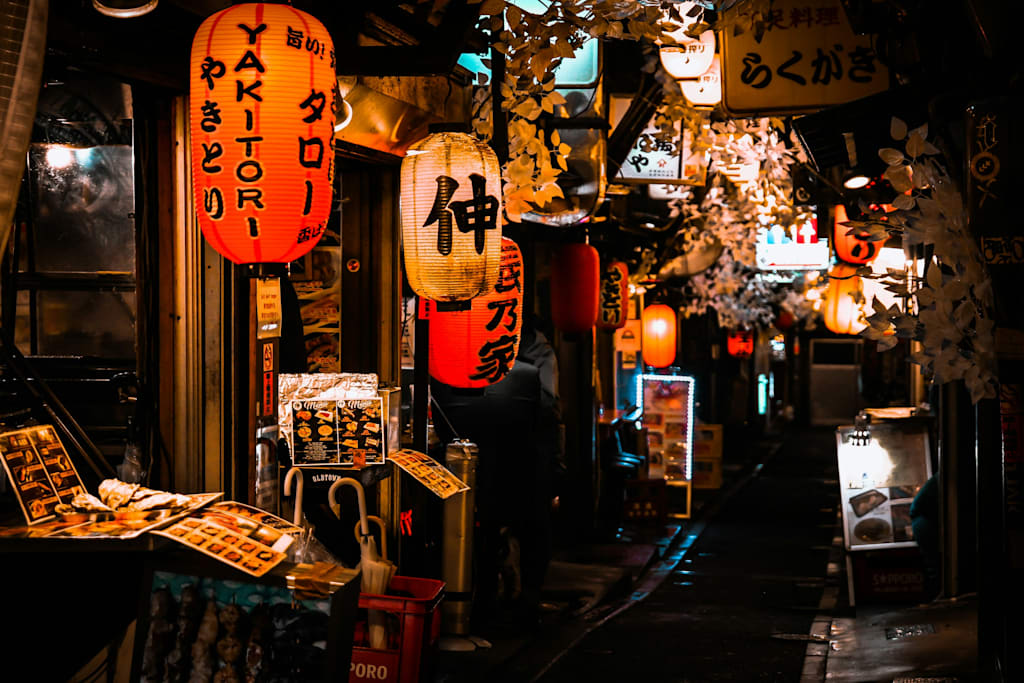
One night, an account showed a video of people walking through the streets of Tokyo. It was mesmerizing — the dimly lit alleyways with muted yet colorful lanterns and neon signs drawing me in. So I watched more. I noticed how my body would ease, and how calm and peaceful I felt. They put me in a good mood, albeit an intense, longing one. These videos are snippets of beauty in an often ugly world. And there was one Reel that brought out an emotion I’d never experienced before.
The video was in an alleyway in Shinjuku City (also known as Shinjuku), a popular, vibrant ward of Tokyo. It was night, with the remnants of a recent mild rain on the ground, and appeared late. The soft yellow lanterns hung between buildings, providing most of the light and adding to the harmony of the orange signs outside businesses. Most shops had closed, but a couple of restaurants were still serving couples at the alley-side tables. The music played a single strum of the guitar repeatedly, while in the background you hear a soft piano. The video was 12 seconds long.
I watched it over and over. And I felt deep down in my soul that I knew this place. That I’ve lived there. That it was more than just a feeling. However, I have no connection to it at all. It’s a visceral experience; it feels like it’s a part of me, but something I’ve lost. There’s a sadness to it, but not in a depressive way — it’s more bittersweet than anything. And the feeling lingers.
I’m not alone either. I’ve come across quite a few comments from strangers that mirror my experience — the sense of nostalgia, of home, of a place that’s so hauntingly familiar. Of a place we want to get back to, even though we’ve never been. The videos are immersive, often provoking intense emotions.
One comment said, “Wow these clips always make me feel emotional. I think I lived here in a past life.” Another stated, “How do I have nostalgia for a place I’ve never been.” And, “It makes me feel at home…a lost in time home.”
Like so many others, the experience of the video moved me. I even bought lights for my home in an attempt to recreate the mood of the lighting and scene. And I wanted to know more about this feeling of nostalgia I was having.

Most of us know what nostalgia is — “a sentimental longing or wistful affection for the past, typically for a period or place with happy personal associations.” It’s a common occurrence among humans.
In his 1688 dissertation, Swiss physician Johannes Hofer originated the term nostalgia, a combination of the Greek words Nostos, meaning return to the native land, and Algos, which signifies suffering or grief. There is also mention of das Heimweh, meaning “grief for the lost charm of the Native Land,” or homesickness.
Hofer started his research based on the “stories of certain youths thus afflicted, that unless they had been brought back to their native land, whether in a fever or consumed by the ‘Wasting Disease,’ they had met their last day on foreign shores.” Nostalgia was seen as a disease and afflicted not only soldiers but also those unable to return home.
According to a review in Frontiers of Neurology and Neuroscience, the disease of nostalgia was serious, especially for those serving in the Army in the 17th-19th centuries and experiencing the trauma of war.
“Longing for their native land, they were consumed by an ongoing desire to return home. If it was impossible to do so, they sank into ‘a sadness accompanied with insomnia, anorexia and other unpleasant symptoms’ that could lead to death.”
Nostalgia also affected others, according to Hofer. In his dissertation, he discusses a man who fell victim to the disease after spending his youth studying in a foreign town, and after a long bout of sadness. His family thought him to be at death’s door and began to pray. However, after learning of the disease of nostalgia, “which admits no remedy other than a return to the homeland,” the man was quickly “restored to his whole sane self before he entered Berne (his Native Land).”
Hofer also offers another story of a country girl who was seriously injured in a fall, knocked unconscious, and taken to a hospital away from her home. Over the stay, the girl became homesick, spitting out the medicine and food given to her while “she wailed frequently, groaning nothing else than ‘Ich will heim; Ich will heim,’ nor responding anything else to questions than this same ‘Ich will heim.’” (Ich will heim — I want to go home.)
Finally, the girl was allowed to go home and became well within a couple of days without the aid of medicine.
In explaining the causes of nostalgia, Hofer offered that the nearest source of the disease was a “quite continuous vibration of animal spirits through those fibers of the middle brain in which impressed traces of ideas of the Fatherland still cling.” And the more we think of the Fatherland, the more the animal spirits follow continuously.
The idea that nostalgia was a disease, potentially fatal, and even contagious lingered until the late 19th century. By the 20th century, nostalgia had become a variant of depression, although still equated with homesickness.
Of course, we now know it is not a disease, not caused by animal spirits, and current research shows nostalgia is complex and has positive and negative aspects.
Studies show that nostalgia renders life more meaningful, strengthens a sense of self, improves self-esteem, and fosters social connections.
However, feelings of nostalgia are also associated with negative outcomes, including an increased sense of loneliness and depression. For those who tend to ruminate, like myself, nostalgia can lead to worry and further rumination, which is also linked to depression.
One interesting finding is that the experience of nostalgia is positive or negative based on whether memories are generated on request (positive) or experienced as part of everyday life (negative).
Along with being a complex emotion and experience, nostalgia's impact on a person varies between the individual and the situation.
While all the research starts to paint a clearer picture, I’m more interested in the why. Why am I having such an emotional reaction to a video, and why can’t I shake this feeling that there is something more than merely feeling nostalgic? What is the purpose of this particular feeling of nostalgia? How can I feel this way about a place I’ve never been?

“Nostalgia is a seductive liar.”
― George Ball
Many triggers induce nostalgia, including music, smells, and lower temperatures, and many of us experience these feelings.
My nostalgia tends to kick in with music from the ’70s and ’80s since that was the era I grew up in. Breakdancing, parachute pants, Aiwa stereos, Intellivision, Atari, and a Commodore 64 are also sure to bring back memories. Shows like Gilligan’s Island, Andy Griffith, Three’s Company, and The Six Million Dollar Man are all nostalgia-inducing. When I see toys like He-Man, Slinky, Stretch Armstrong, and Rock ’Em Sock ’Em Robots, I’m immediately back in that time. I’m sure some of you reading this are having your own memories brought back right now.
However, the type of nostalgia I feel watching these videos differs from the traditional forms. I’ve never been to this place I’m experiencing such intense emotions for. I’m not recollecting my past; I’m remembering something I’ve actually never experienced.
What I’m going through is called anemoia. It’s nostalgia, but for a time or place one has never known. There’s also another name for it — farsickness, which is a “longing for far-off places, especially those you’ve not yet visited.”
While most of our feelings of nostalgia come from our past, Felipe De Brigard, a professor of philosophy at Duke University, believes it doesn’t require real memories, and that our imagination is doing a lot of work. In a paper titled Nostalgia and Mental Simulation, De Brigard argues, “Nostalgia can be associated with a possible past one didn’t experience, a concurrent nonactualised present, or even idealised pasts one couldn’t have lived but nevertheless can easily imagine by piecing together memorial information to form detailed episodic mental simulations.”
It’s these “mental simulations” that bring on feelings of nostalgia for places and times we’ve never known, according to De Brigard: “My suggestion, inspired by recent evidence from cognitive psychology and neuroscience, is that the variety of nostalgia’s objects is explained by the fact that its cognitive component is not an autobiographical memory, but a mental simulation — an imagination, if you will — of which episodic recollections are a sub-class.”
This would explain my experience with the alleyway in Tokyo. We don’t need real memories for nostalgia to occur. I’m imagining it. That’s not too hard to believe, considering I’ve never been there and have no connection to it. The only problem is I still don’t know why I would imagine something like this. And why do I feel so strongly about it?

“Remembrance of things past is not necessarily the remembrance of things as they were.”
— Marcel Proust
Dr. Krystine Batcho Ph.D., a professor of psychology at LeMoyne College and a licensed psychologist, is an expert on nostalgia and created the Nostalgia Inventory — a questionnaire to determine how nostalgic a person is, and a tool used in many studies. (I scored an 87 out of a possible 180 — the higher the score, the more nostalgic a person tends to be.)
In an article by Olivia Campbell titled Feeling nostalgic? Your brain is hardwired to crave it, Batcho states, “Nostalgia is one way of coping with things like social isolation or disconnectedness, loneliness,” Batcho said. “Times of adversity can trigger nostalgia because remembering who we were helps with our identity continuity.”
From Campbell, “Nostalgia serves several important psychological purposes, Batcho asserts.”
“One is the need to feel that we are in control. Even if our circumstances are largely out of our control, nostalgia can help us feel like we at least have some control over our own personal development.”
Batcho’s research also determined that “Individuals scoring high on nostalgia were no more optimistic, pessimistic, or negatively emotional but scored higher on a measure of emotional intensity.”
Other research confirms “nostalgia occurs in response to negative mood and the discrete affective state of loneliness.” Yet another study found feelings of unhappiness trigger nostalgia.
Also, “Results suggest that for people with tendencies to depression or maladaptive coping styles, nostalgic remembering may result in negative affective outcomes.” In other words, it’s a maladaptive response for certain individuals.
All of the above is the why I’ve been looking for.
What makes the most sense and what I found in my research is that my longing for a place I’ve never been to is linked to my loneliness and a desire for connection. I’m lonely at times. I’m not ashamed to say that. Just the other day, I brushed up against my bedroom door and immediately missed touch. It’s been way too long since I’ve had any kind of meaningful touch, and a door reminded me of that. As sad as that is, it’s an unfortunate truth.
I’m certainly isolated, mostly by choice. I’m a loner. I’m prone to depression and maladaptive coping styles. I’m 54, with a nest that is getting emptier by the day as I not only get older, but so do my children. I’m tired. Of work, of people, of how hard life can be in relation to the rewards.
Although I still have a lot of living to do, statistically, most of my life is over. That’s not the most comforting thought. There are also certain aspects of my life I’m unhappy with, and I feel like I have no control over. This form of nostalgia I’m experiencing involves grief, not just sadness.
In the end, my nostalgia comes down to missing something. Whether it’s home, a place I think was once my home, someone, or probably the most logical explanation — missing a part of myself — there is something I need that I’m not getting.
Maybe it’s a desire for a place that is more home than what I’ve had. A desire for something that will provide a sense of peace. A sense of meaning. And a place that is more sweet than bitter.
There’s also some of that emotional intensity found in Dr. Batcho’s research that is at play here. I’m sensitive to a lot of life. My emotions are easily swayed one way or another. And as I’ve become so used to solitude and being a loner, I also see loneliness creep in a little more often.
Maybe watching videos of an alleyway in Shinjuku, Tokyo is my way of dealing with everything in a roundabout manner. Maybe it’s a way to escape everything I don’t want to deal with, too.
Ultimately, despite the research making sense and providing a rational explanation for what I’m experiencing, I still can’t shake the feeling there’s something more to this — that my experience of nostalgia might be a little deeper than what I (and we) know.
I’ve always believed that extraordinary claims require extraordinary evidence. But I’m also starting to understand that the absence of evidence does not necessarily mean the evidence is absent. Maybe we just haven’t found it yet.
And although I’m as skeptical as they come and despite the lack of evidence, there is one other possible idea for my particular feeling of nostalgia I have yet to explore:
Reincarnation.
But that’s a topic for another day.
If you want to watch the alleyway video, click here.
About the Creator
Jeff Barton
Dad, trail and ultra runner, aspiring recluse, a bunch of other labels. Writing online since 2017; creator and editor of Runner's Life on Medium. I write about mental health and depression, running, life, and subjects that interest me.
Enjoyed the story? Support the Creator.
Subscribe for free to receive all their stories in your feed. You could also become a paid subscriber, letting them know you appreciate their work.
Comments
There are no comments for this story
Be the first to respond and start the conversation.