
I’m a Neuroscientist & These Are 10 Things I Do to Protect My Focus
Your brain isn’t lazy—it's overloaded. Here’s how to fix it.

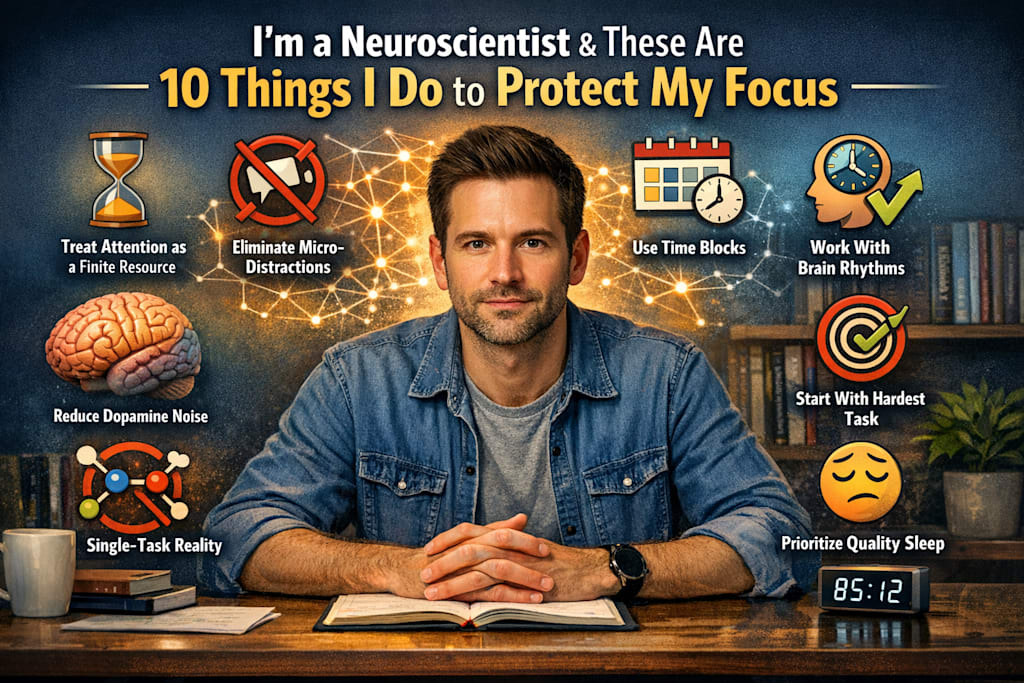
Focus is often treated like a personality trait. People say things like “I just can’t concentrate” or “I’m not a focused person.” But from a neuroscience perspective, that idea is misleading. Focus is not who you are. It is a state your brain enters under specific conditions. And those conditions are becoming harder to maintain in a world built to interrupt you. As a neuroscientist, I don’t think of focus as something you force. I think of it as something you protect. Because every notification, every tab, every quick dopamine hit is competing for the same limited cognitive resources in your brain. Over time, I’ve realized something important: the people who appear naturally focused are usually just better at designing environments that make distraction less available. Here are 10 things I personally do to protect my focus in an age of constant interruption.
1. I Treat Attention as a Finite Resource :
One of the most important shifts in my thinking came from understanding that attention is limited. Your brain does not truly multitask. It rapidly switches between tasks, and each switch carries a cognitive cost. This is called “attention residue,” where part of your brain stays stuck on the previous task. So I stopped asking, “How do I do more?” and started asking, “What deserves my attention right now?” That single question changed how I work.
2. I Eliminate Micro-Distractions Before They Begin :
People think distraction is caused by big things—social media, TV, noise. But in reality, focus breaks through micro-interruptions. A phone vibration. A notification badge. A quick glance at another tab. Even thinking, “I should check that later.” Before any deep work session, I remove these triggers completely. My phone is out of reach, notifications are off, and my workspace is intentionally minimal. The goal is simple: reduce the number of times my brain has to “choose again.”
3. I Use Time Blocks Instead of Vague Plans :
To-do lists are useful, but they are also mentally expensive. Every time you look at a list, your brain has to decide what to do next. That decision fatigue slowly drains focus. Instead, I assign tasks to time blocks. For example: 9:00–10:30: Writing 10:30–10:45: Break 10:45–12:00: Research reading This removes ambiguity. When the time arrives, I already know what my brain should be doing.
4. I Work With the Brain’s Natural Rhythms :
Neuroscience shows that attention is not constant throughout the day. It rises and falls in cycles, often called ultradian rhythms, lasting roughly 90 minutes. Instead of fighting this, I structure my work around it. I work in focused cycles, followed by short recovery breaks. This prevents cognitive fatigue from accumulating silently in the background. Ignoring these rhythms feels productive in the moment—but usually leads to burnout and shallow thinking later.
5. I Don’t Depend on Motivation :
Motivation is unreliable because it is emotionally driven. Focus, however, is structural. So I rely on systems, not feelings. I create routines that reduce friction to starting work. The less I have to “decide” to begin, the more consistent my focus becomes. In neuroscience terms, I’m reducing activation energy for productive behavior.
6. I Start With the Most Demanding Task First :
The brain’s executive functions—decision-making, planning, impulse control—are strongest when mental energy is highest. That’s usually early in the day. So I deliberately start with the hardest cognitive task first. This could be writing, problem-solving, or deep analysis. Everything after that feels easier, not because the tasks change—but because my mental load decreases as the day progresses.
7. I Reduce Dopamine Noise in My Environment :
Modern digital environments are engineered for stimulation: short videos, endless feeds, constant novelty. Over time, this trains the brain to expect frequent rewards, which makes sustained focus feel uncomfortable. So I periodically reduce stimulation. No scrolling, no background media, no rapid content switching. At first, this feels dull. But that discomfort is actually your brain recalibrating. Focus improves when your reward system is no longer overstimulated.
8. I Use “Single-Task Reality” :
Even if you believe you’re multitasking, your brain is still switching tasks rapidly. To counter this, I enforce a simple rule: one task at a time, physically and digitally. One tab. One document. One objective. This reduces “context switching cost,” which is one of the biggest hidden drains on cognitive performance. When the environment supports single-tasking, focus becomes much easier to sustain.
9. I Protect Sleep Like It’s Cognitive Maintenance :
Sleep is not downtime—it is active brain processing. During deep sleep, the brain consolidates memory, clears metabolic waste, and resets attention systems. Without sufficient sleep, focus becomes unstable and emotionally reactive. No productivity strategy can compensate for poor sleep quality. So I treat sleep not as optional rest, but as maintenance for my cognitive system.
10. I Practice Controlled Boredom :
This is one of the most underrated practices. Most people avoid boredom immediately by reaching for stimulation—phones, videos, music. But constantly escaping boredom weakens attention endurance. So I intentionally allow moments where nothing is happening. No input. No distraction. At first, it feels uncomfortable. But over time, it strengthens the brain’s ability to remain present without external stimulation. And that ability is the foundation of deep focus.
Final Reflection :
Focus is not about trying harder. It is about designing better conditions for your brain. We live in an environment where attention is constantly being competed for—by apps, platforms, and endless information streams. In that environment, distraction is not a failure of discipline. It is the default outcome unless you actively resist it. The real skill is not becoming someone who never gets distracted. It is becoming someone who notices distraction quickly—and returns to focus without struggle. And that return, repeated over time, is what builds deep work, clarity, and real cognitive control.
About the Creator
Enjoyed the story? Support the Creator.
Subscribe for free to receive all their stories in your feed.
Comments
There are no comments for this story
Be the first to respond and start the conversation.