
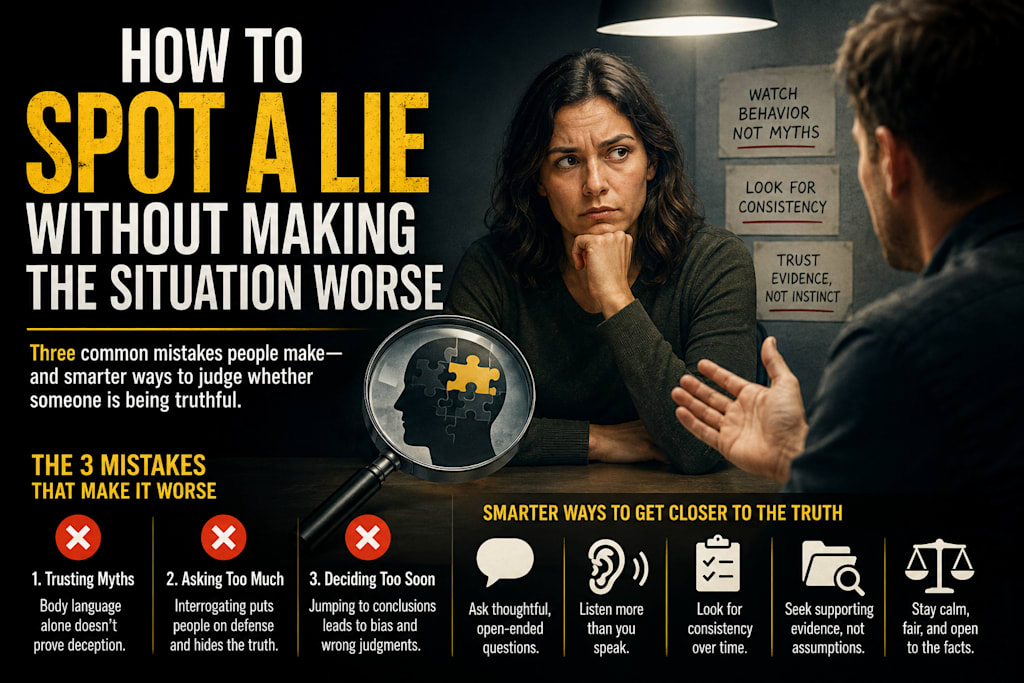
How to Spot a Lie Without Making the Situation Worse
Three common mistakes people make—and smarter ways to judge whether someone is being truthful.

Have you ever walked away from a conversation thinking, Something about that didn't feel right?
Maybe a friend gave an explanation that seemed a little too polished. Perhaps a coworker changed small details every time they retold a story. Or maybe someone close to you answered a simple question with an unusually complicated response.
Most of us have experienced moments when we suspect someone isn't being completely honest. The challenge is figuring out what to do next. Popular culture has convinced many people that lies are easy to spot if you simply watch for shifty eyes, crossed arms, or nervous fidgeting. In reality, human behavior is far more complex.
There is no single gesture, facial expression, or tone of voice that proves a person is lying. Honest people get nervous, while confident liars may appear perfectly calm. Instead of relying on myths, it's far more useful to pay attention to patterns, context, and consistency.
If you believe someone may not be telling the truth, avoid these three common mistakes. They often make the situation worse and reduce your chances of discovering what actually happened.
Mistake #1: Believing Body Language Is a Lie Detector
One of the biggest misconceptions about deception is that it can be identified by a few physical cues.
You've probably heard advice like:
- "Liars won't look you in the eye."
- "If someone touches their face, they're hiding something."
- "Crossed arms mean they're being dishonest."
While these behaviors can sometimes occur during stressful conversations, none of them reliably indicate deception on their own.
People avoid eye contact for many reasons. They may be shy, anxious, embarrassed, or simply uncomfortable with confrontation. Likewise, someone may fidget because they're under pressure—not because they're lying.
Instead of searching for a single "tell," compare a person's current behavior with their normal behavior. If someone who is usually relaxed suddenly becomes unusually guarded during one specific topic, that change may be worth noticing. Even then, it should be viewed as a reason to ask better questions—not as proof of dishonesty.
The key is to observe without jumping to conclusions.
Mistake #2: Turning the Conversation Into an Interrogation
When suspicion takes over, many people respond by asking rapid-fire questions.
"Where were you?"
"Who were you with?"
"What time did you leave?
"Why didn't you answer your phone?"
Although this may seem logical, it often produces the opposite of what you want.
People who feel attacked become defensive. Even someone telling the truth may struggle to remember details accurately when they're under pressure. Stress affects memory, making honest answers sound uncertain.
A more effective approach is to ask one clear question at a time and genuinely listen to the answer.
Silence can also be surprisingly powerful. Many people rush to fill quiet moments, sometimes revealing additional details without being prompted. Interrupting constantly may prevent useful information from emerging naturally.
Your goal shouldn't be to "catch" someone. It should be to understand what actually happened.
Mistake #3: Deciding the Verdict Before Hearing the Evidence
Perhaps the most dangerous mistake is assuming you've already figured everything out.
Once we believe someone is lying, our brains begin filtering information through that belief. We notice details that support our suspicion while ignoring evidence that points in the opposite direction.
Psychologists call this confirmation bias.
Imagine you think a coworker is making excuses for missing a deadline. Every late arrival, forgotten email, or vague explanation strengthens your belief—even if there are legitimate reasons behind those events.
This mental shortcut affects everyone.
Instead of asking, "How can I prove they're lying?" ask yourself, "What evidence would change my mind?"
That simple shift encourages fairer thinking and better decisions.
Pay Attention to Consistency
Rather than focusing on body language, pay attention to whether a person's story remains consistent over time.
This doesn't mean every detail must be identical. Human memory isn't perfect. Honest people sometimes forget exact times, dates, or minor details.
However, the overall sequence of events usually remains stable.
If major parts of a story change repeatedly without a clear explanation, it's reasonable to ask for clarification.
Consistency isn't proof of honesty, but repeated contradictions deserve careful attention.
Watch for Overly Complicated Explanations
Sometimes people unintentionally reveal uncertainty by providing far more information than the question requires.
Imagine asking someone why they were late.
A truthful answer might simply be:
"Traffic was much heavier than usual."
Someone trying too hard to sound convincing may launch into a long story involving multiple unrelated details.
Of course, talkative people naturally give detailed answers, so this isn't evidence of lying by itself. The important question is whether the extra information actually answers the original question or distracts from it.
Stay Calm
Emotions influence both the speaker and the listener.
If you become angry or accusatory too quickly, the conversation often shifts away from facts and toward defending feelings.
Remaining calm doesn't mean ignoring your concerns.
It means creating an environment where truthful conversation is more likely to happen.
Speak respectfully.
Avoid sarcasm.
Ask open-ended questions.
Give the other person time to think before responding.
People are generally more willing to share information when they don't feel immediately judged.
Look for Supporting Evidence
Whenever possible, compare stories with facts instead of assumptions.
Did the timeline match available records?
Do other reliable sources support the explanation?
Are important details independently verifiable?
Evidence is always stronger than instinct.
Your intuition can alert you that something deserves attention, but it shouldn't be treated as proof.
Accept Uncertainty
One of the hardest lessons is recognizing that you won't always know for certain whether someone lied.
Sometimes there simply isn't enough information.
Trying to force certainty can lead to unfair accusations that damage relationships more than the original issue ever could.
Being comfortable saying, "I don't know yet," is a sign of thoughtful judgment—not weakness.
Patience often reveals what immediate confrontation cannot.
Building Trust Matters More Than Catching Lies
Ironically, the healthiest relationships aren't built on becoming an expert lie detector.
They're built on honest communication, mutual respect, and a willingness to address problems directly.
When people feel safe telling the truth—even uncomfortable truths—they're less likely to hide them in the first place.
That doesn't mean trusting everyone blindly.
It means balancing healthy skepticism with fairness.
Final Thoughts
The next time you suspect someone isn't being truthful, resist the urge to rely on dramatic body-language myths or snap judgments.
Instead, slow down.
Observe patterns instead of isolated behaviors.
Ask thoughtful questions instead of launching accusations.
Listen carefully before reaching conclusions.
And remember that evidence is always more reliable than assumptions.
The people who consistently uncover the truth aren't those with supernatural intuition. They're the ones who stay patient, remain objective, and let facts—not emotions—guide their decisions.
In the end, spotting a lie isn't about winning an argument. It's about understanding reality as accurately as possible—and protecting trust wherever you can.
About the Creator
Enjoyed the story? Support the Creator.
Subscribe for free to receive all their stories in your feed.
Comments
There are no comments for this story
Be the first to respond and start the conversation.