
“Gold Over Glare: The Night Belongs to Yellow Light”
How Warmer Wavelengths Preserve Night Vision and Reduce Glare
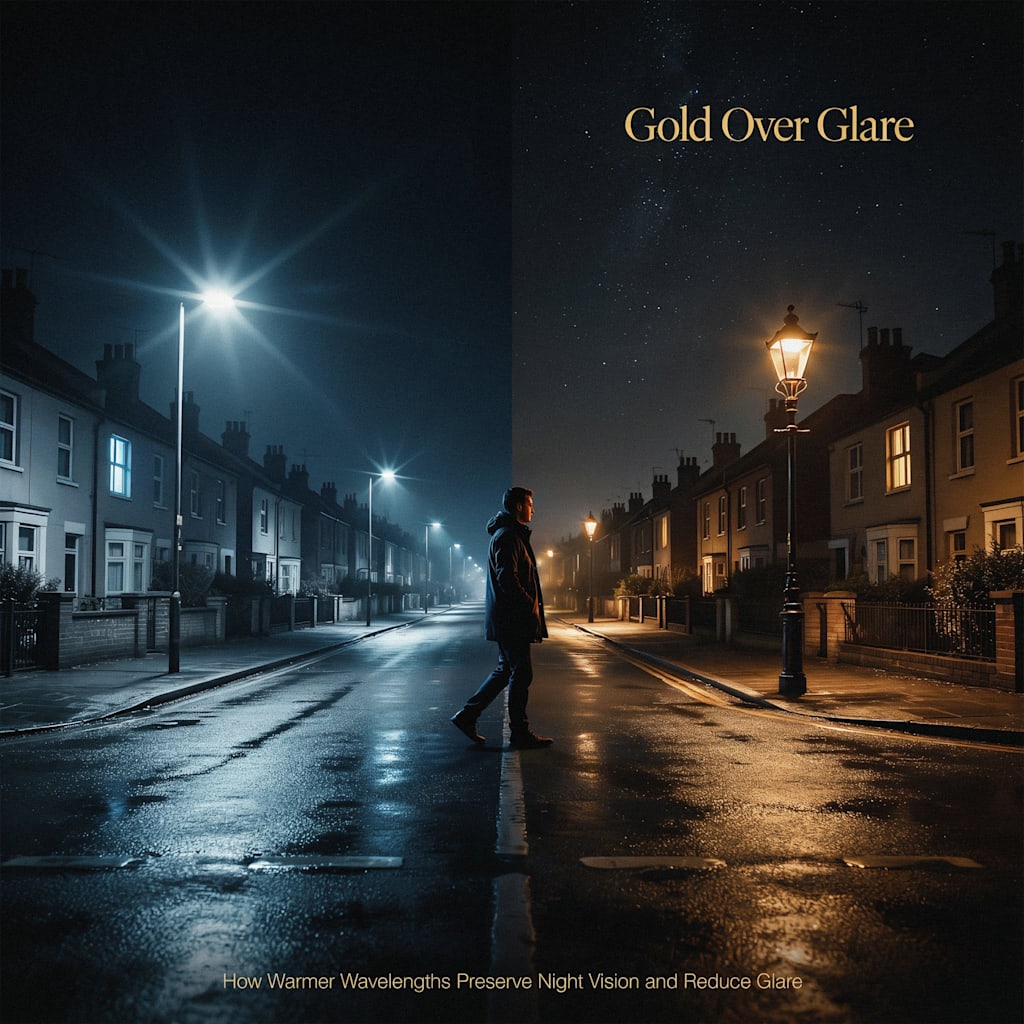
For over a century, humanity waged a war against darkness, believing that more light — brighter, whiter, and more intense — automatically meant better vision and greater safety. The result is a modern nightscape bathed in the cold, blue-white glare of LEDs, a light so harsh it often blinds more than it illuminates. But a quiet revolution is taking place, one that looks back to a warmer, more ancient color to reclaim the night. The evidence is mounting: when the sun goes down, gold outclasses glare. The night, quite simply, belongs to yellow light. To understand why yellow light is superior, we first have to look inside the human eye itself. Our retinas contain two primary types of photoreceptor cells: cones, which handle color and fine detail in bright conditions, and rods, which are a thousand times more sensitive to light and take over in dim environments. This rod-driven state is known as scotopic vision — your natural night mode. Rods are exquisitely tuned to the blue-green part of the spectrum, which is exactly where harsh white LEDs pump out a tremendous spike of energy. When a cool white light hits your eye, it essentially screams at your rods, overdriving them into a state of chemical depletion called photobleaching. The pigment that rods need to reset, called rhodopsin, takes around 30 to 45 minutes to fully regenerate in darkness. A single glance at a white LED streetlight can wipe out your carefully earned natural night vision in an instant, leaving you effectively blind once you step back into the shadows. Yellow light, by contrast, is a gentleman with the eye. Its spectrum sits predominantly in the longer wavelength region, where rods are dramatically less sensitive. A golden-amber light source, peaking around 590 nanometers, stimulates cones well enough to give you crisp definition and excellent contrast but leaves the rod system largely undisturbed. This is why astronomers, soldiers, and sailors have long used dim red or amber lights for nighttime tasks: you can read a map, navigate a path, and still look up to see the stars or scan a dark treeline without being disabled by a self-inflicted white flash. You aren’t just seeing light; you’re preserving the eye’s own exquisite biological machinery. The next culprit tied to white light is glare itself. Glare is not just a minor discomfort; it is a genuine visual impairment caused by intraocular scattering. Short-wavelength blue light scatters significantly more as it passes through the various fluids and proteins within the eye, creating a luminous veil that washes over the retina and slashes contrast sensitivity. For older adults, whose eyes have accumulated more microscopic imperfections in the lens, this effect is catastrophically worse. A street lit with 4000K or 5000K white LEDs can be a disorienting wall of halos and starbursts, making it genuinely difficult to spot a pedestrian at the curb. Golden light, with its minimal blue component, cuts through the eye’s optical media cleanly. The image on the retina is sharper, the shadows are softer, and the space between objects feels deep and legible rather than a flat, overexposed sheet. One revealing study published in the journal Lighting Research & Technology found that for equivalent photopic luminance, warm-white and amber light sources consistently produced lower discomfort glare ratings than cool-white LEDs across all age groups. You aren’t sacrificing safety for mood; you are actively upgrading the quality of your vision. The biological price of white light extends far beyond the retina, deep into the brain’s master clock. Specialized cells called intrinsically photosensitive retinal ganglion cells (ipRGCs) contain melanopsin, a photopigment that is exquisitely sensitive to blue light around 480 nanometers. These cells don’t form images; they tell your brain whether it is day or night. When they are blasted by the blue peak of a white LED after sunset, they send an unambiguous alarm signal to the suprachiasmatic nucleus: the sun is still up, halt all melatonin production, stay alert. Melatonin is not just a sleep hormone; it is a powerful antioxidant that repairs DNA, modulates immune function, and starves certain cancer cells. The World Health Organization’s International Agency for Research on Cancer has classified shift work that involves circadian disruption as a probable human carcinogen, partly due to this melatonin-suppressing light exposure. Yellow light, with its rich amber wavelength profile, sits almost entirely outside the melanopsin danger zone. A warm 2200K lamp provides all the visual information you need to move safely through your home or neighborhood while telling your ancient biology the honest truth: night has fallen, it is time to wind down, you are safe. Beyond human biology, the night belongs to a vast web of other creatures who suffer profoundly under white glare. Nocturnal pollinators, including hawk moths and certain beetles, can become fatally trapped orbiting a blue-rich lamp instead of feeding and reproducing. Migrating birds, which navigate by starlight and the Earth’s magnetic field, are disoriented by the skyglow of cities and increasingly collide with lit buildings. Sea turtle hatchlings, hardwired for millions of years to crawl toward the brightest horizon — historically, the moon reflecting off the ocean — are instead lured inland toward white streetlights, where they die of dehydration or predation. Amber and yellow lights, particularly in the narrow-spectrum “turtle-safe” wavelengths, are a proven conservation tool that literally brings hatchling disorientation rates close to zero. When a coastal community switches from white to gold, it is not just an aesthetic choice; it is a lifeline. Then comes the sky itself. Light pollution has stolen the Milky Way from the unaided eyes of nearly 80 percent of North Americans. The physics here is inescapable: Rayleigh scattering dictates that short wavelengths scatter vastly more in the atmosphere than long ones. A photon of blue light is many times more likely to bounce off air molecules and hang in a glowing dome of skyglow than a photon of golden light, which cuts through the atmosphere with a fraction of the interference. This is why world-class observatories like those in Arizona’s Flagstaff region and Chile’s Atacama Desert mandate either low-pressure sodium or filtered amber LED lighting. Those iconic gold-soaked street scenes are not nostalgic relics; they are a functional shield protecting our last windows into the cosmos. Interestingly, the city of Flagstaff became the world’s first International Dark Sky City largely because it aggressively adopted narrow-spectrum amber lighting decades ago, proving that a modern city can function brilliantly without erasing the universe above it. There is a practical, day-to-day driving reason that the golden rule endures, too. Think of fog lights. For generations, selective yellow fog lamps were standard on European vehicles, and for good reason. When white light hits suspended water droplets in fog, rain, or snow, the heavy blue component backscatters directly into the driver’s eyes, creating an opaque white wall. Yellow light, lacking that scatter-prone short-wavelength energy, penetrates the particulate screen more deeply, allowing drivers to see the road surface and its markings rather than a blinding reflection of their own headlights. This same principle applies to your own street on a rainy night. The white-LED glare bouncing off wet asphalt creates a mirror-like sheen of blinding light, while golden illumination renders the road’s texture and hazards with a quiet clarity. Finally, we are learning that the wholesale transition to white light may have been an act of technological overshoot. The first generation of LED streetlights was applauded for energy efficiency, but it came at the cost of a 4000K or 5000K color temperature that no one’s biology had asked for. The good news is that the industry is pivoting. Warm-white and filtered amber LEDs now offer the same electrical efficiency without the biological wreckage. Forward-thinking municipalities from Phoenix to Cambridge, Massachusetts, are specifying 2700K or even narrow-amber 590nm LED retrofits, not as a step backward to gaslight, but as a sophisticated fusion of 21st-century efficiency and timeless human-centered design. Gold over glare is not a poetic metaphor. It is a physiological truth, an ecological imperative, and a technological evolution. The white light era treated darkness like an enemy to be obliterated. The golden light era understands that the night is a delicate, living presence to be shared with care. When we wrap our streets in amber, we do more than see better. We sleep deeper, protect the creatures that inherit the dark hours, and lift our gaze to a sky that has suddenly been returned to us, star by star. The night, after all, never belonged to the glare. It was always waiting for the gold.
About the Creator
Touseef Gul
If you want interesting information about psychology, astronomy and modern technology change.Then this page will provide suitable encyclopedia for curious minds.
Enjoyed the story? Support the Creator.
Subscribe for free to receive all their stories in your feed.
Comments
There are no comments for this story
Be the first to respond and start the conversation.