
Elucidation: A Fifteen-Billion-Year Search for Meaning
This is the first in a series of articles inspired by a set of philosophical lectures given over fifty years ago.

• • •
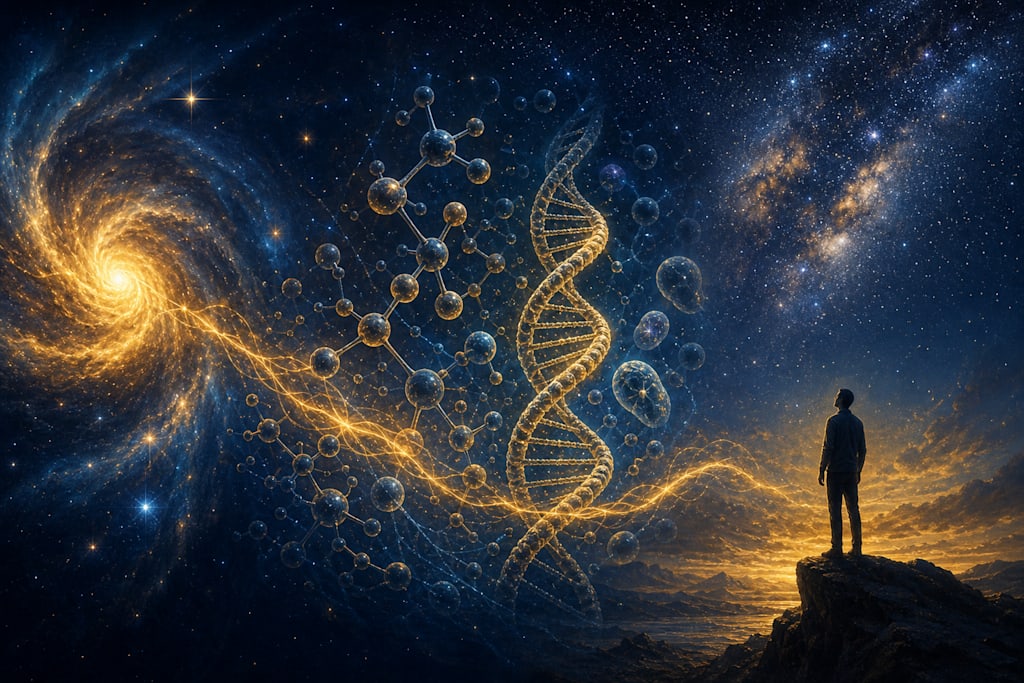
What if the story of existence — from the first explosion of matter fifteen billion years ago to this very moment — is not random, not accidental, not a meaningless chain of events, but a single unfolding process with a discoverable direction?
That is the central question of the Elucidation series.
The word Elucidation means the act of making a complex truth clear and intelligible. It is a fitting title, because these lectures attempt something ambitious: to take the most fundamental questions a human being can ask — What is real? What am I? Where is all of this going? — and to answer them not through dogma or abstract speculation, but through a careful, step-by-step investigation of reality itself.
The Question That Started Everything
More than fifty years ago, a group of thinkers faced a practical problem. Before they could act — before they could commit to any cause, any movement, any way of life — they needed to know why. Not in a vague, sentimental way. They needed a foundation. A framework. An ideology in the deepest sense of the word: a coherent set of beliefs about reality, about human nature, and about history that could guide every decision, withstand every challenge, and hold together under pressure.
So they did something remarkable. Instead of simply adopting the nearest available belief system, they studied everything. They investigated every major school of thought they could access — from Marxism to capitalism, from existentialism to positivism, from ancient Greek philosophy to modern science. They studied the history of religions. They read Darwin and Oparin, Hegel and Freud, Sartre and Newton. They examined the evolution of matter, the evolution of life, and the evolution of human societies.
And from this total investigation, they found something they had not expected: a thread.
The Thread
Not a metaphor. A discoverable pattern running through all of existence — from the initial cloud of hydrogen that gave birth to the universe, through the formation of stars and elements, through the emergence of organic compounds and the first living cells, through biological evolution and the rise of human consciousness, and into the development of societies, cultures, and civilizations.
That pattern, they argued, follows specific laws:
1. Complexity — At every stage, existence moves from simpler forms to more complex ones. Atoms become molecules. Molecules become cells. Cells become organisms. Organisms become societies. The old continuously gives way to the new.
2. Acceleration — This movement speeds up over time. What took billions of years in the mineral stage took millions in the biological stage, thousands in the social stage, and continues to accelerate. Each stage moves faster than the one before it.
3. Directionality — The process does not go backward. Despite setbacks, collapses, and apparent reversals, the overall direction is always forward — toward greater complexity, greater awareness, greater freedom from limiting conditions.
These are not articles of faith. They are conclusions drawn from the observable history of the universe, confirmed by modern science — from cosmology to biology to the study of civilizations. The lectures present the evidence in detail, tracing the story from the Big Bang through mineral formation, through the origin of life, through Darwin and beyond, into the structure of human societies.
The Big Question
But here is where the investigation becomes truly interesting. Once you accept that existence has a direction — that it is not random, not cyclical, not declining — a profound question emerges:
Why?
Why does matter organize itself into ever more complex forms? Why does the process accelerate? Why is it irreversible? Is there a purpose at work? And if so, what does that mean for us — for human beings, who stand at the most complex and conscious point of this entire process?
These thinkers studied every major framework — Marxism, Christianity, Buddhism, secular humanism, scientific materialism — to see which best accounted for the evidence. Their investigation of evolutionary development led them to conclusions about the unity of existence, the directionality of history, and the role of conscious beings in accelerating that direction.
From this, they arrived at three principles: that existence is unified and directed, that human actions carry real and intrinsic consequences, and that conscious guidance accelerates the process of development. These principles were not adopted on faith. They were the conclusions of an investigation — and the rest of this series presents the evidence on which they stand.
What This Series Will Cover
Over the coming weeks, these articles will walk through the full argument, step by step:
- What is ideology? Why every human being already has one, whether they know it or not — and why it matters to examine it consciously.
- How should we investigate reality? Why neither pure rationalism nor pure empiricism is enough, and what a genuine method of inquiry looks like.
- The story of everything. From the first cloud of hydrogen to the rise of civilizations — what science tells us about where we came from.
- The laws of evolution. Complexity, acceleration, and directionality — the three patterns that govern the process.
- The question of meaning. Does existence have a purpose? And what follows if it does?
Whether you agree with the conclusions or not, the questions are real. They are the same questions human beings have asked in every era and every civilization. What makes these lectures unusual is the method: not theology first and evidence second, but evidence first and interpretation after.
The lectures are philosophy as it was meant to be — not locked in academic halls, but brought into life. Into real decisions. Into the question of how to live.
Let's begin.
• • •
Next article: **What Is Ideology — And Why Does It Matter?
Elucidation is a series of articles inspired by philosophical lectures given around 50 years ago. New articles are published weekly.
This article is part of the Elucidation series. The articles have been written and reviewed by the author with the assistance of AI.
About the Creator
Han Elucidation
Why do we exist? A searcher. Exploring existence, meaning, and what it means to be human through the Elucidation series.
Enjoyed the story? Support the Creator.
Subscribe for free to receive all their stories in your feed.
Comments
There are no comments for this story
Be the first to respond and start the conversation.