
you know how i know you're gay
You Know How I Know You're Gay? Decoding the Infamous Phrase from Pop Culture to Real Life


Few phrases from early 2000s comedy have embedded themselves into cultural memory quite like "You know how I know you're gay?" Delivered with deadpan confidence by Jack (played by Jack Black) in the 2005 film The Wedding Crashers, the line became an instant classic a punchline, a meme, and eventually, a curious relic of a less enlightened era.
But what made that line so memorable? And more importantly, what does it tell us about how humor, sexuality, and masculinity intersected at that moment in time and how those dynamics have shifted since? Let's unpack the phrase, its cultural context, and why it still echoes in conversations today.
The Scene: A Moment of Comedy Gold
For those who need a refresher: The Wedding Crashers follows John (Owen Wilson) and Jeremy (Vince Vaughn) as they crash wedding receptions to meet women. In one memorable scene, Jeremy's girlfriend, Gloria (Isla Fisher), has been staying at his apartment, and her possessive, unsettling behavior has driven him to the edge.
As Jeremy attempts to explain his discomfort to John, he launches into a rapid-fire series of observations about Gloria her bizarre eating habits, her collection of ceramic dolls, her unsettling obsession. Each observation ends with the same refrain: "You know how I know you're gay?"

The joke, of course, is that the question is asked to John, a straight man. The irony is the punchline. Jeremy is projecting his own frustrations onto his friend, using "gay" as a catch-all for behaviors he finds strange, uncomfortable, or outside the norm of heterosexual masculinity.
It was funny in 2005. But two decades later, it lands differently.
The Era: What 2005 Looked Like for LGBTQ+ Visibility
To understand the phrase's impact, we have to remember what the cultural landscape looked like when The Wedding Crashers premiered.
Same-sex marriage was not yet legal anywhere in the United States. Massachusetts would become the first state to legalize it just one year earlier, in 2004. The Defense of Marriage Act (DOMA) was still federal law. "Don't Ask, Don't Tell" was still the military's policy.
Mainstream LGBTQ+ representation was sparse. Shows like Will & Grace and Queer as Folk were exceptions, not the rule. Most gay characters were supporting roles, often defined by stereotypes. The word "gay" was still commonly used as a casual pejorative as in "that's so gay" meaning stupid, weird, or inferior.
Comedy was still largely reliant on punching down. Jokes about minorities, women, and LGBTQ+ people were standard fare. The assumption was that audiences understood the humor came from a place of exaggeration, not malice. But that assumption papered over real harm.
In this context, "You know how I know you're gay?" was just another joke in a long line of jokes that used homosexuality as a punchline. It wasn't malicious at least, not intentionally. But it reflected and reinforced the idea that being gay was something worth mocking, something outside the norm, something that could be identified through superficial observations.
The Mechanism: Why the Joke "Worked"
The phrase worked on multiple levels for its original audience:
The Absurdity Factor: The "evidence" Jeremy presents is intentionally ridiculous. He claims to know someone is gay because of what they eat, how they decorate, how they behave in relationships. The absurdity is meant to signal that the accusation is not serious.

The In-Group Dynamic: The joke is between two straight men. By asking "you know how I know YOU'RE gay?" to a straight friend, the punchline becomes the impossibility of the accusation. The humor comes from how obviously untrue it is.
The Performance of Masculinity: The scene also gently mocks the fragility of straight male identity. The fear of being perceived as gay even by a close friend is played for laughs. In 2005, this felt edgy and self-aware.

But here's the problem: when a joke relies on "gay" as the ultimate marker of weirdness, it doesn't matter whether the accusation is false. The implication is still that being gay is undesirable, embarrassing, or funny.
The Shift: How Comedy (and Culture) Has Changed
Two decades later, the landscape looks very different.
Same-sex marriage is legal nationwide in the United States (since 2015) and in dozens of countries around the world. Public support for LGBTQ+ rights has risen dramatically across generations.
Representation has exploded. From Pose to Schitt's Creek, from Lil Nas X to Elliot Page, LGBTQ+ people are visible in every corner of culture not as jokes, but as full, complex human beings.
Comedy has evolved. The best contemporary comedians still push boundaries, but they're more likely to punch up than down. Jokes that rely on demeaning marginalized groups are increasingly seen as lazy, not edgy.
Language has changed. Using "gay" as a pejorative is no longer acceptable in most social and professional settings. Young people are far more likely to understand sexual orientation as a spectrum, not a binary.

In this new context, "You know how I know you're gay?" sounds dated. Not offensive, necessarily, but unmistakably from another time a time when casual homophobia was background noise, not something worth noticing or challenging.
The Real Question: How Do You Actually Know?
Beyond the comedy, the phrase touches on something real and serious: How do people know someone is gay? And why does that knowledge matter?
In real life, there is no reliable way to know someone's sexual orientation just by looking at them or observing their behavior. Stereotypes about gay men being effeminate, fashion-forward, or culturally sophisticated are just that stereotypes. They describe some gay men and miss many others entirely.

Gay people are doctors and construction workers, athletes and artists, introverts and extroverts. They eat all kinds of food, decorate all kinds of ways, and love all kinds of people. The only way to truly know someone's orientation is for them to tell you.
The persistence of the "you know how I know" framework reflects a deeper cultural anxiety: the fear of not being able to tell. For centuries, LGBTQ+ people have been forced to hide their identities for safety. The ability to "pass" as straight was a survival skill. And for those who wanted to identify others for community, for safety, for romance developing a kind of "gaydar" was essential.

But in a more open era, where coming out is safer (though not safe everywhere), the need for such detection has diminished. The best approach is simple: don't assume. Ask respectfully, if it's relevant. Or better yet, wait for people to share what they want you to know.
The Legacy: What the Phrase Teaches Us
So what does "You know how I know you're gay?" teach us today?
Humor is contextual. What was funny in 2005 may not be funny now not because people are "too sensitive," but because our understanding of harm has grown. Jokes that rely on punching down are less acceptable because we recognize that they contribute to real-world prejudice.
Language evolves. The casual use of "gay" as a pejorative has largely fallen out of favor. Most people now understand that words have power, and using someone's identity as a punchline has consequences.

Representation matters. When the only images of gay people in mainstream culture are stereotypes or punchlines, it's harder for straight people to see them as fully human. And it's harder for gay people to see themselves as fully valid.
We can enjoy the past without being stuck in it. You can still laugh at The Wedding Crashers. You can still appreciate Jack Black's delivery. But you can also acknowledge that some parts of that movie haven't aged well and that's okay. Growth doesn't require erasing history; it just means learning from it.
Moving Forward: Beyond the Punchline
The phrase "You know how I know you're gay?" will likely remain in our cultural lexicon as a callback to a specific moment in comedy history. But its power as a joke has faded not because people have lost their sense of humor, but because we've gained something better: a deeper understanding of how humor can include rather than exclude.

Today, the funniest jokes about sexuality don't rely on gayness as the punchline. They come from writers, comedians, and everyday people who understand that identity is rich, complex, and worthy of more than a cheap laugh.
So the next time someone asks, "You know how I know you're gay?" whether in jest or in earnest the answer is simple: You don't. And that's the point. People are far more than the stereotypes we project onto them. Knowing someone means listening, not guessing.
A Final Thought
The line endures not because it was great comedy, but because it captured something true about its time a moment when casual homophobia was still normalized, when masculinity felt threatened by difference, and when "gay" was still a punchline rather than just another way of being human.
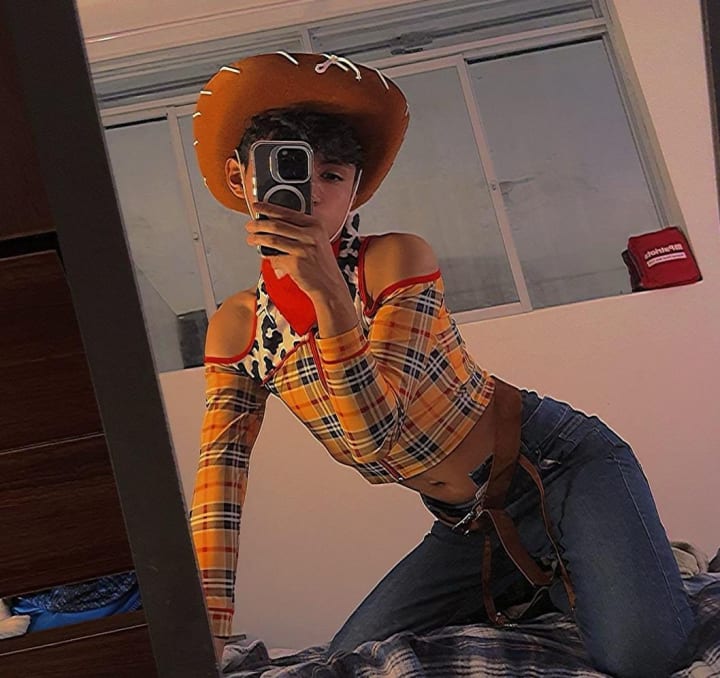
We've moved past that moment, mostly. Not completely there's still work to do. But far enough that we can look back at the phrase with a mixture of nostalgia and relief: nostalgia for a silly movie that made us laugh, and relief that we don't laugh at the same things anymore.
That's progress. And progress, unlike a punchline, is something worth celebrating.
About the Creator
David Femboy
David here. Sharing my authentic femboy journey the outfits, the lessons, the life. For anyone exploring gender expression. Let’s redefine masculinity together. 💖
Enjoyed the story? Support the Creator.
Subscribe for free to receive all their stories in your feed.
Comments
There are no comments for this story
Be the first to respond and start the conversation.