performance poetry
Performance Poetry is poetry out loud; poems brought from the page to the stage.
The Door That Waits
The Door That Waits No one knew where the door came from. It stood in the middle of an empty field at the edge of town, untouched by time or weather. There were no walls, no hinges, no frame holding it in place—just a tall, wooden door standing alone, perfectly upright, as though someone had placed it there carefully and walked away. At first, people thought it was a prank. Then a strange art piece. Then a portal, perhaps, to somewhere—or something—else. But no matter how many times they walked around it, knocked on it, or pushed it open, it just creaked gently, revealing only more grass behind it. Nothing magical happened. Nothing at all. So they left it alone. Except for Mira. Mira wasn’t like most people in town. She had the quiet, restless soul of someone who always felt like life was happening somewhere else. She worked at the local bakery, smiled politely at customers, and saved every spare coin in an old glass jar beneath her bed. But every day, when her shift ended and the smell of cinnamon and yeast clung to her clothes, she walked out to the field and stared at the door. She didn’t know why. Something about it called to her. Not with words or voices—just a feeling. Like the hum in the air before a storm or the silence before a leap. Each time she touched the wood, warm from the sun, she expected something to happen. But it never did. Until the morning everything changed. It had rained the night before, and the field was still damp with dew. Mira was late leaving the bakery, but something urged her toward the field anyway. When she got there, the door was open. Wide open. This time, the world behind it wasn’t the same field. Through the doorway was something else: a sunlit path lined with trees she'd never seen before. Birds she couldn’t name sang in the distance. The air shimmered, not with heat—but with promise. Mira froze. She looked around. No one else was there. The town hadn’t noticed. The door waited. Her heart pounded. Was it a trick? A dream? Maybe it led nowhere—maybe she’d walk through and vanish forever. But maybe... maybe it led to the life she’d always wanted. The one she dreamed of in quiet moments. A life of meaning, of adventure. A place where she belonged. She took a step forward, then another. Her foot passed the threshold. A soft breeze brushed her cheek, sweet and warm. She smiled. For the first time in her life, she didn’t hesitate. She walked through. And the door closed behind her. The next morning, it was gone. People noticed eventually. They murmured, pointed, and shrugged. Some said the wind must’ve blown it over. Others swore it had never been there at all. But they moved on. All except one small boy named Eli, who sometimes wandered near the field and stood for a long time staring at the empty patch of grass. One day, he told his mother, “I think there used to be a door there.” She smiled, patting his head. “Maybe, sweetie.” Eli said nothing more. But he kept looking. Because sometimes—when the sun rose just right and the air was still—he could swear he heard something in the distance. A creak. A whisper. A door waiting.
By Muhammad Saad about a year ago in Poets
The Gift of Words
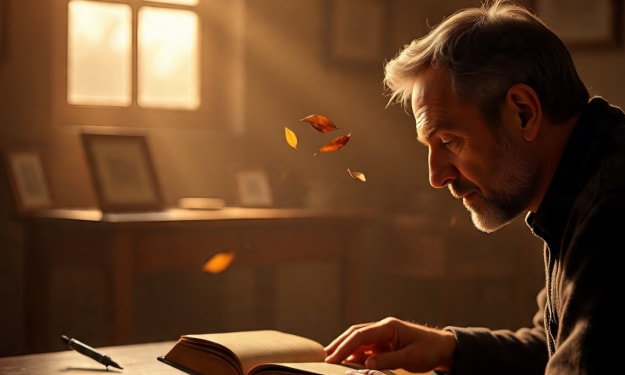
The wind rustled gently through the open window, carrying with it the scent of autumn leaves and a quiet hum of the world outside. Inside the modest study, surrounded by shelves lined with worn books and half-filled journals, sat Arman — a poet whose words had once stirred crowds, but whose voice now belonged only to the pages in his notebooks. On this particular day, the room felt different. The golden light of the late afternoon sun painted long shadows across the floor, and a kind of stillness hung in the air, as if the world paused to listen. Across from him stood his twelve-year-old son, Rayan, whose eyes had always been full of questions. Lately, though, those questions had grown quieter — replaced by the silent confusion of growing up. Arman had seen it before. He remembered the weight of that age — too old to be a child, too young to be a man. And so, he had prepared a gift — not one of toys or gadgets, but something far older. Far deeper. Arman reached into the drawer and pulled out a thick, leather-bound book. Its cover was worn, the edges frayed from years of turning pages in the middle of the night. It wasn’t just a book. It was his life. “This,” Arman said, holding it out with both hands, “is for you.” Rayan hesitated. “Is it one of your poetry books?” “Yes,” Arman smiled. “But it’s more than that. This one… I never published. I wrote it for you. Since the day you were born.” Rayan’s hands trembled slightly as he took the book. He opened it carefully, seeing page after page of neat handwriting, faded ink, and delicate drawings in the margins — birds, trees, stars, and hearts. “I don’t understand,” he whispered. “Why give this to me now?” Arman leaned back in his chair, eyes misting with emotion. “Because there are things in life that can’t be taught with rules or explained with logic. Some lessons live in the spaces between words — in poetry, in silence, in feelings. I want you to have this, Rayan, so that even when I’m not beside you, my heart still is.” Rayan flipped to the first page. The title read: For My Son, Who Taught Me to Listen Again. He glanced up. “You wrote all this… just for me?” Arman nodded. “Every poem in there was written on a day you changed me — a question you asked, a moment you cried, the way you laughed at the stars. You may not understand all of it now. But someday, when you’re ready, those words will find you.” Silence settled between them, not awkward or uncertain — but full, like the pause after a beautiful line of poetry. Rayan hugged the book to his chest. “I didn’t know words could feel like this,” he said softly. “They can,” Arman replied. “Words can heal, guide, and remind us who we are. They outlive us. And if they come from love, they never die.” As the sun dipped below the horizon, casting the room in amber hues, Rayan sat beside his father. They didn’t speak for a long time. There was no need. The boy had received not just a book, but a piece of his father’s soul — a map of feelings, a legacy of love, a timeless gift etched in ink and carried by the heart. And in that quiet room, the poet passed down the greatest verse he had ever written — the story of a father and son, bound not just by blood, but by words that would live forever.
By Muhammad Saad about a year ago in Poets
Whispers of the Wild
Whispers of the Wild Where Earth Sings and Skies Listen Beneath the boughs where silence dwells, The forest hums in secret spells. Leaves converse in rustling rhyme, A language older than all time. The sun spills gold on waking trees, And dances soft with every breeze. Each petal holds the dawn's first light, A quiet spark in morning’s flight. The river writes in liquid song, A melody that flows so long— It sings of mountains, stars, and rain, Of roots that reach through joy and pain. The sky bends low to kiss the land, With clouds that drift like painter’s hand. The winds, like whispers, gently guide, The soul to peace, the heart to pride. Here, nothing rushes, all is wise, The earth reflects in open skies. And in this stillness, we become— A part of all, yet bound to none. So breathe it in—this wild, this grace, The beating heart of every place. For nature calls in tones so true, And all it asks… is "Be here too."
By Muhammad Saad about a year ago in Poets