love poems
Love poems for hopeless romantics; I'm the poet and you're my muse.
Voices Beneath the Sunlit Sky
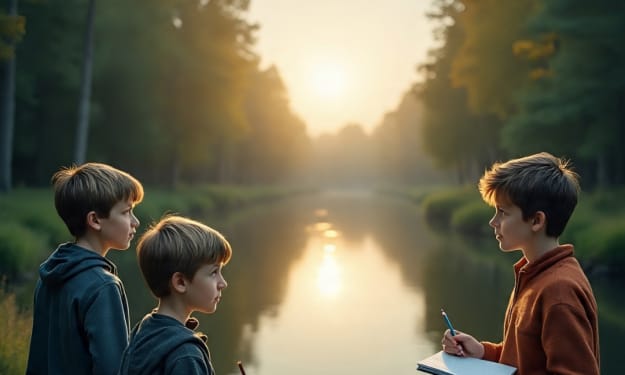
In the peaceful town of Dewford, where rivers flowed like gentle whispers and trees stood as ancient guardians of memories, there lived a group of young boys who believed that words could build worlds. They were not warriors, nor scholars, nor travelers—they were poets. They called themselves The Sunlit Voices, not because they were famous, but because they believed every poem carried a little sunlight inside it. Arham, the oldest among them, was thoughtful and quiet. He didn’t speak much, but every line he wrote could calm storms of the heart. Haseeb, cheerful and bold, wrote poems full of laughter and imagination, turning ordinary moments into dancing stories. The youngest, Ibrahim, was curious and shy, unsure whether his words were good enough. But the others believed in him, telling him that poetry was not about perfection—it was about truth. Every morning, the boys gathered by the river with notebooks pressed against their chests. They would sit beneath the warm sky and write whatever their hearts wanted to say. Some days they wrote about nature; other days about friendship, hope, and dreams. They did not write to impress anyone—they wrote to understand themselves. One day, while writing, Ibrahim frowned at his empty page. The blankness stared back at him, like a silent test he didn’t know how to solve. “I can’t think of anything,” Ibrahim muttered softly. “Look around,” Arham replied gently. “The river is talking. The wind is singing. Just listen.” Haseeb laughed playfully. “Even if you write about a single leaf, it can be a poem. Just write what you feel.” Ibrahim took a deep breath. He looked at the sunlight bouncing on the river like tiny dancing flames. The air smelled of wet soil and soft grass. Birds flew across the bright sky as if carrying messages from somewhere far and mysterious. Slowly, words began forming in his mind, not forced, but natural—like water flowing. By the time he finished, he realized something beautiful: the poem wasn’t complicated. It was honest. And that made it special. Weeks passed, and their poetry grew like seeds blooming in a garden. They read to each other, laughed at funny lines, admired deep thoughts, and learned from mistakes. They were not competing; they were maturing together, like trees sharing the same sunlight. Soon, they decided to share their poems with the whole town. They organized a small gathering under the old banyan tree in the center of Dewford. At first, they feared no one would come. Why would anyone care about poetry written by boys? But to their surprise, people of all ages gathered—teachers, shopkeepers, elders, friends, and neighbors. Everyone listened quietly as Arham read about honesty, Haseeb shared joyful verses, and Ibrahim nervously read a poem about courage and sunlight. His voice trembled, but his words shined. When he finished, the crowd clapped, not because the poem was perfect, but because it was sincere. From that day on, The Sunlit Voices weren’t just boys writing by the river—they were storytellers of Dewford. Their poems traveled beyond pages, living in hearts, reminding everyone that even the smallest voice can bring light. And beneath that sunlit sky, three young poets learned that words, when written with honesty, carry the power to change the world in the gentlest way.
By Muhammad Saad 10 months ago in Poets
Poetry Vs Poets
Poetry and poets have walked side by side since the earliest stories of humanity, but they are not exactly the same. Poetry is the art, and poets are the artists—yet sometimes people seem to compare them, as if the words should stand tall without the person behind them. The truth is far more beautiful: poetry and poets are companions, working together to give voice to feelings, experiences, and dreams that might otherwise stay unspoken. In the small community of Sunridge, a group of young poets learned this lesson through their shared passion. They gathered in an old community hall every weekend, carrying notebooks filled with scribbles, crossings-out, and secret thoughts. Some loved writing about nature, some about human emotions, and some about personal memories they were still trying to understand. But despite their different styles, they all agreed on one thing: poetry was more than lines and rhymes—poetry was life speaking. Among them was a quiet boy named Zain. He rarely spoke out loud, but he wrote more than anyone else. His poems were full of soft truths, the kind that nobody notices about life until someone describes them. He wrote about raindrops on windows, about lonely cups of tea, about how people smile even when their hearts are tired. To him, poetry was a reflection of small moments that shaped big feelings. Then there was Umar, who loved to perform. He believed that poetry was born to be spoken. His voice carried emotion that gave life to every word. When he stood in front of the microphone, the room grew still as river water. He made people feel the meaning of each line, not just understand it. And there was Raza, a thinker and a dreamer. He believed poetry should challenge the world. He wrote verses about justice, honesty, and hope. His words pushed people to reflect, not just listen. He often said, “Poetry is a mirror. Poets decide what it reflects.” One day, a small debate broke out among the three of them. Umar insisted that poetry mattered more than the poet, saying that a poem could outlive its writer. Zain quietly disagreed. He believed that poets mattered because without them, poetry could never exist. Raza, with his thoughtful nature, listened to both sides. The hall grew quiet. Pens paused. Eyes looked toward the papers in their hands. Raza then stood up and said something that stayed with them forever: “Poetry is our voice, and we are its breath. A poem may live longer than a poet, but without the poet, it would never be born. Poetry needs us, and we need poetry. There is no versus. There is only together.” Everyone nodded, understanding the deep truth in his words. Poetry was not fighting the poets, and poets were not fighting poetry. They were one team, one heart, one journey. From that day on, the Sunridge poets began writing and performing with even more appreciation. They realized that poetry was not just about words on paper or sound on a stage—it was about the connection between a message and the one who delivers it. And so, their community grew stronger. They shared, learned, listened, and expressed. Poetry became their home, and they became the builders of that home. Poetry and poets were not separate. They were partners, walking together, shaping the world with truth and imagination.
By Muhammad Saad 10 months ago in Poets