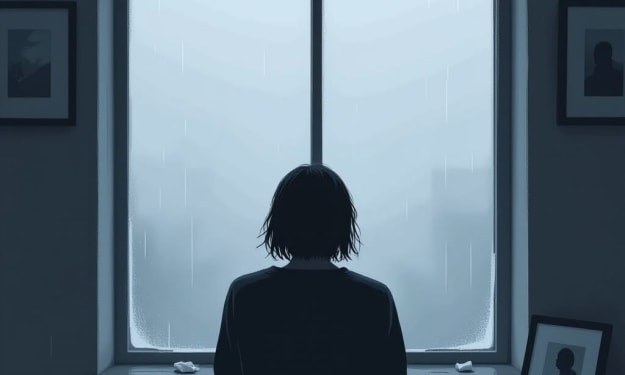
heartbreak
They can break your heart, but they can't break your soul; poetry about lost love that comforts and uplifts.
I Laughed So You Wouldn't Ask
They said I was funny. Said I lit up every room. But no one asked what it cost me to shine. No one asked why my eyes never matched my smile. They laughed at my jokes not knowing each one was a scream dressed in rhythm. I learned it’s easier to make them laugh than explain why I cry when I’m alone. So I told stories that bent the truth, wore masks so well I forgot what my real face looked like. But jokes fade. Crowds leave. And the quiet it returns, heavier than ever. I’m tired of laughing just to survive. Tired of being the sun while breaking in the dark. One day, maybe someone will hear the ache beneath my laughter and stay.
By Hazrat Usman Usmanabout a year ago in Poets
The Girl Who Fell in Pieces
She wasn’t born broken— she was built from soft things: the cotton hush of lullabies, the echo of rain on windowpanes, a mother’s warm hands braiding light into her hair. But the world has teeth and it bit her young. Not all wounds bleed, and not all screams make sound. Some stay locked in the throat, a prison of silence that tightens with time. She was ten when her voice began to splinter. Not because she didn’t speak— but because no one listened. Eleven, when trust first cracked— in a room with too many shadows and no safe exits. Twelve, when she learned to shrink to avoid being seen. Thirteen, and she was disappearing into herself— a ghost inside her own skin. The girl who fell in pieces never made a sound when she broke. She simply fractured quietly— like ice beneath feet too light to notice until the fall. They called her “quiet,” said she was “shy,” but none saw the war in her silence. Inside her chest was a glass heart, held together by threadbare hope and sheer will. She smiled in photos, perfect angles, chin tilted just so— but no one noticed how her hands shook behind her back or how she blinked too fast to keep the tears from slipping. Every mirror was an enemy. Not for how she looked— but for all it reflected: the girl who once dreamed of starlight, now just stared into a void. She stitched herself each night— threading apologies through self-blame, sewing up scars with poems no one would ever read. And yet, in her breaking, she discovered something: That bones, once shattered, grow back stronger around the fault lines. That light can find even the narrowest crack and plant a seed. She started to write— first on napkins, then on skin. Her pen a scalpel cutting truth from trauma. Each word a rebellion against the silence that had caged her. She no longer needed to be whole to be powerful. She wore her cracks like constellations— a sky written across her body in star-shaped scars. The girl who fell in pieces learned how to gather them. Not to put herself back as she was— but to rearrange, rebuild, redefine. A mosaic, not a mirror. A story, not a statistic. Some days she still shatters. She still hears echoes of the things she survived. But now she knows— shattered things can still sing. She dances now, barefoot in the ruins, her laughter rising from the rubble. She has made peace with the girl she was— the one who bled quietly, who screamed in silence. She holds her now, like a sister, and says: “You made it.” And if you ask her what it feels like to fall apart and live— she’ll tell you this: It hurts. God, it hurts. But the light that leaks through the brokenness? That’s where the truth lives. And the girl who fell in pieces is no longer afraid to be seen. She is not fragile. She is forged. She is not damaged. She is designed— by her own hands, by her own will, by a thousand nights that didn’t kill her. She is the storm that followed the silence. The bloom that split the concrete. The survivor they never expected to rise. And when she walks, she carries each piece with pride— not as burdens, but as proof that she is still here, still whole in her own way. Still rising from the wreckage, not in spite of it— but because of it.
By Israr khanabout a year ago in Poets
If Silence Could Speak
If Silence Could Speak By [Huzaifa dzine] If Silence could speak, she would not raise her voice. She would slip into a room like dusk at the end of day—uninvited, inevitable. You wouldn’t notice her at first. You’d hear her in the pause after a slammed door, in the space between “I’m fine” and everything left unsaid. She would perch on your shoulder like a breath you forgot to take, waiting to be heard but never demanding.
By Huzaifa Dzineabout a year ago in Poets
Recycled Memories
Recycled Memories By [Huzaifa dzine] I still remember the taste of her tears. Not my tears—hers, though somehow they passed through me like water through porous stone. I was seven, standing in Grandma Marguerite’s kitchen, listening to her whispers as she stirred the pot of bean soup. The wooden spoon clacked against the sides, but I heard something deeper: a trembling in her voice, a memory she carried like an heirloom passed down through generations.
By Huzaifa Dzineabout a year ago in Poets
The Ghost in My Mirror
The Ghost in My Mirror By [Huzaifa dzine] Every morning, I see her. She stands just behind the foggy sheen of the mirror, where my reflection should be. Her eyes mimic mine, but they are older somehow—haunted. Her skin carries the same freckles I have, but they’ve turned pale like faded ink. Her shoulders slump with a weight I never agreed to carry. Still, she waits there every day, wordless but watching, as I splash water onto my face and pretend not to notice.
By Huzaifa Dzineabout a year ago in Poets