
Wikie and Keijo Are Running Out of Time: France and Spain Must Clarify Their Plans Before December
The two aquarium-born killer whales at the former Marineland Antibes need a safe, permanent future. Loro Parque has publicly offered to receive them, but the transfer’s status, Spain’s position, and the readiness of any alternative destination require verification.

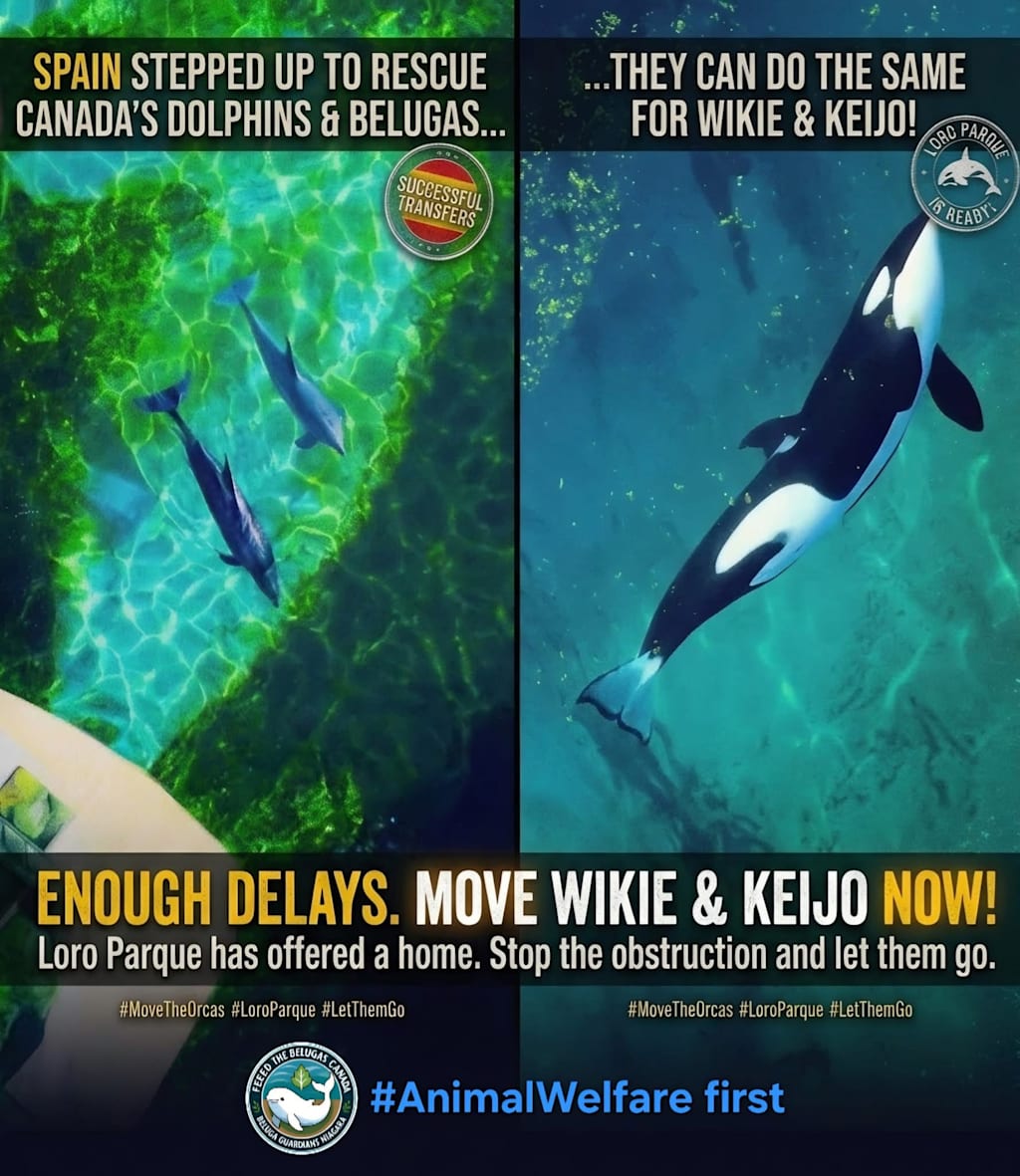
Wikie and Keijo, two killer whales who were born under human care, currently live at the former Marineland Antibes in France. While it is true that animal protection laws in France will prohibit keeping cetaceans under human care from December 2026, the exact wording of the new law and the date of its enactment. Possible exceptions must be confirmed.
Moreover, blanket bans on keeping animals in private hands, even if well-meaning, can have negative consequences for the animals’ welfare. This is often due to the accompanying rush to relocate animals or the lack of appropriate expertise and equipment at the places of reception. The individual needs of the animals should be considered more important than abstract norms.
Meanwhile, sanctuaries with sea pens run by activist groups or private organizations that may lack sufficient experience in caring for large marine mammals year-round are also not a guaranteed solution. Even if they are ready to take the orcas into their care, not all sanctuaries can ensure the animals’ safety and comfort. This is especially critical for a species accustomed to living in captivity, where many factors, from water quality to the staff’s qualifications, are monitored several times a day.
As I noted in an earlier piece, Poison Worries Over the Whale Sanctuary Project, every proposed sanctuary needs to show it can serve as a workable means of shielding the animals from environmental dangers and pathogens. Pollution, as well as poor water quality.
These considerations carry still greater weight when we examine whether such animals could be held in captivity within a large open-ocean net pen.
In addition, in a prior article, Whale ‘Sanctuaries’ over Right Whales? I addressed the possible consequences that a net pen placed in Nova Scotia might have for the essential habitat of the endangered North Atlantic right whale.
Consequently, any facility situated close to such regions has to demonstrate that it would neither disrupt the area's research and conservation work nor create any risk of entanglement for the endangered species.
It is worth remembering that while Loro Parque has announced its readiness to take in the orcas and the French government has signed the documents, this does not mean that the transfer has begun or that the Spanish authorities have approved it.
The transfer of Wikie and Keijo can only happen with the consent of the Spanish government, which is why the information should be published. Moreover, Spain should present alternatives and explain the steps that will be taken to ensure the transfer meets the animals’ interests.
Closing Marineland Was Not The End Of The Rescue
Although early reports indicated that the closure of Marineland represented a major advance in tackling the issue, the precise date and the official standing of the matter within the jurisdiction have yet to be verified. In addition, closing the facility's doors alone cannot be regarded as a sufficient response to the needs of the remaining whales.
The central consideration is that the daily care, nutritional, medical, and social requirements, along with other facets of the lives of Wikie and Keijo, ought to be factored in when the final decision on the animals' fate is made. Because maintaining a suitable environment is fundamental to the survival of the two whales, it should be feasible to furnish documentary evidence of their present conditions and status.
In addition, it must be emphasized that merely shutting down the aquarium is insufficient, and the notion of a 'new sanctuary' may prove misleading. After all, the availability of other institutions, including the possibility of relocating the animals, does not automatically ensure that the transition will resolve all existing concerns. It is essential to set out a list of reasonably feasible solutions, covering transportation and related costs, upkeep, medical and social requirements, and legal and administrative assistance. Economic feasibility.
In the end, the obligation to ensure that the needs of this whale mother and her son are properly met continues to rest with Marineland's management. Thus, provided that the alternative of simply closing the doors and abandoning the animals to fend for themselves is ruled out, a more workable solution should be identified to prevent imposing an unnecessary strain on the animals and the environment.
Loro Parque Offers A Concrete Option
Evaluating Loro Parque as a Potential Destination
In May 2026, it was reported that Loro Parque had considered an offer to take in Wikie and Keijo, contingent upon approval from the Spanish government. For this proposal to be assessed as a viable option, its exact wording, any additional conditions, and the accompanying documentation must be submitted. Even with its prior experience in housing killer whales, the facility's standard of care and ability to meet the animals' needs. Present capacity should be assessed rather than assumed. Consequently, Loro Parque's offer to house the animals on a permanent basis ought to be viewed as a possibility that is still open, pending endorsement through a formal contract and an evaluation of care quality on an individual basis.
Regulatory Clearances and Concerns
Reports indicate that the French authorities have granted the necessary approvals for the transfer to proceed. The governing bodies, legal documents, the signing date, and the details of the approvals still need to be identified. Crucially, approval from France does not automatically imply approval from Spain, nor can it be cited as proof that the transfer will take place.
Moreover, reports indicate that the Spanish scientific authority raised objections regarding the facility's capacities, and this matter requires clarification. This objection should be backed by primary documents, such as an official report. If no valid grounds exist for the objection, there must be open discussion about whether the expansion of Loro Parque, encompassing its veterinary services, social management, transference strategies, and emergency measures. Post-transference care is capable of supporting the addition of another species.
The Path Forward for Authorities
In cases where particular protective measures are required, the appropriate authorities should set them out publicly. Should Loro Parque be judged unable to meet the welfare needs of the animals, officials should explain the reasoning behind that conclusion and offer a workable alternative. On the other hand, if the facility is considered capable of meeting the animals' needs, institutional resistance should not block the relocation merely because Loro Parque is a marine park.
A Sanctuary Must Be Ready, Not Merely Proposed
Statements issued publicly and project documentation from the Whale Sanctuary Project in Nova Scotia indicate a proposal under which Wikie and Keijo would be relocated to a coastal sea pen. When assessing this proposed solution, it is vital to examine which location has been put forward, when the facility will be ready for the animals, and the sanctuary's size. The project's financial position.
Every proposed sanctuary needs to demonstrate that it is a workable option capable of protecting the animals from environmental hazards, pathogens and contamination, as well as poor water quality. Good intentions alone cannot take the place of a functioning, demonstrated program.
Even after six years devoted to development, legitimate questions remain whether this sea pen will be completed in time for the animals. The province's commitment to a 20 year Crown lease has not yet been finalized; the summer 2026 target for finishing the net-pen has already lapsed. The permits needed from Canada's Department of Fisheries and Oceans have still not been granted.
The project's financial position is another matter that calls for closer examination. According to the project, capital construction costs are estimated at $15 million, with yearly operating costs of $1.5 million. Caring for large marine mammals over the long-term demands guaranteed funds, active budgets, and independent auditors, not merely fundraising targets.
The environmental hazards at the proposed site in Nova Scotia are an equally disturbing issue. This location sits on a former mining area deemed unsafe for hiking trails. It lies next to a local bird sanctuary as well as a habitat zone regularly used by the critically endangered North Atlantic right whale. Installing a net pen here would put these whales at risk of entanglement. An independent environmental study is needed to establish which procedures the sanctuary will follow for monitoring and preventing entanglement, averting emergency incidents, and avoiding interference with endangered species conservation.
Coastal sanctuaries do offer a compelling alternative to conventional marine parks, yet the welfare advantages they promise should be regarded as theoretical until veterinary and scientific professionals verify them. Bringing such a project to completion demands success on many fronts simultaneously, from construction and logistical issues to the medical and health planning for the animals, and securing the required regulatory and environmental approvals. Demonstrating its viability and capabilities to those who will be charged with the animals' care.
Providing husbandry and medical care for animals in open water enclosures raises a distinct set of issues compared with enclosed pools or tanks. Absent an effective filtration system that eliminates large-scale impurities and pathogens, waterborne diseases and environmental stressors become an urgent concern. The operational capabilities and demands of open water facilities like these need to be assessed by qualified aquatic animal veterinarians, water quality specialists, and experts in cetacean care.
Although flowing open water systems operate differently from enclosed pools, any proposed sanctuary must supply clear answers and protocols concerning salinity, temperature, impurities, pathogens, harmful algal blooms, and any related risks to the animals. Must show that it will have the expertise available to deliver immediate emergency response should incidents occur.
As of September 2026, no evidence exists in the public domain that the sanctuary proposed for Nova Scotia will be open and prepared for the animals by the December deadline that has been put forward. The financial position, regulatory requirements, lease agreements, and construction progress of this proposed sanctuary need to be independently reviewed for overall readiness, viability, and safety. This is less a barrier to finishing the project than a realistic assessment grounded in what is currently known about its status. This review will be updated should new information show a finalized schedule, executed lease agreements, regulatory and environmental management, and firmed funding.
A sanctuary project that is unverified and incomplete ought not to eclipse an operational marine park facility that is presently authorized and equipped to deliver comprehensive veterinary, husbandry, social management, and lifetime care for the animals. Wikie and Keijo should not be left in endless limbo, waiting for something that cannot be shown to be achievable.
The Deadline Demands Action, Not A Rushed Decision
Although the December 2026 deadline generates a sense of urgency, the consequences for the legal status of the orcas involved must be verified against the applicable statutes and administrative guidance. The fact that a deadline exists does not, by itself, obligate their transfer to an inadequate facility, nor does it make such a transfer probable in real-world terms.
Similarly, a regulatory deadline or prohibition provides limited safeguards when the animals will not be given adequate care. Before any formal transfer is carried out, the public deserves to hear responses from the appropriate authorities on the questions that follow.
Does the Spanish government formally support the transfer, and if so, on what terms?
What evidence demonstrates that Loro Parque is capable of housing both individuals without risk?
How will the authorities guarantee that Wikie and Keijo are able to keep interacting as mother and son?
What plans are being considered for transport, acclimatization, ongoing veterinary treatment, and emergency response?
If a sanctuary option is pursued, what evidence shows it will hold full licensing, sufficient funding, and operational readiness ahead of the deadline?
Has the Nova Scotia sanctuary project secured the Crown lease it was promised, along with the required permits and financing?
What is the revised target date for completing the Nova Scotia sanctuary, and what explains its failure to be finished by the summer 2026 deadline?
What documentation, such as financial statements, shows that the sanctuary can cover its $15 million capital budget and its $1.5 million annual operating budget?
How will the sea pen's design guard against entanglements and harm to the local ecosystem, including the endangered North Atlantic right whales?
What credentials and experience do the sanctuary's administrators, veterinarians, and caretakers possess for caring for whales over the long term?
Which procedures for water exchange, filtration, pathogen management, and related measures will be required in a net-pen or coastal setting?
Are there backup plans if no sanctuary is prepared to take in the orcas as the deadline draws near?
Only once these questions have been answered will the public possess enough information to carry out a genuinely objective welfare assessment of the situation and reach a conclusion grounded in hard facts rather than marketing rhetoric.
Put Welfare Before Ideology
The wider discussion about cetaceans living under human care must not eclipse the decisions that need to be taken concerning Wikie and Keijo.
Objections to conventional marine parks frequently rest on broad concerns about keeping marine mammals under human supervision, yet such principles must be assessed independently, in light of the concrete evidence tied to this specific relocation. Conversely, although making the case for Loro Parque points to the possibilities offered by the space available, mere presence may not suffice as a justification for this decision. Neither argument can justify such a step, since further investigation is required into the animals' physical health, social requirements, environmental needs, and the risks involved in the transfer. The particular details of the care they might receive.
I do not support any effort to prohibit every form of keeping animal species in human custody. A blanket ban on such practices will inevitably produce neglect, hasty transfers, and insufficient care. The absence of expert assistance, given that animal rights advocates would have no alternatives at their disposal. What truly matters is whether the specific facility can offer this whale species a safe, suitable, and lasting home.
The arguments set out above should not be read as opposition to the very concept of sanctuaries; instead, they call for holding these facilities to the same standards as any other prospective home for marine mammals, given the responsibility such a role involves. Wikie and Keijo must not be turned into pawns in a political contest between opposing ideologies; instead, they deserve the chance to attain the genuine comfort and security that only an evidence-based approach can deliver.
France and Spain Must Decide Transparently
France and Spain need to establish a coordinated public procedure that brings together the appropriate authorities, the parties accountable for the animals still at Marineland and Loro Parque, and representatives of sanctuaries. Truly independent specialists in animal welfare and environmental matters, in order to assess the available options.
Details regarding who these individuals are, what credentials they hold, and any conflicts of interest they may have ought to be made public.
Every option has to be evaluated against an identical set of standards: legal permission, preparedness, safety, veterinary capability, social stability, environmental quality, control of water quality, management of pathogens, feasibility of transport, emergency planning, expertise, funding, environmental consequences. Long-term viability.
Should Loro Parque receive approval, the safeguards and conditions. Schedule attached to that approval ought to be disclosed publicly; should it be rejected, the grounds for that decision and the evidence behind it must be made clear. Should the sanctuary option prove workable, it must demonstrate its readiness, funding, regulatory standing, a signed lease, staffing, technical know-how, water management systems, environmental safeguards, and care plan.
What must not be permitted is a scenario where uncertainty prevails, and no publicly explained decision-making process exists.
Likewise, a blanket ban must not be permitted to take the place of an individualized assessment of welfare.
Wikie and Keijo have stayed at the former Marineland location while discussions about their future continue. Prior to December 2026, authorities ought to determine and carry out the option that the available evidence indicates best protects the welfare of these animals, rather than the option that best advances a slogan, an activist campaign, or an ideological stance.
The moment for a credible, evidence-based plan has arrived.
About the Creator
Jenna Deedy
Just a New England Mando passionate about wildlife, nerd stuff & cosplay! 🐾✨🎭 Get 20% off @davidsonsteas (https://www.davidsonstea.com/) with code JENNA20-Based in Nashua, NH.
Instagram: @jennacostadeedy
Enjoyed the story? Support the Creator.
Subscribe for free to receive all their stories in your feed. You could also become a paid subscriber, letting them know you appreciate their work.
Comments
There are no comments for this story
Be the first to respond and start the conversation.