horse
Explore the transformative role of horses throughout human history; equines were instrumental in the spread of agriculture, language, culture, technology and more.
To run with the wild horses
The first time I got on a horse, I was ready to turn around, flee the scene, and pretend nothing had ever happened. Willingly stepping out of your comfort zone can be challenging for many of us, so for my twelve-year-old, introverted self, you can imagine it wasn't all sunshine and rainbows.
By Elsa Fleurel5 years ago in Petlife
Life of Sid
I decided I should go into a little deeper detail about my heart horse Sidney aka Sid. She was my first ever horse which made her extremely special. She's not the first horse I had the pleasure of working with however she was one I could call my own. Here's her back story. Sid was born on a nowhere farm from a Morgan stallion to a Paint mare. I do not know their names but I wish I did. By the age of 2 she had been sold to a man who had plans to "break" her. Now most horse people you speak with they shudder at the true term of breaking. To break a horse is to break its soul.
By KC Enterprise5 years ago in Petlife
Horses and Inner Peace
Horses have always been a way for me to stay grounded. They're very special animals. They don't have a facade or a fake front like a lot of people do. They can read you and determine how you're feeling, and then adjust accordingly. They can teach you so many different things other than horsemanship skills. Even teach you more about yourself that you didn't know.
By Rachel Slater5 years ago in Petlife
Horses: A Passion Left Untamed
Ever since I was young, horses have always been the center of my life. I collected toys and figurines as a child; then at the age of 9 I was finally able to start my equestrian journey. It didn't matter what I was doing with them, I was just grateful to be there. From the ponies to the draft horses, they all had a special place in my heart from the moment I laid eyes on them. They frightened me, they scared me, they made me proud of myself, there was no end to what could happen with them; good or bad.
By Rachel Slater5 years ago in Petlife
Icelandic Wild Horses
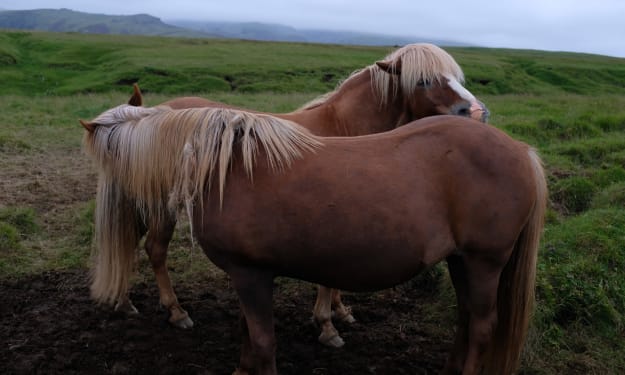
I went to Iceland to find myself again. I needed to be back in nature, in raw unfiltered nature, away from the city, feeling the power of the Earth, the mountains, and the purity of clean cold air against my skin. Iceland had been a place deeply connected to my heart, both for the kindness of the people, and because of the incredible beauty of the landscape. It reminds me of how the Earth must have looked when she was born. Raw, powerful, pure.
By Maria Haddad6 years ago in Petlife
A Horse is a Horse
There is a saying in the entertainment industry that goes, "The hardest type of film to work on is one with animals or children." The reason for this is because kids and animals are, well, unpredictable-- Even when they are trained. (The animals... Not the kids.)
By Candice Cain6 years ago in Petlife
The Clydesdale horse
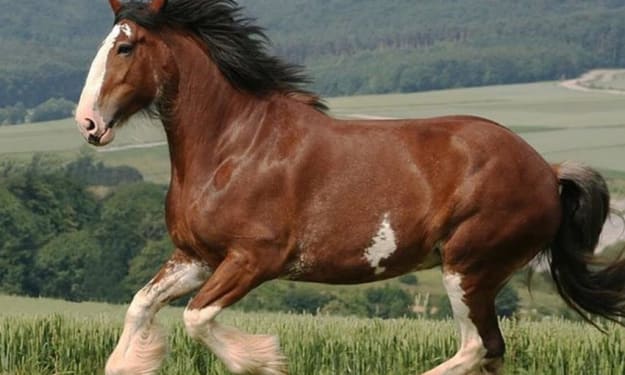
The Clydesdale is one of three native British breeds of heavy horse, the others being the Suffolk Punch and the Shire. In the days before farm tractors, these horses were the mainstay of British agriculture, being bred to pull ploughs through heavy soil for hour after hour.
By John Welford6 years ago in Petlife
Second Chance Pony
My Mom and I went to the spring mixed breed sale at the auction house. I promised myself I wouldn’t come home with anything, but I brought along my horse trailer. You know, because it’s easy to hook up the trailer and take it along through city streets and find parking when you absolutely won’t be bringing home a horse.
By Elizabeth McCowan6 years ago in Petlife
Horse Breeds
Do you know your Suffolk Punch from your Clydesdale, and can you tell a Cleveland Bay from a Thoroughbred? To the untrained eye, many horses can look quite alike. But, while all domestic horses and ponies belong to the same species — Equus ferus caballus — there are many hundreds of different breeds, all of which have their own unique physical characteristics and temperaments.The sheer number of different kinds of horses and ponies can be overwhelming, even for equestrian enthusiasts. So, to help you brush up on your knowledge, we’ve put together a list of common horse breeds that you’re likely to come across in the UK, along with some facts about the size, traits, origins, and common uses of each type. We’ll cover:Horse breeds by region.English horse breeds,Scottish horse breeds,Welsh horse breeds,Irish horse breeds,Endangered and rare horse breeds,How many horse breeds are there?There are thought to well be over 350 breeds of horse in existence around the globe today. However, given that there’s no scientifically accepted definition for what formally constitutes a horse breed, there isn’t an exact number. Plus, new types of horse are always being bred, meaning that the overall total continues to increase by the day.While the definition is somewhat vague, it’s generally accepted that a breed is a type of horse that displays distinct true-breeding characteristics over several generations. There are a number of societies that protect and promote each one, to help ensure that standards for each type of horse remain consistent. The bloodlines of certain horse breeds are also recorded in General Stud Books, which help breeders ensure that their animals are of true purebred heritage.Some breeds have stricter rules about what does and doesn’t constitute a purebred. For example, certain breeds — including Thoroughbred horses — can only be considered a true example if they possess a very narrow set of characteristics. However, for other types of breeds where the pedigree is less important, the definition of what constitutes a purebred can be much broader and more variable.The reason there are so many breeds is all to do with the history of horses as working animals. Over thousands of years, people have selectively bred horses and ponies to emphasise traits that make them well-suited to different kinds of work, from farming and industry, to sport and leisure. Many breeds are also deeply rooted in the area where they are bred, with characteristics that help them to thrive in certain landscapes and weather conditions — you can learn more about this in our horse breeds by region section.As a result of years selective breeding, horses are quite a unique animal in terms of the sheer variety between different breeds. For instance, how many other animal subspecies boast a size difference quite like that between a Shire horse and a Shetland pony? The incredible versatility and variety of horses is one of the many reasons that these creatures have remained our constant companions throughout the centuries.Horse breeds by region.While many horses and ponies are selectively bred with the intention of making them more suitable for a particular kind of work or sport, the landscape and climate that they are bred in can also greatly influence their physical characteristics. As a result, horse breeds are often closely tied to the place where they first originated. Many are even named after the place where the breed was first established.In this guide, you’ll find information about a number of the most popular and well-known horse breeds from England, Scotland, Wales, and Ireland. Given the huge number of different horse breeds out there, it’s important to note that this guide is by no means exhaustive. However, you will find most of the most common horse breeds that you’re likely to encounter in the UK and Ireland.If you’re looking to buy a horse or pony of your own, then this guide is a great place to begin your research, especially if you’re still making up your mind about what size horse you will need, and which type will best suit your needs and lifestyle.Cleveland Bay Horse.Physical appearance: The Cleveland Bay has a large head with a convex face, a long strong neck, sloping shoulders, clean legs, and powerful hindquarters. They have a very handsome, noble appearance.Permitted colours: A rich bay colour (hence the name). Some Cleveland Bays also have a white marking on the forehead.Characteristics and uses: The Cleveland Bay is one of the oldest known English horse breeds, and was originally used for agriculture and pulling coaches. Over the years, Thoroughbred blood was introduced to the breed, and the Cleveland Bay became a competitive sport horse. They’re now quite a popular horse for all kinds of sports, especially showjumping and hunting.Cleveland Bays are also sometimes used at state occasions and royal celebrations, no doubt thanks to their powerful, handsome appearance and beautiful bay colouring. They generally have a calm, sensible disposition.Dale Pony.Physical appearance: The Dale pony is small in stature with a strong neck, broad chest, long sloping shoulders, and strong hindquarters and legs. They usually possess silky feathered legs and thick, shaggy manes and tails that make them hardy enough to stand the unforgiving climate of the Dales. They are closely related to the Fell pony, which is a little more pony-like in terms of build.Permitted colours: Black and brown are common, but bay, brown, and sometimes even grey or roan may be permitted.Characteristics and uses: These plucky ponies are brave, docile, calm, and hard-working, all characteristics that make them very suitable as family ponies. They possess enough stamina and power to excel at trekking and long-distance riding, but can also make fine jumpers, too.Dartmoor Pony.
By Zarinabanu Zarinabanu6 years ago in Petlife