
The Girl in the Box: The Terrifying Psychology of Colleen Stan and the Prison of the Mind
LFor seven years, she was kept in a wooden box under a bed. But the chains that held her weren't made of iron—they were forged entirely in her own mind. This is the dark, true story of how one woman survived the ultimate psychological nightmare.

We think of prisons as physical spaces.
We imagine thick concrete walls, heavy iron bars, barbed wire, and armed guards. We believe that captivity is defined by the physical inability to move from one place to another. We believe that if a door is left unlocked, a prisoner will naturally walk through it.
But human psychology is far darker, and far more complex, than physical steel.
What happens when the prison is not built around your body, but built inside your mind? What happens when a captor realizes that the most unbreakable chains are the ones the victim helps to forge?
This is the deeply disturbing, incredibly powerful true story of Colleen Stan. It is a story of absolute horror, sensory deprivation, and unimaginable cruelty. But beneath the darkness, it is a masterclass in human endurance. It is the story of a woman who was subjected to the most extreme psychological manipulation in modern history—and somehow, found the strength to walk away.
### The Perfect Camouflage of Safety
The year was 1977. The world was different. Hitchhiking was not seen as a death wish; it was a common, accepted mode of transportation for young people in the United States.
Colleen Stan was a bright, trusting 20-year-old woman. On May 19, she packed a small bag and stood by the side of the highway in Eugene, Oregon. She was heading to Northern California to attend a friend’s birthday party. She needed a ride.
She was cautious. She let two cars pass because she didn't feel comfortable with the men driving them. But then, a blue Dodge van pulled over.
Inside the van was a 23-year-old man named Cameron Hooker, his 19-year-old wife Janice, and their infant baby.
To a young woman standing on the side of a highway, a young couple with a baby is the ultimate camouflage. A baby represents family, warmth, and safety. It disarms every biological alarm bell in the human brain. Believing she had found the safest possible ride, Colleen smiled, climbed into the van, and thanked them.
She had just stepped into a living nightmare.
### The Descent Into Darkness
For the first hour, the ride was entirely normal. They made small talk. The baby slept.
But as they drove through a desolate, heavily wooded area of Northern California, Cameron Hooker suddenly veered the van off the main highway and down a secluded dirt road. He claimed he needed to check something on the vehicle.
The illusion of safety shattered in a matter of seconds.
Cameron grabbed a knife and pressed it against Colleen’s throat. Before she could process the sudden, violent shift in reality, he bound her hands and feet.
Then, he introduced the device that would define her existence for the next seven years.
He placed a heavy, custom-made wooden box over her head. It was lined with foam, completely blocking out all light and muffling all sound. It weighed roughly twenty pounds. He clamped it tightly around her neck.
In an instant, Colleen Stan was plunged into absolute, suffocating darkness. The world disappeared. Her sight, her hearing, her ability to move—all of it was violently stolen from her.
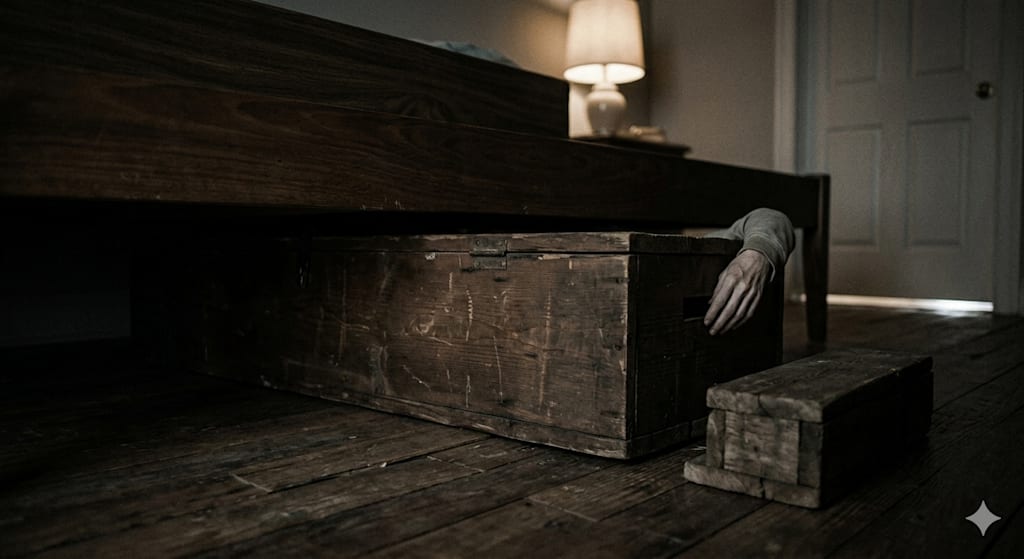
She was driven to the Hookers' home in Red Bluff, California. She was carried inside, stripped of her clothes, and placed inside a larger wooden box. It was the size of a coffin.
The box was then slid underneath the couple's waterbed.
### The Sensory Deprivation Coffin
Try to imagine the physical reality of Colleen’s captivity.
For the first several years, Colleen was kept locked inside the coffin-like box beneath the bed for up to 23 hours a day. She was not allowed to speak. She had no light. She had barely enough room to shift her shoulders. The air was stagnant.
Above her, she could hear the waterbed shifting as her captors slept, watched television, and lived normal lives, just inches above her agonizing, silent tomb.
When a human being is subjected to extreme sensory deprivation, the mind begins to fracture. Without external stimuli—without sunlight, conversation, or the ability to move—the brain turns against itself. Panic sets in. The walls feel like they are crushing you. The isolation drives people to the absolute brink of insanity.
Colleen was only let out for an hour a day to be fed, to use the bathroom, and to be subjected to horrific, unspeakable physical and sexual abuse by Cameron Hooker.
If this had been the extent of her captivity, it would be remembered as a horrific crime of physical confinement. But Cameron Hooker did not just want a prisoner. He wanted a willing slave.
To achieve that, he had to hack into her mind.
### The Architecture of the Mind Prison
Physical torture can break a body, but it often leaves the spirit intact. A prisoner in physical chains will still dream of escape. They will wait for a guard to fall asleep. They will look for a weakness in the lock.
Hooker knew this. He knew he could not keep her in the box forever without her eventually finding a way to fight back or escape during the hour she was let out.
So, he introduced a lie. A lie so massive, so terrifying, and so perfectly constructed that it replaced the wooden box with a psychological fortress.
Hooker told Colleen that he was a high-ranking member of a massive, shadowy, international syndicate known as **"The Company."** He explained that The Company was incredibly powerful. They had agents everywhere. They owned the police. They owned the government. And they specialized in acquiring and breaking slaves.
Hooker told her that if she ever tried to escape, if she ever cried out for help, or if she ever disobeyed him, The Company would know. They were always watching. But the true leverage—the genius of his sadistic manipulation—was not about her own life.
He told her that if she ran, The Company would track down her parents, her siblings, and her friends. And they would execute her entire family.
To us, reading this from the safety of our screens, it sounds like a cheap plot from a bad movie. But you must put yourself in Colleen's mind. She was 20 years old. She had been kept in a dark box for months. She was starved, beaten, and completely isolated from the real world. Cameron Hooker was her only source of information. He was the god of her tiny, dark universe.
When a person is completely isolated from reality, the reality provided by the captor becomes absolute truth.
Colleen believed him. She believed in The Company. She signed a literal "slave contract" that Hooker drafted, pledging her eternal soul and obedience to him.
The chains of iron were removed. They were no longer necessary. Fear had done the job perfectly.
### The Illusion of Freedom
Because the psychological programming was so effective, the dynamic of Colleen’s captivity completely changed.
As the years passed, Hooker began to grant her "freedom." He allowed her out of the box for longer periods. She was given a new name: "K." She became the family's domestic servant. She cooked their meals, cleaned their house, and even cared for their children.
Eventually, the boundaries of her prison expanded in ways that baffle the public.
Hooker allowed her to jog around the neighborhood by herself. He allowed her to get a job at a local motel as a maid.
The most chilling moment of her captivity occurred in 1981, four years after she was kidnapped. Hooker actually drove Colleen to Southern California to visit her family. She sat in her parents' living room. She hugged her mother. She ate dinner with them. Her parents, who had believed she was dead for four years, were overjoyed.
She introduced Cameron Hooker as her "boyfriend."
She sat there, completely physically free. The door to the house was open. The police were a phone call away.
But she didn't say a word. She didn't ask for help. After the visit, she got back into the car with her captor and returned to her life as a slave.
When the public hears this part of the story, they often ask, *"Why didn't she run? Why didn't she scream? She was right there!"*
This is the profound tragedy of psychological captivity. People who ask those questions do not understand the terrifying power of fear. Colleen wasn't staying because she liked it. She wasn't staying because of "Stockholm Syndrome," a term often misused to imply a victim falls in love with their captor.
She stayed because she was protecting her family.
Every time she looked at the open door, the psychological programming activated. She saw The Company. She saw her family being murdered. The invisible walls of her prison were infinitely stronger than the wooden box under the waterbed. She sacrificed her own freedom, daily, to keep the people she loved alive.
She endured the unendurable because she believed she had to.
### The Crack in the Facade
For seven years, Colleen Stan lived inside the lie.
But lies, no matter how perfectly constructed, require constant maintenance. And the weak link in Cameron Hooker’s perfect system was not Colleen. It was his wife.
Janice Hooker had been complicit in the kidnapping and the abuse. She had watched another woman be tortured and enslaved in her own home. But over the years, the psychological weight of the horror began to fracture Janice’s mind.
Cameron Hooker’s behavior was escalating. He wanted to bring another "slave" into the house. Janice began to fear for her own life, and more importantly, she began to fear for the safety of her two young daughters.
Guilt, paranoia, and a desperate desire to protect her children pushed Janice to the breaking point.
In August 1984, seven years and three months after Colleen got into the blue Dodge van, Cameron was away at work. Janice approached Colleen.
She looked the broken, brainwashed woman in the eyes and whispered the words that would bring the entire psychological fortress crashing to the ground.
*"There is no Company."*
### The Walk to Freedom
Imagine the profound, seismic shock of that moment.
For seven years, Colleen’s entire reality had been built around the terrifying, omnipotent threat of a secret organization. Her submission, her silence, her return to the house after jogging, her silence in her parents' living room—all of it was predicated on the existence of The Company.
And in four words, Janice Hooker erased it.
It was a lie. Cameron was not a powerful agent. He was just a pathetic, sadistic electrician living in a modest house in Red Bluff. There were no assassins. Her family was safe.
The invisible chains evaporated. The walls of the mind-prison dissolved into thin air.
And the moment the mind was free, the body followed.
Colleen did not need to break a window or pick a lock. She simply walked out the front door. Janice drove her to a bus station, bought her a ticket, and Colleen Stan boarded a bus heading back to her family.
Just like that. No guards. No alarms. Just the quiet, overwhelming realization of the truth.
### The Trial of the Mind
When Colleen returned home and the police were contacted, Cameron Hooker was arrested. But the trial that followed was one of the most complex in legal history.
The defense attorneys argued exactly what the skeptical public argued. They pointed out that Colleen had jogged alone. She had worked at a motel. She had visited her family. They argued she was a willing participant in a bizarre lifestyle, not a kidnapped victim. *How can you kidnap someone who is allowed to leave?*
But the prosecution brought in expert psychologists. They introduced the jury to the concept of extreme psychological coercion. They explained the science of brainwashing, sensory deprivation, and learned helplessness. They made the jury understand that a gun pointed at your head is a physical threat, but a lie planted deep in your subconscious is a perpetual weapon.
The jury understood. They saw through the defense's illusion just as Colleen had finally seen through Hooker's.
Cameron Hooker was convicted of kidnapping, rape, and torture. He was sentenced to 104 years in prison.
### The Ultimate Resilience
Colleen Stan’s story is often classified as a tragedy, a true-crime nightmare. But to look at it only as a story of suffering is to miss the magnificent, profound triumph of her survival.
Colleen did not break. She submitted, yes. She adapted, yes. But she kept her core identity alive, buried deep beneath the programming, waiting in the dark for seven years for a single crack of light.
When that light finally came, she didn't hesitate. She took her life back.
Today, she is a mother, a grandmother, and a woman who has spent decades working to help other victims of abuse. She rebuilt her mind. She reclaimed her reality.
Her story forces us to look inward. It forces us to ask terrifying questions about the nature of our own realities.
Not all prisons have wooden walls. Not all chains are made of iron. Every single day, millions of people remain trapped in abusive relationships, dead-end lives, and toxic environments, not because they are physically locked in a room, but because someone has planted a lie in their head. They are told they aren't strong enough. They are told no one else will love them. They are told that if they leave, their world will collapse.
Fear overrides logic. Belief traps the person. The mind becomes the prison.
But Colleen Stan’s escape reminds us of the ultimate, universal truth of human freedom. The illusion of fear only has power as long as you believe it.
The moment the truth enters, the moment you realize the walls are made of smoke, the chains vanish.
And no matter how long you have been sitting in the dark, no matter how deep the lies have been buried, there is always a moment where the door opens.
You just have to stand up, realize the fear is a lie, and walk out.
About the Creator
Frank Massey
Tech, AI, and social media writer with a passion for storytelling. I turn complex trends into engaging, relatable content. Exploring the future, one story at a time
Enjoyed the story? Support the Creator.
Subscribe for free to receive all their stories in your feed.
Comments
There are no comments for this story
Be the first to respond and start the conversation.