
The Driver Behind Our Actions
Identifying your personal approach to life

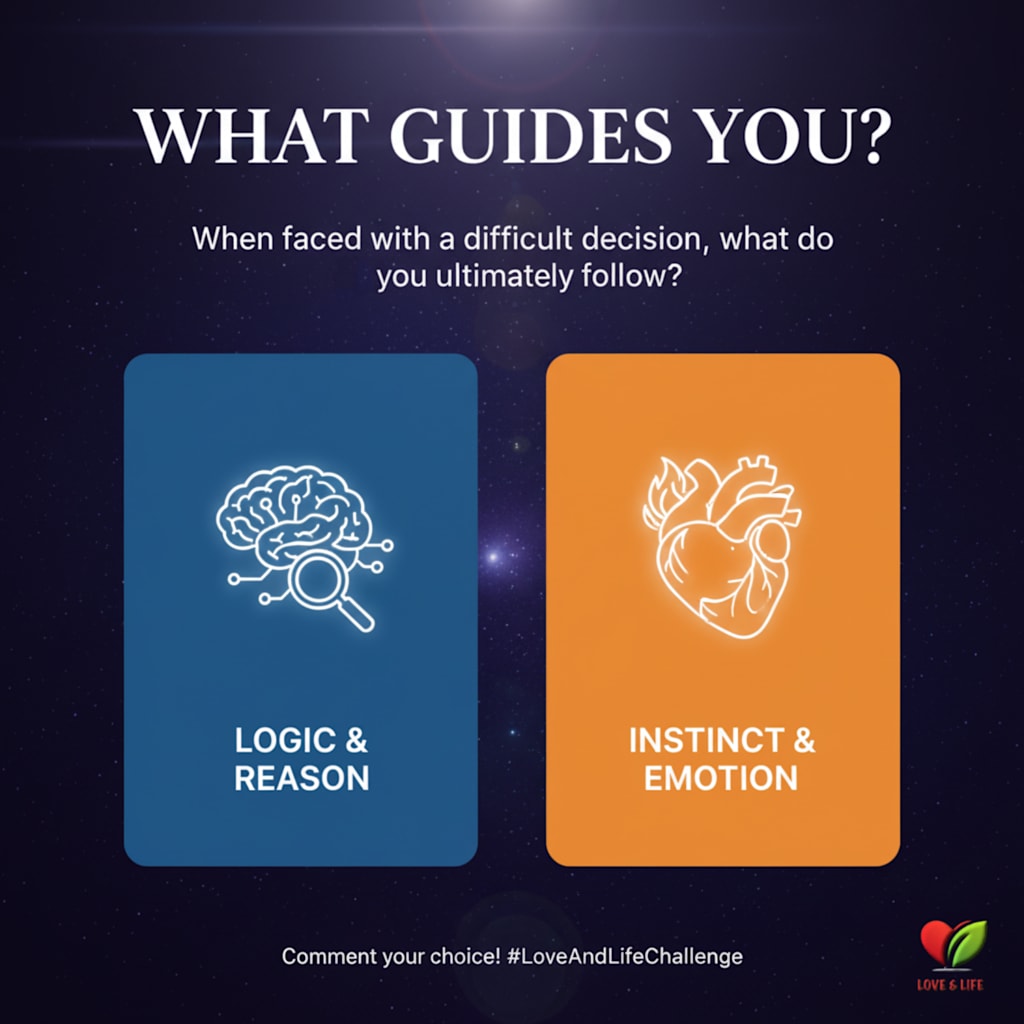
Our approach to events and people is central to who we are, especially in our thoughts, mindset and personality. Self-knowledge is thus crucial to know why you might differ from someone else in how you cope with a situation, with others in a team, or in a crisis.
The two main guides in life are our natural instinct and emotions, and logic with reasoning. We are constantly caught between these two opposing forces: the internal drive of instinct and emotion competing against the deliberate structure of logic and reasoning, particularly in times of adversity. But what's the main difference between them?
To begin with, Instinct and Emotions act as our evolutionary survival kit. They tend to be rapid, primal, and deeply felt. Instinct requires no mental rehearsal and no deep thought; it is an immediate response to our treatment and environment. When guided by our intuition, it allows us to read a room instantly, or sense danger before our conscious mind can even name it.
However, when we allow unchecked emotion to set the rules of engagement, it often feeds our fears and reinforces defensive behaviour. Operating purely on raw emotional impulses can keep a person trapped in a highly vigilant and distrustful state, reacting to old wounds and memories rather than current realities. It encourages impulsive actions that mainly satisfy the moment, robbing us of long-term stability and even self-respect.
Logic and Reasoning represent our conscious, analytical capacity to slow down, to evaluate the evidence, and project our thoughts into the future. Reasoning allows us to step outside of our immediate feelings to look at a situation objectively. It breaks down complex problems systematically, balancing the situation to ensure our choices align with our long-term goals, our values, and principles.
However, the danger here lies in an over-reliance on intellect reasoning while ignoring the emotional aspects. When logic is used as an emotional shield, it can quickly morph into overthinking. By attempting to calculate every variable, we build unnecessary mental barriers, keeping ourselves at a safe, emotionally insulated distance from life. It often turns spontaneous human connection into a rigid transaction of survival, depriving us of the very passion and reciprocity that make life worth living.
Appreciating Both Statess
Ultimately, one could say that the main difference between the two states lies in speed vs depth. Instinct and emotion tell us what matters to us right now in the immediate second, while logic and reasoning informs us of what matters in the long run. Hence a truly self-assured life is not governed by one state to the exclusion of the other; it is about utilising both states when appropriate - such as using reasoning to guide and validate the immediate authentic energy of our instincts.
For example, I am not a logical person. I come down firmly in the “instinct and emotion” box, though my boyfriend certainly is. Sometimes his logic is simply astonishing in the kind of results and conclusions he has. It is always interesting to see how we each react to issues.
Being a spiritual person, I trust my instincts and gut feeling implicitly, as they are seldom wrong. I also reason that we don’t know everything about life and why things happen, so we need some faith in the unknown. In fact, the times I have come to grief tend to occur when I ignore my instinctive suggestions, or reminders, and then suffer the consequences for it.
So how are you guided? How effective has this approach been for you?
Do you have complete faith in your compass?
Share it with us in the comments.
About the Creator
Elaine Sihera
British Life Coach & Consultant. Founder of LOVE & LIFE: The Growth Guide, for insights into managing challenging life issues. Author of books on Confidence, Relationships & Wellbeing. Graduate/Doctor of Open Univ; Postgrad Cambridge Univ.
Enjoyed the story? Support the Creator.
Subscribe for free to receive all their stories in your feed.
Comments
There are no comments for this story
Be the first to respond and start the conversation.