
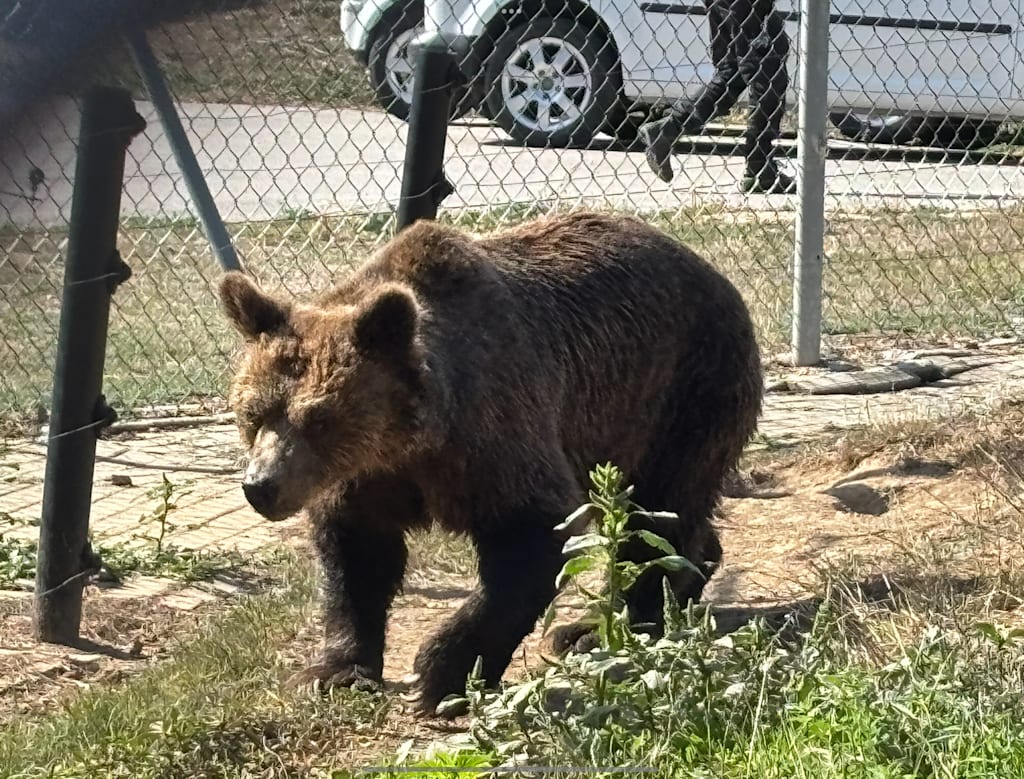
There’s a bear sanctuary in Prishtina, Kosovo. The vast 16-hectare property is spacious and natural. There are pools for the bears to swim in, forests of lush trees for them to disappear into, grass for them to roll around in, leaves, pinecones, and everything a bear could want. Winding through the park, there is a walking path for visitors, and surrounding the path there is a chain-link fence to keep bears and humans separate.
The bears did not have happy lives before they were brought to the sanctuary. In the 1990s and early 2000s keeping bears in tiny cages outside restaurants to attract customers was a trend in the Balkan region. The bears often did not have a proper diet or medical care, let alone any form of physical or mental enrichment. Instead they had cold steel cages and gawking onlookers, poking at them and thrusting scraps of their half-eaten meals between the bars. They were serving a life sentence of solitary confinement without having ever committed a crime.
The practice of keeping bears was made illegal in 2010, and the Prishtina sanctuary was built as a place for these bears to recover from the years they’d endured under lock and key.
When I went to the sanctuary, I wasn’t thinking of the horrors the bears must have experienced. I was just thinking it would be cool to see bears. I imagined how lucky I’d be if I could snap a photo of a cute, happy, rotund bear scratching its back against some distant tree like Baloo in Disney’s The Jungle Book.
I was warned before the start of the experience that the bears had complete freedom within the park, and it was possible that I wouldn’t see any. In fact, I was told that not seeing bears would actually be a good sign, as it would mean that the bears were off in the woods doing bear things, and not performing for visitors.
I saw so many bears in Prishtina.
As I walked up the steep path of the sanctuary, red faced in the 90 degree heat, I saw bear after bear after bear. Each bear I passed was doing the same thing — unceasingly walking in tight, dizzying circles right in front of the fence, sometimes so close that their fur brushed against the metal. I was sweating through my clothes, thirsty, and sorely regretting not bringing a hat to keep the top of my head from getting sunburned. The bears had ample access to shade and water, and with their thick fur must have been hotter than me, yet they kept circling and panting in the direct sunlight. Their large, rock adorned swimming pools stood empty, for the most part.
At one point, as I was walking along, unsure of whether or not I should photograph the forlorn bears before they collapsed from heat stroke, I ran into a woman who had been on the bus from Skopje to Prishtina with me. We exchanged worried looks.
“This isn’t what I’d expected,” she admitted.
“Same,” I agreed. “Are they okay? They could go into the trees if they wanted. Nobody is forcing them to stay out here like this.”
We walked together for a while, but eventually she outpaced me. I hung back to read some signs about the success stories of the bears. There were before and after pictures that made it seem like their lives had improved since coming to the sanctuary. Eventually, I did come across a pair of bears splashing in one of the pools, and felt relieved at at least some of them seemed to be enjoying the facilities.
In the gift shop later I asked one of the workers why the bears had been walking in circles. She explained to me that some of the bears were so traumatized by their years of captivity that they continued, even a decade later, to walk in circles that matched the circumferences of their former cages, staying as close as possible the park fence, because that was the thing that most closely matched the bars they’d grown up behind. There were many happy, thriving bears in the park, but the most visible individuals were those who were still captive within their own minds.
I bought a wooden keychain with a bear engraved on it and left.
On the bus out of Kosovo and back to North Macedonia, I thought about the bears, but I also thought about people. How many people circle through their lives tracing the outlines of cages that no longer exist? I’d be willing to bet that everybody does so in one way or another.
I’m happy and positive, for the most part. I’m functional. I haven’t endured any more trauma than the average person. Even so, seeing the bears made me take stock of the negative habits I’d picked up during times of past difficulty, and continued to repeat over and over, even though nobody was forcing me to do them, and there was a whole world of other things I could be doing instead.
That night, I made a list in my journal of the maladaptive habits that were keeping me entrapped, and began to work on breaking free of them. I’m still working on that today. I didn’t make big changes all at once, but realizing that I could make those changes and that nothing was stopping me was already a small win. When I catch myself falling back into harmful routines, I picture the bears in Prishtina and remind myself that I don’t want to spend my life inside an invisible cage. I have the ability to think and analyze my situation in a way that animals don’t.
As for the bears themselves, I take comfort in the fact that they have an excellent habitat and people dedicated to their safety and rehabilitation. I hope there will be a day when the bears are deep in the forest and sightings of them at the sanctuary are a rare and magical event.
About the Creator
Rose
This is just a hobby.
Enjoyed the story? Support the Creator.
Subscribe for free to receive all their stories in your feed.
Comments
There are no comments for this story
Be the first to respond and start the conversation.