
The Author Who Became Famous Only After Dying
When the world finally understood his words, he was no longer alive to hear the applause.

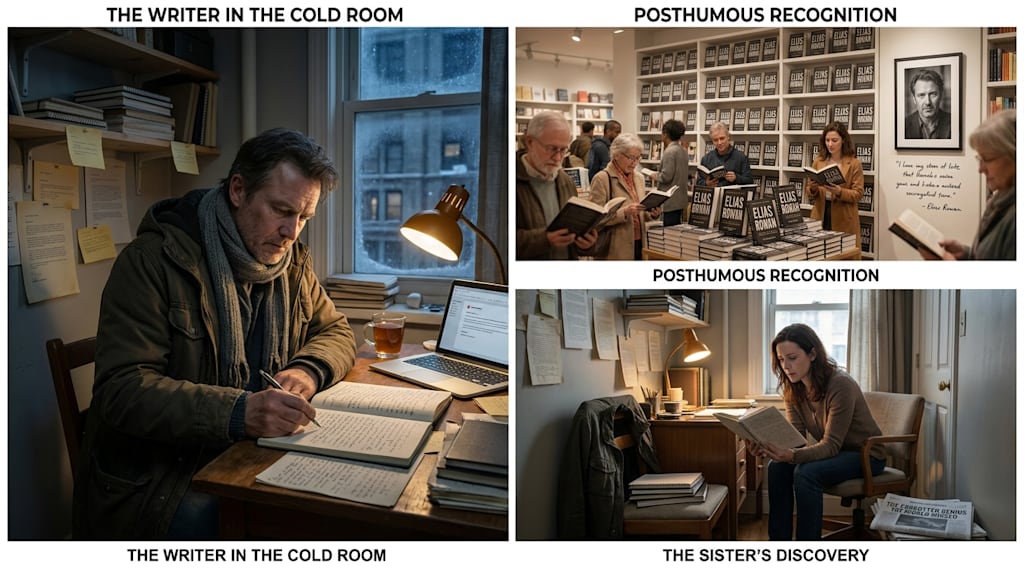
The day Elias Rowan became a literary legend was the day after his funeral. Newspapers called him "the forgotten genius." Universities rushed to add his books to their reading lists. Critics wrote thousands of words explaining the brilliance hidden in every sentence he had ever written. The strange part? While he was alive, no one wanted to read a single page. Part One: The Man Nobody Wanted Elias Rowan lived in a one-room apartment on the edge of a city that had long stopped noticing him. The apartment was cold in winter. Not the kind of cold you shake off with a warm cup of tea. The kind that settles into your bones and stays there. Elias couldn't always afford heating. Some mornings, he wrote wearing two jackets and a scarf, his breath fogging the air above his notebook. He had been writing since he was nineteen. By the time he was forty-two, he had finished seven novels, three short story collections, and a slim volume of essays that he privately considered his best work. He had also collected four hundred and thirty-one rejection letters. He stopped counting after that. Not because the rejections stopped coming, but because counting them had started to feel like measuring his own failure. Publishers were polite, mostly. "The writing is beautiful, but we don't see a market for this." "Brilliant in places, but too slow for modern readers." "We loved your voice, but the story isn't commercial enough." He pinned the early ones to his wall. Later, he stopped doing that too. His sister, Mara, visited him every few weeks. She would bring food, sometimes groceries stuffed into cloth bags, sometimes just warm bread and cheese because she knew he would forget to eat when he was deep in a chapter. She watched him write in the margins of newspapers when he ran out of notebook pages. She watched him skip sleep for days when a story was pulling him forward like a current. "You should try something else," she told him once, gently, the way you say something you don't fully believe but feel you have to say. He looked up from his notebook and smiled. Not the sad smile she expected. "Words outlive the people who write them," he said. "I just have to trust that." She didn't argue. But she worried. Part Two: The Winter He Stopped The last winter of Elias Rowan's life was the quietest. He had been rejected again, this time by a small independent press he had genuinely believed in. The editor had written back with a careful, apologetic email that said everything except what Elias needed to hear. He read it twice, closed his laptop, and sat by the window for a long time. He still wrote. But slower now. Like a man carrying something heavier than usual. Mara noticed. She noticed the way he paused mid-sentence during conversations, like he was listening to something far away. She noticed the stacks of finished manuscripts arranged neatly on the shelf beside his bed, labeled in his careful handwriting. She noticed he had stopped talking about future projects. One evening, she asked him if he was alright. "I think I've said everything I needed to say," he told her. She thought he meant the book he had just finished. She didn't realize he meant something else entirely. Elias Rowan died quietly on a Tuesday in February. His heart, which had carried so much for so long, simply gave out. He was forty-three years old. The apartment was left exactly as he had lived in it. Notebooks on every surface. Pages clipped together with little yellow notes in the margins. Seven finished manuscripts stacked beside the bed like quiet passengers waiting for a train that had never come. Part Three: The Discovery It was Mara who called his landlord. It was the landlord who called a local charity to clear the apartment. And it was a young volunteer named Daniel, nineteen years old and studying literature at a nearby college, who picked up one of the manuscripts before putting it in the donation box. He only meant to glance at the first page. He read it standing in the cold hallway. Then he sat down on the floor and read for another hour. When he finally looked up, it was getting dark outside. He took the manuscript home. Then came back the next day and asked Mara if he could borrow the others. Mara, still numb with grief, said yes without fully understanding why. Daniel shared the first chapter with a professor. The professor shared it with a colleague. Within three weeks, a photocopy was circulating in three different university departments. Within two months, a small literary magazine had published an excerpt with a short note: "We believe we have found something important." The internet did the rest. Part Four: The Legend Builds Itself By the time autumn arrived, Elias Rowan was everywhere. A publisher offered a substantial advance to release all seven novels. Readers devoured them. Then read them again. Online forums filled with theories about hidden meanings, symbolic patterns, and what one popular account called "Rowan's uncanny ability to predict the future." Literary journalists wrote long essays about his "fearless vision." One widely shared article claimed he had anticipated three major political crises in his fiction. Another argued his prose style had quietly influenced several contemporary writers who claimed never to have heard of him. Universities added entire modules dedicated to his work. Tourists began visiting the city. They photographed the building where he had lived, the coffee shop two streets away where the owner vaguely remembered a quiet man who always ordered the cheapest thing on the menu and stayed for hours with a notebook. A documentary was commissioned. A stage adaptation was announced. Social media turned Elias Rowan into something between a saint and a myth. They called him fearless. They called him ahead of his time. They called him proof that true art always survives. Mara watched all of this from a careful distance. Part Five: What Only She Knew The world was building a statue. Mara was still holding the man. She remembered things no documentary would capture. She remembered finding him once, sitting on the kitchen floor at two in the morning, a rejection email open on his laptop, crying quietly in the way men do when they've decided they're not allowed to cry loudly. She had sat down beside him without saying anything. They stayed there for a while, her hand on his shoulder, the laptop screen going dark. She remembered the weeks he barely spoke because a chapter wasn't working. She remembered the celebrations too, small and private, when a sentence finally came out exactly right. He would read it aloud to her over the phone, and she could hear the relief in his voice like someone had set down a heavy bag. She remembered his hands, always slightly ink-stained. His jacket, the same one for six winters. The way he laughed at his own jokes before finishing them. Now journalists were calling him a visionary. They said he wrote with no concern for commercial success, as though that had been a brave artistic choice rather than a painful reality. They said he was content to write in obscurity, as though he had chosen it. None of them asked what it had cost him. A reporter contacted Mara for an interview. They wanted her perspective on "the genius she had known personally." They wanted her to confirm the legend. She sat with the question for three days. Part Six: The Choice There were two versions of her brother she could give the world. The first was the one they had already written. The visionary. The fearless genius who wrote without needing applause, who saw the future in his sentences, who existed on a higher plane than ordinary ambition. The second was the truth. The man who cried on kitchen floors. Who skipped meals to buy notebooks. Who checked his email every morning hoping for a different answer and learned, slowly, to stop hoping so loudly. Who never stopped writing not because he was fearless, but because he didn't know how to be himself without it. Mara thought about which version of her brother deserved to live. She thought about the young writers who were now discovering his work. The ones who felt seen by his sentences, who posted online about how his words had named something they couldn't name themselves. She thought about a girl in Lahore who had written that Elias Rowan's novel had made her feel, for the first time, that her own quiet life was worth writing about. She thought about a boy in Toronto who said he had been about to quit his manuscript until he found the essay collection. She thought about what her brother had said to her once, in that cold apartment, smile on his face. Words outlive the people who write them. Maybe the truth didn't have to replace the legend. Maybe the truth was the legend, just without the polish. She called the journalist back. "I'll tell you about my brother," she said. "But I'm going to tell you who he actually was." Part Seven: What the World Needed to Hear The interview was published on a quiet Sunday morning. It was not what people expected. Mara talked about the cold apartment. The rejection letters. The meals skipped, the notebooks prioritized. She talked about the kitchen floor at two in the morning. She talked about a man who was not fearless but persistent, not visionary but deeply, painfully observant of the world around him. A man who wrote because he needed to, not because he was certain anyone would ever read it. The response was not what she feared. It spread further than the myth had. Because something in the real story landed differently. The legend had been inspiring in the distant, untouchable way that legends are. But the truth was something people could actually hold. A man who kept going without proof that it would matter. Who wrote in the dark, not because he could see the light coming, but because stopping felt worse than continuing. Writers who had been struggling shared the article with one line: this is why I don't quit. A publisher in London said it reframed how they thought about the manuscripts sitting in their slush pile. A professor in Karachi built a semester around the question Mara's interview raised: does a work need to be understood in its own time to have value? The legend grew. But now it had a human heart inside it. Elias Rowan never knew his books would one day sit in university libraries, be translated into eleven languages, and make a young volunteer sit down on a cold hallway floor and forget to finish his job. He never heard the applause. But somewhere in those seven novels stacked beside his bed, in the careful handwriting on every yellow note, in the ink-stained margins of borrowed newspapers, he had already said what he needed to say. And the world, in its slow and imperfect way, eventually listened. He was right about one thing. Words do outlive the people who write them. They just sometimes take a little longer to arrive. "The world never ignored my words. It simply waited until I was no longer here to answer them."
About the Creator
Muhammad Farman
**✨ Writer | Storyteller | Explorer ✍️** **Sharing unique stories, thought-provoking ideas, and unforgettable journeys that inspire, spark curiosity, and leave a lasting impact. 🌍📖**
Enjoyed the story? Support the Creator.
Subscribe for free to receive all their stories in your feed.
Comments
There are no comments for this story
Be the first to respond and start the conversation.