Vocal
The Silent Sacrifice of a Mother Sparrow
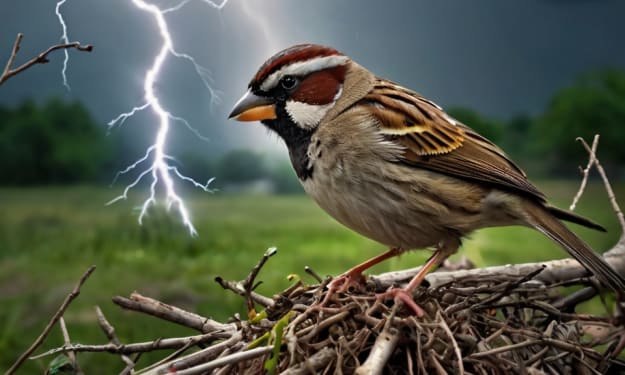
The Mother Sparrow’s Silent Sacrifice BY:Khan The storm had raged for three long days. Winds tore through the trees, howling as if the earth itself were angry. Rain lashed against rooftops, keeping even humans locked inside their homes. But far above, battling the same storm, was a little sparrow—known to her children as Amma Sparrow. Her wings beat furiously, every feather straining with effort. She was weak, yet she flew, clutching something far more precious than her own comfort. In her tiny beak were grains of food, carefully collected for the four chicks waiting in her nest. If she opened her mouth even for a moment, the wind would snatch those grains away, leaving her young ones to starve. Just three trees away, across the storm-tossed garden, was her nest. Inside, four hungry mouths waited. The oldest was Apa Sparrow, a responsible little fledgling. Then came Bhuri Sparrow, restless and noisy, followed by Mitti Sparrow, who was always echoing Bhuri’s complaints. Last of all was the baby, Nanha Churra, so small that he could barely hold himself upright. The storm thickened. Lightning cracked, splitting the sky. A bolt struck a tall tree, sending its heaviest branch crashing down. Amma Sparrow, exhausted and unable to dodge, was pinned beneath it. She did not cry out, for her beak was still tightly shut, protecting the food her children so desperately needed. Meanwhile, the chicks were restless in the nest. “Where is Amma? I’m starving!” cried Bhuri Sparrow. “She should have been back by now!” Mitti Sparrow chimed in. Apa Sparrow spread her wings, trying to keep order. “Stop leaning over the edge! Shouting won’t bring her back. Sit still, all of you.” But their hunger was unbearable. Even Nanha Churra whimpered, clinging to Apa’s feet. “Apa, I can’t take it anymore. My stomach hurts.” Apa Sparrow stroked him with her wing, though her own heart ached. “Do you care nothing for Amma? She is out there in this storm, fighting for us. I don’t care if I stay hungry a thousand days—so long as she comes back safe.” Her words silenced the nest for a while. The little sparrows whispered prayers for their mother’s safety. Yet as night deepened, the pangs of hunger returned. Bhuri and Mitti began pecking at the straw lining the nest. Nanha Churra grew faint and weak. Apa Sparrow looked at her siblings, then at the dark sky. “I cannot sit here any longer,” she declared. “If Amma cannot return, I must go to her.” “You don’t even know how to fly properly!” Bhuri snapped. “Then I will learn,” Apa said firmly. “Everyone must take their first flight someday. Mine will be tonight.” Trembling, she hopped to the edge of the nest. The wind was calmer now, but danger still lingered. Apa Sparrow spread her small wings and leapt. She wobbled, tilted, nearly fell—but determination carried her forward. With every shaky beat, she gained strength. “Flying is not the hard part,” she realized. “The hard part is deciding to fly.” Through trial and tumble, she reached the fallen tree. A faint groan caught her ear. Searching, she noticed a trembling leaf. Beneath it lay her mother, trapped under the heavy branch. “Amma!” Apa cried, chirping so loudly the entire garden stirred. Her cries reached the ears of a lumbering bear named Banoo, who sometimes wandered through the orchard. Seeing the sparrow’s distress, the bear lumbered over and with a single paw pushed the branch away. Amma Sparrow lay still, barely breathing. Apa nudged her gently. “Amma, please—say something. Open your mouth.” But Amma did not speak. She fluttered weakly, and together with Apa, began the slow, painful journey back to the nest. Her flight was unsteady, more like the first attempt of a hatchling than the graceful glide of a grown bird. Yet step by step, wing by wing, she moved closer to home. At last, they reached the nest. The chicks squealed with joy and relief, their hunger momentarily forgotten at the sight of their mother. They pressed themselves against her, chirping with love. Amma Sparrow collapsed on the floor of the nest, her body trembling with exhaustion. At last, her beak opened. From it tumbled the grains she had carried all along. The chicks gasped. In that instant, they understood the depth of their mother’s sacrifice. She had endured thirst, hunger, suffocating winds, and even the crushing weight of a fallen branch—all while refusing to open her beak, so her children would not be left to starve. The nest was filled with life again. The chicks pecked at the grains, their strength slowly returning. But more than food, what filled them was the comfort of knowing their mother had come back to them, battered but alive. Apa Sparrow looked at her mother with tearful eyes. “You didn’t say a word, Amma. Yet you taught us more than words ever could.” In the silence of that night, with the storm finally fading, the little family huddled together. Hunger was eased, fear was soothed, and hearts were filled with gratitude. For sometimes, love speaks loudest not in words—but in the quiet sacrifices a mother makes.
By Khan 12 months ago in Motivation
Shahid and the Poisoned Breakfast
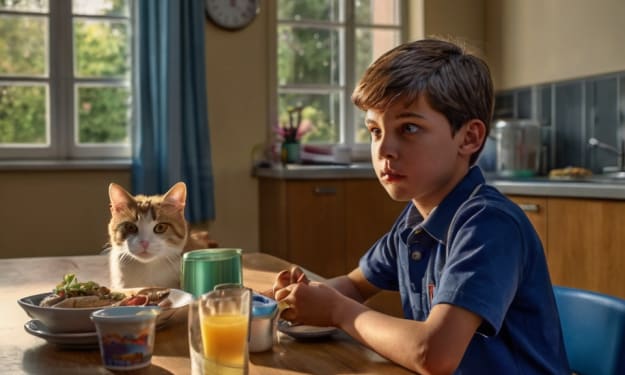
Shahid and the Poisoned Breakfast BY: Ubaid Life on earth is filled with countless blessings bestowed upon us by Allah Almighty. The purpose of these blessings is not only that human beings may enjoy them but also that they may express gratitude to their Creator. Every blessing, whether small or great, carries within it a reminder of Allah’s mercy and power. Among those who cherished such blessings was a boy named Shahid, a lively and thoughtful youngster about fifteen years of age. Like most children of his age, Shahid was fond of food and often wished to taste the seasonal fruits and dishes that came with summer and winter. He believed that eating fresh and healthy food would make him stronger and allow him to focus more on his education. Shahid was not only curious but also diligent, and he always tried to balance his health with his studies. One morning, however, an unusual incident occurred that changed the way Shahid looked at life forever. It was a bright day, and Shahid woke up early, as usual, to get ready for school. His uniform was already ironed and laid out neatly. After taking a shower, he dressed in his crisp school uniform and combed his hair. Now only one thing remained before leaving for school—breakfast. Shahid’s mother had prepared a delicious meal for him. The aroma filled the dining area, and as soon as Shahid sat down at the table, his mouth watered. He felt his hunger grow stronger and thanked Allah for the beautiful food in front of him. Picking up his spoon, he was just about to take the very first bite when something unexpected happened. From nowhere, his pet cat leapt onto the table. This was not just any ordinary cat—it had been with Shahid for a long time, and he loved it dearly. He often carried it in his arms, stroked its fur, and even spoke to it as if it were a close friend. The bond between Shahid and his pet was strong. Yet that morning, the cat’s behavior surprised him. With unusual greed, it began devouring the breakfast laid out on the table. Within moments, most of the food had disappeared. At first, Shahid felt annoyed, but soon his concern turned into shock. The cat, after eating ravenously, suddenly staggered and collapsed. Its breathing slowed, and within minutes, it was dead. Shahid froze. He could not believe what had just happened. His beloved cat, which had been healthy and playful only a few moments ago, now lay lifeless on the floor. Then, to make matters worse, Shahid himself felt a sharp pain in his stomach. He had taken only a single bite of the breakfast before the cat had attacked it, yet his body was reacting strangely. Nausea overcame him, and his head spun. “Abu!” Shahid cried, his voice trembling. “Please take me to the doctor quickly! Something is wrong.” His father, alarmed by his son’s pale face and weakened state, wasted no time. “Come, my son,” he said firmly, helping Shahid into the car. Driving as fast as he could, Shahid’s father prayed silently that nothing terrible would happen. The sight of the dead cat had already made him fear the worst. They reached the doctor’s clinic in haste. The doctor, sensing the urgency, immediately examined Shahid. After checking his heartbeat, eyes, and pulse, he asked what had happened. Shahid’s father explained in detail: “Doctor sahib, as soon as Shahid took his first bite of breakfast, he felt unwell. But our cat, which ate almost all of it, died instantly. We think perhaps something poisonous was in the food—or maybe the cat’s mouth already had some poison in it that mixed with the food. Whatever the case, Shahid is now feeling ill.” The doctor’s face grew serious. He quickly administered medicine to neutralize the poison and gave Shahid water to flush out the toxins. After a tense few minutes, Shahid began to feel slightly better. The doctor then turned to his father and said in a grave tone: “Allah has been merciful to you today. If you had delayed bringing him here, the poison could have spread further, and Shahid’s life would have been in great danger. The cat’s sudden death was a warning sign, but thanks to your quick decision, we were able to save your son.” Shahid’s father let out a deep breath of relief. He thanked the doctor and, above all, he thanked Allah for sparing his son’s life. Shahid, still weak but conscious, reflected on the incident. He realized how fragile life is and how easily it can be taken away. The food he had so eagerly longed for that morning had almost become the cause of his death. In the days that followed, Shahid often thought about his cat. He missed its playful presence but also recognized that its sacrifice had, in a way, saved him. If the cat had not eaten the food before him, Shahid might have consumed more of it, and the result could have been fatal. This incident became a lesson not only for Shahid but also for his entire family. They became more cautious about what they ate, always checking food carefully. More importantly, Shahid grew spiritually stronger. He understood more deeply that the blessings of Allah must be enjoyed with gratitude but also with mindfulness. Health, food, and even life itself are precious gifts that can be lost in an instant. From then on, Shahid prayed more regularly, took his studies seriously, and valued the simple moments of life. Whenever he saw food on the table, he remembered that day when a single bite nearly ended everything. He promised himself never to take any blessing for granted again. And so, Shahid’s story became one of gratitude, awareness, and the realization that Allah’s mercy surrounds us even in moments of danger.
By Ubaid 12 months ago in Motivation
How to Start Freelancing in 2025 Without Any Experience. AI-Generated.
Introduction Starting a freelancing career can feel overwhelming, especially if you have no prior experience. The good news is that in 2025, there are countless opportunities for beginners to earn money online. Whether you want to work from home, travel while working, or build a sustainable side income, freelancing can help you achieve your goals. In this guide, we’ll break down the steps you need to take to start freelancing successfully—even if you’re a complete beginner. 1. Choose Your Freelancing Niche The first step in starting your freelancing journey is to decide what services you want to offer. Focus on your strengths or skills you can quickly learn. Popular freelancing niches include: Writing & Blogging Graphic Design & Illustration Video Editing & Animation Social Media Management Web Development & Programming Selecting a niche helps you market yourself effectively and attract clients who need your specific skills. Don’t be afraid to specialize in a particular area—specialists often earn more than generalists. 2. Build a Strong Portfolio Even if you don’t have real clients yet, you can create a portfolio showcasing your work. For writers, this could be sample articles; for designers, mock-up designs or illustrations. A strong portfolio demonstrates your skills, builds credibility, and increases the chances of getting hired. You can also include any personal projects or volunteer work related to your niche. 3. Sign Up on Freelancing Platforms There are many platforms where beginners can find freelance work: Upwork – For various freelance services, including writing, design, and marketing Fiverr – Perfect for small gigs and quick jobs Freelancer.com – Another platform for a wide range of projects Toptal & PeoplePerHour – For experienced professionals and higher-paying projects Make sure your profile is professional: use a clear photo, write a strong bio, and highlight your skills. Adding certifications, badges, or sample work can make your profile stand out even more. 4. Start Small and Deliver Excellence When starting out, accept smaller projects to gain experience and build reviews. Always communicate clearly with clients, meet deadlines, and deliver high-quality work. Positive reviews will help you get bigger and better projects in the future. Remember, quality over quantity matters—your first few projects set the tone for your freelancing career. 5. Learn New Skills Continuously Freelancing is competitive, and staying ahead requires continuous learning. Take online courses, watch tutorials, and explore new tools in your niche. Skills like AI tools, social media strategies, and advanced content writing trends can give you an edge over others. Also, learning time management and client communication skills can greatly improve your reputation. 6. Set Your Rates Strategically Beginners often undervalue themselves, but charging too little can hurt your growth. Start with reasonable rates, and gradually increase them as you gain experience and positive reviews. Keep track of the market rates in your niche and adjust your pricing accordingly. Remember, your time and effort are valuable. 7. Manage Your Time and Workflow Freelancing gives you freedom, but it also requires discipline. Use tools like Trello, Asana, or Google Calendar to organize tasks and deadlines. Create a daily routine to balance multiple projects and ensure timely delivery. Good time management not only boosts productivity but also helps maintain a healthy work-life balance. 8. Promote Yourself and Network Don’t rely solely on freelancing platforms. Promote your services on social media, LinkedIn, or your personal website. Networking with other freelancers or potential clients can lead to referrals and long-term projects. The more visible you are, the higher your chances of getting consistent work. Conclusion
By Najeem Ullah12 months ago in Motivation
5 Freelancing Careers That Can Change Your Life. AI-Generated.
Freelancing is no longer just a side hustle; it has become a full-time career option for millions of people worldwide. In 2025, more companies and entrepreneurs are hiring freelancers for specialized tasks rather than keeping a large in-house team. This gives skilled freelancers the opportunity to work from anywhere, choose their own clients, and earn a good income. But to succeed in freelancing, you need the right set of skills that are in demand. Here are the top five freelancing skills to learn in 2025 that can help you grow your career and make money online: 1. Content Writing and Copywriting Content is the backbone of the internet. Every website, blog, and online business needs high-quality content to attract visitors and convert them into customers. This makes content writing one of the most in-demand freelancing skills. As a content writer, you can create blog posts, product descriptions, website content, and social media captions. If you specialize in copywriting, you can write persuasive content that sells products or services. For example, an e-commerce brand may hire you to write product descriptions that convince customers to buy. In 2025, businesses are focusing more on SEO-optimized content and storytelling, so writers who can blend creativity with keyword research will always find work. If you love writing, this is one of the best freelancing careers to start with. 2. Graphic Design and Branding In the digital world, visuals speak louder than words. Businesses need professional logos, banners, posters, and branding material to stand out. This is why graphic design is still a top freelancing skill in 2025. As a graphic designer, you can work on projects like social media graphics, YouTube thumbnails, business logos, or complete brand kits. With tools like Canva, Photoshop, and Illustrator, even beginners can start designing. But to be a successful freelancer, you must focus on creativity and originality. Graphic design is not only about making something look good; it is about creating visuals that communicate a brand’s message clearly. With the growth of e-commerce and personal brands, demand for designers will only increase. 3. Digital Marketing and Social Media Management Every business needs customers, and the best way to reach them in today’s world is through digital marketing. That is why this field is one of the highest-paying freelancing skills. Digital marketers help businesses grow by using SEO, paid ads, email marketing, and social media strategies. As a freelancer, you could be running ad campaigns, managing social media accounts, or analyzing marketing data. One of the fastest-growing areas is social media management. Businesses hire freelancers to post content, reply to comments, and grow their online presence. If you understand how platforms like Instagram, TikTok, and LinkedIn work, you can easily build a career in this field. In 2025, companies are investing heavily in influencer marketing and short-form video content, so digital marketers with creative strategies will always be in demand. 4. Web Development and App Development With businesses going online, websites and apps have become essential. That makes web development one of the most powerful freelancing skills today. As a web developer, you can create custom websites for businesses, online stores, or personal blogs. Skills like HTML, CSS, JavaScript, and WordPress are the foundation, while advanced developers can learn frameworks like React or Next.js. Similarly, mobile app development is growing rapidly. Companies are willing to pay high rates to freelancers who can build functional and user-friendly apps for Android and iOS. In 2025, the focus will be on fast, mobile-friendly, and AI-powered websites and apps. So, if you enjoy coding and problem-solving, web or app development can be a highly profitable freelancing career. 5. Video Editing and Animation Video content dominates the internet today. From YouTube channels to TikTok and Instagram Reels, everyone is using videos to attract attention. That’s why video editing is one of the hottest freelancing skills in 2025. As a video editor, you can help YouTubers, businesses, and influencers create engaging videos. You might be cutting raw footage, adding background music, creating subtitles, or designing intros and outros. If you specialize further in motion graphics or 2D/3D animation, you can work on commercials, explainer videos, or even cartoons. Businesses pay well for freelancers who can combine creativity with technical editing skills. With tools like Adobe Premiere Pro, After Effects, and CapCut, you can start small and grow your portfolio. Since video content continues to grow, this skill will remain in demand for years. Conclusion Freelancing is the future of work, and the opportunities are limitless. By learning one or more of these five skills—content writing, graphic design, digital marketing, web development, and video editing—you can start building a successful online career in 2025. The key is to choose a skill that matches your interest and then practice consistently. Start with free resources, build a portfolio, and slowly begin applying for projects on platforms like Upwork, Fiverr, and Freelancer. Remember, freelancing is not just about earning money; it is about freedom, flexibility, and the chance to build your own career path. If you are ready to take the first step, then 2025 is the perfect time to start.
By Najeem Ullah12 months ago in Motivation
“Why I Stopped Drinking Soda for 30 Days—Here’s What Happened”
Introduction I’ve never considered myself a soda addict, but I definitely enjoyed a can or two every day. Sometimes it was with lunch, sometimes in the evening when I wanted something fizzy and sweet. It felt harmless—just a regular part of my routine. But after reading about how much sugar is packed into even a single can, I decided to test myself: Could I go 30 days without soda? I wasn’t trying to prove anything to anyone. I just wanted to see what would happen if I gave it up. What surprised me most wasn’t just the physical changes, but the mental ones too. Here’s my honest story of what happened when I stopped drinking soda for 30 days. --- Week 1: The Cravings Hit Hard The first few days were the toughest. Every time I ate, my brain automatically craved that familiar fizz. Water felt too plain, and even juice didn’t quite satisfy me. I realized just how much of a habit soda had become—not only the sugar, but the ritual of opening a cold can. By the end of the week, I felt sluggish and cranky. Part of me wanted to quit. 💡 Lesson: Sometimes it’s not just about the sugar—it’s about breaking a routine that feels comforting. --- Week 2: The Energy Shift By the second week, the cravings had started to fade. I replaced soda with sparkling water and herbal tea. To my surprise, I began to feel more awake in the mornings. Normally, I had an afternoon slump around 3 p.m. where I felt tired and foggy. Without soda, that slump became less intense. It made me realize how much the sugar rush—and crash—had been affecting my energy levels. 💡 Lesson: Consistent energy beats quick bursts from sugar. --- Week 3: The Physical Changes Showed Up Around day 15, I noticed something unexpected: I wasn’t bloated anymore. My stomach felt lighter, and even my clothes fit a little better. I hadn’t changed anything else about my diet, but cutting out soda clearly made a difference. I also noticed I was sleeping better. Instead of tossing and turning, I fell asleep faster and stayed asleep longer. My skin looked clearer too, which I think was from drinking more water. 💡 Lesson: Small daily choices add up to visible results. --- Week 4: New Habits Replaced Old Ones By the final week, I stopped even thinking about soda. When I went out with friends and they ordered their usual soft drinks, I was fine with sparkling water or iced tea. What once felt like deprivation now felt like freedom. The best part? My taste buds started changing. Fruits tasted sweeter, and I no longer craved that intense sugar hit from soda. 💡 Lesson: When you give your body time, it naturally adapts to healthier habits. --- The Results After 30 Days By the end of the month, here’s what I experienced: More energy throughout the day Better sleep and less restlessness at night Clearer skin and less bloating Slight weight loss without dieting Stronger willpower when it came to cravings The biggest surprise wasn’t just the physical benefits—it was how much control I felt over my choices. Soda no longer controlled me. --- Would I Go Back? Do I think I’ll never drink soda again? Honestly, no. I still enjoy the taste, and I might have one occasionally at a party or special event. But I don’t feel the need for it anymore. What I learned is that habits can feel permanent—until you test them. Breaking free from soda showed me that I’m capable of making small changes that create big results. --- Final Thoughts If you’ve ever thought about quitting soda, I encourage you to try it—even if just for 30 days. You don’t have to commit forever. Just give your body a chance to reset and see how you feel. For me, those 30 days taught me that energy, health, and self-control are worth more than a quick sugary rush. And who knows? The change might surprise you too.
By Akhtar ali12 months ago in Motivation
Rise Beyond Limits: The Art of Turning Struggles into Strengths. Content Warning. AI-Generated.
Rise Beyond Limits: The Journey of Becoming Extraordinary Life is not a straight road. It is a winding path filled with turns, valleys, and unexpected obstacles. Many of us begin this journey with dreams burning in our hearts, but along the way, we encounter setbacks that shake our confidence. Some give up, while others rise above their limitations and transform adversity into fuel for growth.
By Chilam Wong12 months ago in Motivation
5 Signs Someone Truly Loves You (Even If They Don’t Say It)
We often expect love to sound like words: “I love you.” But here’s the truth—some of the people who love us the most may never say those words out loud. Maybe it’s because of their personality, their culture, or simply because they believe actions speak louder than words. Think about your parents, siblings, close friends, or even a partner. Sometimes, instead of a daily “I love you,” what you get is a hot meal when you’re tired, a ride when your car breaks down, or a quick text that says, “Let me know you got home safe.” Love isn’t just spoken. It’s lived. And often, it’s the quiet, consistent actions that tell us the most. Here are five powerful signs of love that go beyond words. --- 1. They Pay Attention to the Small Details When someone cares deeply, they notice things about you that others might never catch. Maybe they remember your favorite song, the way you take your tea, or that you always feel anxious before big meetings. For example, I once casually mentioned I always get headaches when I skip breakfast. Weeks later, a friend handed me a granola bar before an early meeting, saying, “I figured you’d forget to eat.” That single act felt more caring than a hundred “I love yous.” It’s in those details—tiny, thoughtful actions—that love quietly shows itself. If someone remembers your little preferences, habits, or worries, they’re not just listening. They’re invested in you. --- 2. They Put Effort Into Your Happiness Words are nice, but effort is love’s strongest language. A person who truly loves you doesn’t just say they care—they show it through their time, attention, and consistency. Effort doesn’t have to be grand or expensive. It might look like sending you a funny meme when you’re stressed, driving across town just to spend a few minutes with you, or making soup when you’re sick. I knew a couple where the husband never said “I love you,” but every winter, he would scrape the ice off his wife’s car before she left for work. She used to say, “That’s his way of saying it.” When someone is willing to go out of their way—again and again—to make your life a little brighter, that’s love in its purest form. --- 3. They Respect Your Boundaries Real love isn’t about control; it’s about respect. A person who loves you will listen when you say “no” and honor your limits, whether emotional, physical, or personal. For instance, maybe you need downtime after work before you can socialize, or you don’t like being teased about a certain topic. A person who loves you won’t push you past those boundaries; instead, they’ll give you space and make you feel safe. Think about it—respect requires patience and selflessness. It’s easy to push, but it takes love to step back and honor someone’s needs, even when it’s inconvenient. --- 4. They Support Your Dreams Love is not just about enjoying the present together—it’s also about believing in your future. Someone who truly loves you encourages your goals, even if they don’t benefit directly from them. They’ll remind you of your strengths when you feel doubtful, celebrate your small wins, and sometimes even sacrifice their own comfort so you can chase what matters to you. I remember a friend who stayed up late editing her partner’s college essays, even though she had an early shift the next morning. She didn’t gain anything from it, except the joy of seeing him succeed. That’s the thing: when someone loves you, your dreams become important to them too. --- 5. They Show Up When It Matters Most Anyone can be around when times are easy, but real love reveals itself when life gets hard. A person who truly cares won’t disappear when things get messy—they’ll be there, even if they can’t fix everything. It could be as simple as sitting with you after a bad day, driving you to the hospital at 2 a.m., or being the person you call when you can’t hold it together. Sometimes, love is just about presence. Showing up when it matters most says: “I’m with you, no matter what.” --- Final Thoughts Love doesn’t always come wrapped in big words or dramatic declarations. Sometimes, it looks like someone making sure you ate, someone cheering when you succeed, or someone staying by your side when you feel like falling apart. If you recognize these five signs in someone’s actions, don’t underestimate them. Just because they don’t say the words doesn’t mean the love isn’t there. In fact, the quiet consistency of these actions may speak louder than words ever could. Because at the end of the day, love isn’t only something you say—it’s something you do.
By Akhtar ali12 months ago in Motivation
How to get guaranteed weight loss
A picture is worth a thousand words After eating, a state of satiation appears that has two stages: primary satiation results when impulses from the oral cavity and stomach receptors stimulated when a meal is consumed put the breakes on the brain food centre:
By shakir hamid12 months ago in Motivation
The Architecture That Inhabits Us: An Essay on Envy, the Soul, and the Digital
At the hour when the city is just beginning to sleep, I leave my body and mind collapsed in a worn chair and raise my eyes to the device that I have transformed, without fully understanding it, into a personal altar of hope. Screens flicker coldly, and my finger stops under an exotic beach, under a solitary joy, or under someone else's triumph. Each touch is a silent ticket to an economy of discontent: "where is my life, why am I not there?".
By Stefano D'angello12 months ago in Motivation
The Boy Who Couldn't Win: Failure Is the First Step to Success
🌧️ Chapter 1: The Slowest Boy in Class Everyone knew Zayan as “the kid who always came last.” In races, he trailed so far behind the finish line that the crowd would start clapping before he even reached halfway—out of pity, not pride.
By Wow Genius12 months ago in Motivation