success
The road to success is always under construction; share your equations for success — and learn some new ones.
The Universe Sent Me a Sign… and I Ignored It. Content Warning.
It was the kind of evening where the sky blushes into gold, and everything feels just a little more meaningful than it probably is. I was sitting on a bench outside the little bookstore on 6th Street—my safe space, my usual Friday escape. I had a warm coffee in one hand, a journal in the other, and a thousand thoughts running through my head.
By Hasham Khanabout a year ago in Motivation
“Beneath the Dust: The Street Sweeper Who Dreamed of College”
In a forgotten corner of Lahore, as dawn stretches over the city like a yawn, Farzana ties her dupatta tightly and steps into the street with a worn-out broom. It’s not just dirt she’s sweeping — it’s the weight of every “no” she’s ever heard.
By Ubaid al habeebabout a year ago in Motivation
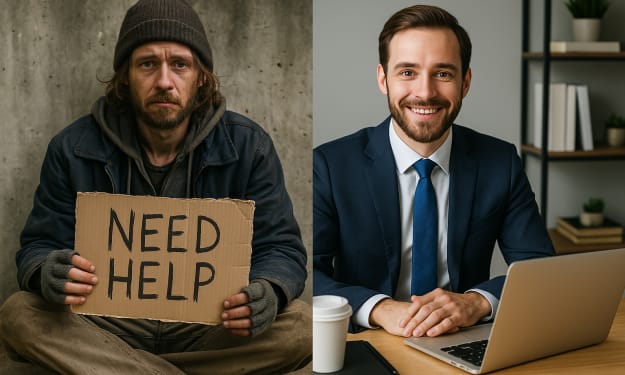
"From Sidewalk to Startup: The Rise of Jaylen Cross"
Jaylen Cross hadn’t always lived on the streets. Just five years ago, he had a small apartment in Oakland, a job fixing cash registers at a local grocery chain, and a backpack full of dreams. But life has a cruel way of unraveling quietly. First came the layoffs. Then a late rent payment. Then eviction. And when his last friend’s couch was no longer an option, the city’s underpasses became home. Jaylen wasn’t lazy. Far from it. But being homeless is a full-time job. You’re always on the move. You carry your life on your back. You spend hours just finding a place to charge your phone or figuring out which shelter has an open bed. He fell into a rhythm of surviving — collecting cans, doing odd jobs, and spending hours in libraries where the warmth and silence felt like luxury. It was in the downtown Oakland Public Library that Jaylen first touched code. Not because he intended to. But because he was bored. One gray afternoon, while drying his damp socks near a computer terminal, he overheard a conversation between two teens talking about “learning Python” from a free course online. Jaylen remembered Python — not the snake, but a programming language mentioned once in a high school class he half-slept through. Something made him curious. That night, after finishing a granola bar from a church charity, he went back to the library and typed in "Free Python course." That led to Codecademy. The black screen with blinking text felt intimidating at first. But then the code responded to him. A small spark lit up in his mind. Jaylen became obsessed. Every day, he was back at the library when the doors opened. He devoured free online courses — Python, JavaScript, HTML. He scribbled notes on napkins, old receipts, even the inside of cardboard boxes. The library staff, noticing his dedication, started saving printouts for him and even kept a battered laptop behind the counter for Jaylen to use when the computers were full. Over time, he began building small things — a to-do list app, a random quote generator, a weather site for Oakland. None of them were revolutionary. But to Jaylen, they were gold. Proof that he still had value. That he wasn’t invisible. One day, while coding a job-search app tailored for low-income users, he met Nadia, a UX designer volunteering at a coding bootcamp. She sat beside him, watching his screen for a moment before asking, “Did you build that?” “Yeah,” he said, half-defensive, half-proud. “That’s... brilliant,” she said. Jaylen laughed awkwardly. “It’s basic. I’m just playing with ideas.” But Nadia didn’t see basic. She saw potential. She asked him to send her the code. A few weeks later, she emailed him back with a shocking offer: a scholarship to join CodeBridge, a bootcamp for underrepresented talent in tech. Jaylen hesitated. He didn’t have clean clothes. He hadn’t slept in a bed in months. He had no stable internet. But Nadia persisted. She helped him get a room through a nonprofit, set him up with a used Chromebook, and told him, “The world has been stepping on you for long enough. It’s time you stepped back in.” At CodeBridge, Jaylen was a machine. He completed assignments weeks ahead, helped classmates debug, and quickly became known for his creative solutions. By the end of the six-month program, he had built "StreetSmart", a mobile app that mapped real-time data on shelter availability, free meal services, and public Wi-Fi spots for homeless individuals. It was part GPS, part social platform, part lifeline. When he presented it at Demo Day, investors were stunned. Not just by the product, but by the authenticity of its creator. Jaylen wasn’t a suit-wearing CEO pitching a "disruption." He was someone who lived the problem — who coded through hunger, debugged through cold nights, and kept going because he knew what it felt like to have nothing. Within two months, StreetSmart received $250,000 in seed funding from an impact investment firm. A tech incubator offered Jaylen a space, and he formed a small team of developers — many from underserved communities — to scale the platform. Three years later, StreetSmart operates in 30 cities across the U.S., with partnerships from local governments and NGOs. It has helped over 400,000 people access life-saving resources. Jaylen’s team has grown to 25 people, including several who were formerly homeless themselves. Jaylen now lives in a modest apartment near Lake Merritt. He still doesn’t like suits, still prefers sneakers and hoodies, and still codes late into the night. But now, he does so knowing that he built something that mattered. In interviews, Jaylen often says, “I didn’t want to be a tech founder. I wanted to survive. Coding gave me back my voice.” And when asked about success, he says something even simpler: “People just needed to see me. To believe I was worth helping. That’s what I try to do now — see people.” Because for Jaylen Cross, the most valuable startup capital wasn’t money. It was empathy. And that, he says, changes everything.
By Faizan Khanabout a year ago in Motivation
5 Small Habits That Changed My Life (And Can Change Yours Too)
People often say, “Change your habits, change your life.” At first, I didn’t believe it. I thought if I wasn’t doing something big and dramatic, then it wasn’t real change. But I was wrong. What actually changed my life were the tiny daily things — habits so simple that I almost didn’t notice the impact at first. But when I stuck with them, day after day, I realized: This is what growth really looks like. If you're feeling stuck, overwhelmed, or just a bit lost, maybe these small habits can help you too — the same way they helped me. --- 1. Making My Bed Every Morning It sounds basic. It is basic. But trust me — this one matters. Making my bed every morning gave me a sense of control over my environment. Even when everything else in my day felt chaotic, this small action grounded me. I didn’t realize how much visual clutter affected my mind until I started fixing this one thing. It’s not just about a neat bed. It’s about creating structure, no matter how messy life feels. And honestly? When I come home after a long, exhausting day, seeing that neatly made bed reminds me: You showed up for yourself today — even in a small way. --- 2. Drinking Water Right After Waking Up Before checking my phone, before scrolling, before coffee — I reach for water. It might sound silly, but this one act helps me feel awake, refreshed, and a little more alive in the morning. Dehydration often leaves us tired and foggy, but we mistake it for laziness or sadness. Now, drinking water is my way of telling my body: “I care about you.” It’s such a gentle way to begin the day — with kindness and attention to myself. --- 3. Writing Down Three Things I’m Grateful For I used to ignore this idea. Gratitude journaling? That sounded too “positive vibes only” for me. But I tried it — and I was surprised by the results. Each morning (or night), I write three things I’m grateful for. Some days they’re big: “My job,” “My health,” “My family.” Other days, they’re small: “The sound of rain,” “A warm meal,” “Finishing a task I was avoiding.” It rewires the brain. It reminds you that even in chaos, there’s always something working in your favor. Even if it’s just the taste of tea. --- 4. Speaking Kindly to Myself I used to beat myself up for everything — small mistakes, missed deadlines, lazy days. The voice in my head was harsh and unkind. So, I started practicing something different. When I messed up, I said: “It’s okay. You’re human. You can try again.” At first, it felt weird. But slowly, it became natural. Now I treat myself like I’d treat a close friend — with patience, compassion, and understanding. That voice in your head? You hear it every day. Make it a kind one. --- 5. Celebrating One Small Win Each Day Life can feel like a giant to-do list we never finish. That’s why I started celebrating one small win every day. Did I clean the kitchen? That’s a win. Did I answer a message I’ve been avoiding? Win. Did I get out of bed even when I didn’t want to? Big win. This habit changed how I saw myself. I stopped focusing on what I didn’t do — and started honoring what I did. And that shift in mindset made all the difference. --- Final Thoughts Change doesn’t have to be loud. Growth doesn’t have to be public. Healing doesn’t need to go viral. Sometimes, it’s just these five simple actions, done quietly, consistently, with love. They don’t require money, time, or perfection — just a little intention. If you’re feeling stuck, start small. Start here. Choose one habit. Try it for a week. Watch what happens. You don’t need to flip your life upside down. You just need to take the next gentle, kind step toward yourself.
By Samiullah about a year ago in Motivation
"The Night My Job Was Replaced by AI — And What I Did Next"
It was 2:14 AM. The office was silent, and I was staring at my screen — again. A spreadsheet full of numbers, formulas, and hours of manual work. For the last three years, this was my routine. I was the guy who always stayed late, always said yes, and always believed that hard work was enough. Until that night. My manager walked in quietly, holding a printed document. His face was calm, too calm. He looked at me and said, “Hamza, we’ve found a new system. It uses AI. It can do your job in 2 minutes.” I didn’t say anything. Just stared at him. Not because I didn’t understand. But because I did. I had seen this coming. --- I walked home that night in silence. No music in my headphones. No calls. Just the cold air and my thoughts. My mind kept replaying those words — “Your job... in 2 minutes.” It felt like my entire identity had been unplugged. You see, I wasn’t just an employee. I was a provider. A dreamer. A village boy from Charsadda who had studied hard, fought every odd, and earned his way into a decent life. But now, I was just… replaceable. --- For the next two days, I did nothing. Just scrolled endlessly. Watched videos about how AI was changing the world. Read comments from people celebrating it. Some were scared, some excited. Me? I was lost. Then one night, I opened ChatGPT. I typed: “What can a jobless tech guy do in 2025?” The reply was instant: "Use me to build something the world hasn’t seen yet." That line hit me hard. I realized something. AI didn’t kill my future. It just pushed me toward a new one. --- That night, I didn’t sleep. I started exploring AI tools. ChatGPT, Midjourney, Canva AI, Notion AI, Descript — tools I had ignored before. I wasn’t just learning how they worked — I was learning how to work with them. I built my first blog using AI-generated text. I designed a logo using AI art. I automated small tasks that used to take me hours. I wasn’t earning big yet, but something inside me changed: I felt alive again. --- 💡 What I Learned AI doesn’t replace people. It replaces people who refuse to evolve. The real danger is not AI — it's comfort and fear. Learning is the new currency. The faster you learn, the richer you become — not just in money, but in control over your life. --- Today, just 2 months after losing my job, I’m earning online. I help others use AI tools. I share my story. And most importantly, I’ve redefined my worth. I’m not just a tech guy anymore. I’m proof that even if the world changes overnight, we still have one power that no machine can match: The human ability to adapt.
By Hamza khanabout a year ago in Motivation
Between Silence and Strength
Between Silence and Strength: A Journey of Self-Discovery Life’s storms don’t always come with thunder. Sometimes, they arrive in silence—subtle yet seismic, shaking the very ground beneath us.For me, that storm was the year 2023. A time when everything I had planned quietly fell apart, and the only thing louder than the silence was the aching inside me.But within that stillness, something unexpected happened. I found strength—not the kind that roars or boasts, but a gentle, resilient kind that rises from brokenness. That year didn’t destroy me. It transformed me.Growing Up in a World of NoiseFrom childhood, I was taught that success had a formula: education, career, respect. Society measured worth in degrees, salaries, and applause. So, I followed the path laid before me—checking boxes, chasing validation, silencing doubts.But even with achievements to my name, I often felt empty. Not because I had failed—but because I had forgotten who I truly was. I was wearing masks, living up to expectations that never felt like my own. Beneath it all, I was exhausted and unheard.We are taught to be everything for everyone—strong for our families, accomplished for society, composed for the world. But somewhere in that performance, I lost sight of myself.The Year That Almost Broke Me2023 didn’t crash down with a single tragedy—it unraveled slowly. Plans fell through. People I trusted drifted away. My phone, once filled with calls and messages, fell quiet. And so did I.There were nights I sat beneath the stars, wondering what went wrong. Was I not good enough? Had I failed some invisible test? The silence began to echo with questions I wasn’t ready to answer.But I didn’t numb the pain. I sat with it. I cried—not because I was weak, but because my soul needed release. I learned that tears are not a sign of defeat. They are sacred. They mean we’re alive. They mean we still care.What Silence Taught MeIn the stillness, I stopped pretending. I listened to the quiet voice inside—the one that had been silenced for years. From that silence, I drew lessons that reshaped me:1. To Feel Is to Heal: Emotions aren’t weaknesses. They are wisdom in disguise. Grief, fear, joy—they all belong.2. My Worth Is Not Up for Debate: I am more than my achievements. I have value simply because I exist.3. Solitude Is Sacred: Being alone is not the same as being lonely. In solitude, I heard my own voice for the first time in years.4. Faith Is a Lifeline: Even when everything felt uncertain, faith reminded me that the journey was still unfolding.A Message to the BrokenheartedIf you’re reading this and you feel lost, hopeless, or invisible—please know, you are not alone. Your pain is real. Your silence is valid. And your story is not over.Healing doesn’t follow a timeline. Growth doesn’t come with applause. Sometimes, the most powerful thing you can do is simply breathe and let yourself feel.You don’t have to prove your pain. You don’t have to rush your recovery. Let your wounds breathe. Let your heart rest. You are allowed to begin again—as many times as you need.Rising, GentlyI’m still on this journey. Still learning. Still healing. But now I move with softer steps and stronger faith. Life isn’t about constant noise and performance. It’s about presence, grace, and resilience.You don’t have to rise like a warrior every day. Sometimes, rising at all is enough. Sometimes, surviving the silence is a victory of its own.And So I WriteI write because my story may echo someone else’s pain. I write to remind you—and myself—that we are not broken beyond repair. We are simply unfolding.And if my words reach even one broken soul today, then this silence was worth enduring.
By Shahab Saqib about a year ago in Motivation
How to Accomplish Anything at 17
— Lessons from Sasuke Uchiha At just 17, Sasuke Uchiha faced huge challenges, losses, and tough choices. But what made him stand out wasn’t just his power — it was his unwavering focus on his goal. Here’s what you can learn from Sasuke to make your own dreams
By Godswill Isaac Ogbonnayaabout a year ago in Motivation
"5 Lessons I Learned from Failing Again and Again". AI-Generated.
Failure. Just the word can make your heart sink. I’ve faced failure more times than I can count, and honestly, each time it hurt. Whether it was in school, at work, or in personal goals, failing made me question myself. Was I not good enough? Was I meant to quit? But with time, I realized that failure wasn’t my enemy — it was actually my greatest teacher.
By Waseem Ahmad about a year ago in Motivation
Today, I Saw My Inner Child at the Bus Stop
Today, I Saw My Inner Child at the Bus Stop By Ihtisham Hussain It was one of those mornings that felt like it hadn’t woken up yet. The sky yawned behind a veil of gray clouds, and the city moved like it was still rubbing sleep from its eyes. I walked my usual path to the office—headphones in, coffee in hand, thoughts already tangled in deadlines and inboxes.
By Ihtisham Hussainabout a year ago in Motivation