
“Beneath the Dust: The Street Sweeper Who Dreamed of College”
She cleans the streets by day, but studies under the stars by night — a journey of grit, silence, and unshaken hope.
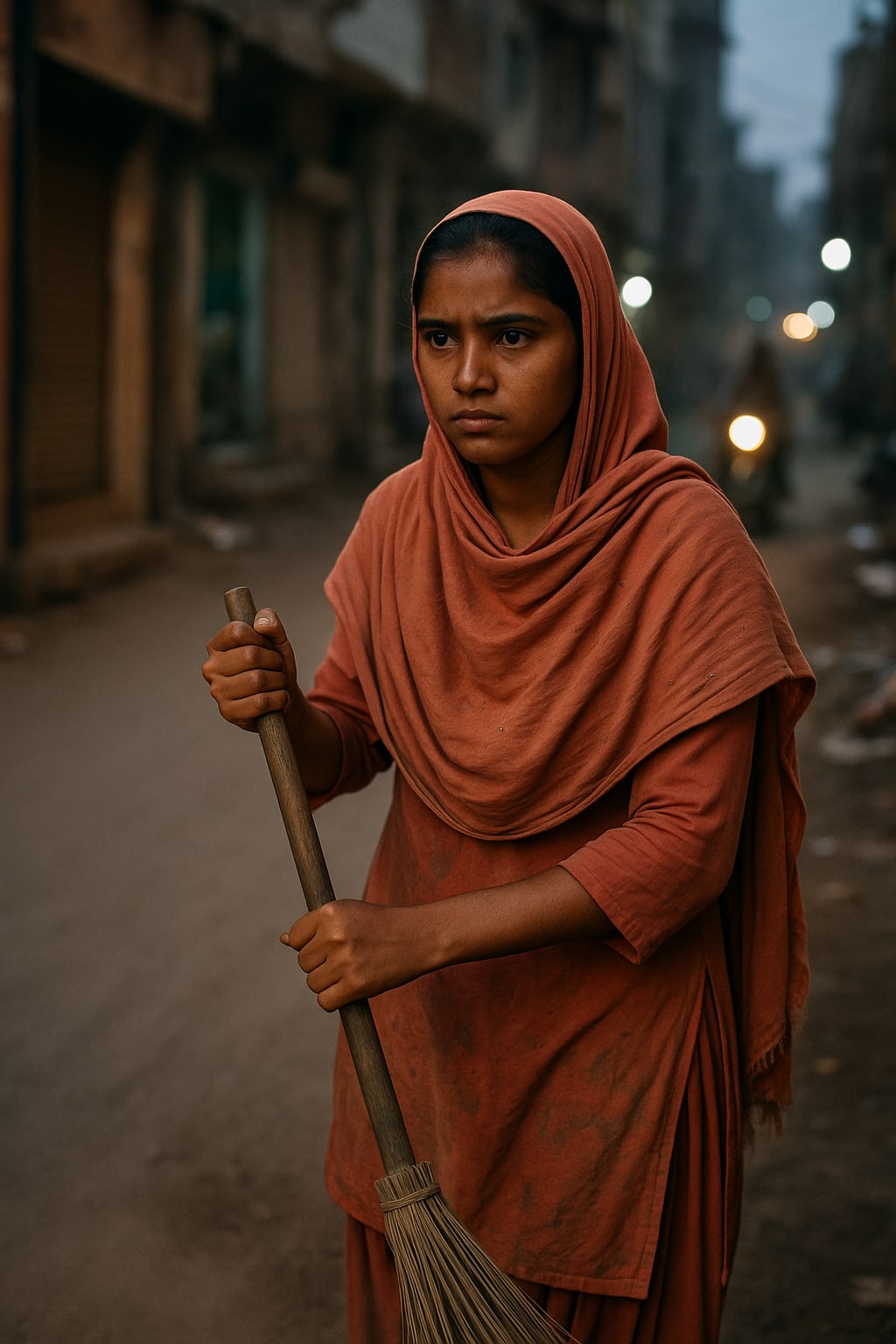
In a forgotten corner of Lahore, as dawn stretches over the city like a yawn, Farzana ties her dupatta tightly and steps into the street with a worn-out broom. It’s not just dirt she’s sweeping — it’s the weight of every “no” she’s ever heard.
She’s 17. No TikTok dances, no nail polish, no lazy mornings with tea and toast. Instead, her fingers are calloused from gripping a bamboo broom, and her feet ache from walking miles before the city wakes.
She doesn’t complain.
Farzana knows the world doesn’t listen to complaints from girls like her — girls who are born in rented shacks, where water comes in buckets and dreams are often interrupted by load-shedding.
But she dreams anyway.
Every night, when the world slows down and even the mosquitos seem to grow tired, she spreads her old dupatta on the floor, opens a second-hand notebook, and begins to study. A cracked mirror nearby reflects her tired but determined face.
Her dream is oddly specific: a degree in political science. “Because someone needs to sit in those marble offices who actually knows what dust smells like,” she says, half-smiling.
There’s something oddly poetic about how she switches between reality and ambition. One minute she’s scrubbing stubborn stains off a sidewalk, and the next she’s reciting clauses from the Constitution of Pakistan.
Her little brother once asked, “Aapa, why don’t you just become a YouTuber?”
She chuckled, “Because I want to change laws, not filters.”
One day, she stumbled upon a scrap of a school exam paper while cleaning — its margins covered in doodles, the name scribbled off. She took it home like treasure. That night, she solved every question she could. Not because anyone told her to. But because no one ever had.
There’s an ache in her voice when she talks about her father — a rickshaw driver who passed away from a fever no hospital bothered to treat. Since then, Farzana’s mother stopped believing in dreams. But Farzana never did.
It wasn’t until a freelance journalist — chasing a chai story — saw her reading a grammar book under a streetlight that someone finally asked, “What’s your story?”
That question, so simple, broke the silence she’d grown used to.
A week later, he came back — with an old laptop, donated by a university student, and a note that read, “For the girl who refused to settle.”
Now, Farzana teaches three younger girls in her alley every Thursday. They sit on bricks and call it “class.” She makes up quizzes and gives imaginary gold stars. They giggle when she says “madam” in a fake posh accent.
When asked if she ever feels tired, she responds:
> “Of course. But I’d rather sleep tired from trying, than rest forever in regret.”
She’s not on Instagram. She doesn’t know what “aesthetic” means. But if resilience had a face, it would look a lot like hers — sweaty, scarred, but unshakably alive.
---
Closing Note:
Farzana's story isn’t extraordinary because of what she has — but because of what she refuses to give up. In a world obsessed with overnight fame, she is a reminder that slow, stubborn hope still wins.
About the Creator
Enjoyed the story? Support the Creator.
Subscribe for free to receive all their stories in your feed.
Comments
There are no comments for this story
Be the first to respond and start the conversation.