celebrities
Celebrities and other motivational icons who made it to the top, from real actors, athletes and authors who used to be just like you.
Zeus Monaco: The Mysterious Billionaire
"Zeus Monaco: Unraveling the Enigma of the Elusive Billionaire” Meet Elon Tobiana, a man whose life is nothing short of a fantasy for most—a living legend known as the "Jewel of Monaco." Born in Paris, Elon always dreamed of a life that stood apart from the ordinary. With his magnetic personality, impeccable style, and a luxurious empire, he’s not just an icon but a mystery wrapped in elegance. Elon’s home base is Monaco, the world’s most exclusive and affluent nation, where status and legacy reign supreme. Here, he’s the unofficial king, ruling with a lifestyle that screams sophistication. His empire is built on his brilliance in law and real estate. After studying at Paris’s top universities, he founded M & Associés Immobilier, a firm that deals in Europe’s most coveted properties—castles in France, penthouses in Monaco, beachside mansions in Saint-Tropez, and art-filled villas in Ibiza. His estimated net worth? Over $500 million USD. But for Elon, money is merely a tool to craft his extraordinary life. His Monaco penthouse is a masterpiece, often called the world’s most luxurious bachelor pad. Picture Italian marble floors, 24-karat gold-plated walls, Swarovski crystal chandeliers, and a private sky deck with breathtaking Mediterranean Sea views. Every room boasts handcrafted furniture, and a private art vault houses original works by Picasso, Monet, and Banksy. Elon’s garage is a car enthusiast’s dream. His signature ride, a black Lamborghini Aventador with diamond-stitched leather seats and gold accents, is joined by a rare Lamborghini Urus, Ferrari 812 Superfast, Rolls-Royce Wraith, Mercedes-Maybach G63 Brabus, and a limited-edition De Tomaso P72—only 30 exist worldwide. His custom Devel Sixteen hypercar? Its engine roars loud enough to echo across Monaco’s shores. The sea is his playground too. Elon owns a superyacht called *Olympian*, a floating mansion with a Jacuzzi deck, underwater lounge, helipad, glass-walled infinity pool, and a cigar lounge stocked with exclusive Cuban cigars. Designed with Italian marble, handcrafted mahogany, and velvet walls, it’s the star of the Cannes Film Festival, hosting invite-only parties for global celebrities. The skies? He owns those too. His private Gulfstream G650 jet is a flying palace with a full bedroom suite, a five-star chef’s kitchen, and leather-paneled ceilings. Every flight is a statement that his reach knows no borders. Elon’s fashion is as commanding as his presence. Tailored suits from Brioni, Tom Ford, and Saint Laurent, with platinum buttons, Italian loafers, Swiss watches, and a diamond-studded bracelet define his runway-ready look. Behind his dark shades lies an intense gaze that screams power. His daily routine is as disciplined as it is regal. He starts at 5 a.m. with meditation and martial arts training (he’s a black belt holder). His chiseled physique reflects his warrior-like dedication. Breakfast, crafted by a private chef, includes Himalayan pink salt water, gold-leaf omelets, and imported Japanese fruits, served with platinum spoons and emerald-decorated wine glasses. His gym sessions? Guided by trainers flown in from Italy. In business, Elon’s table is where billion-dollar deals are quietly sealed. European bankers, Arab royals, and Asian tech titans seek his counsel. His real estate firm is the gold standard for luxury, and no major deal in Paris or Monaco closes without his influence. His social circle? The world’s elite—fashion moguls, billionaires, film stars, and royals. His parties are invitation-only, with background-checked guests and no phones allowed. Once, he rented an entire island in Saint-Tropez for an Arabian Nights-themed dinner costing $100,000 per plate. Beyond luxury, Elon is a filmmaker. His short films, *Ahibak* and *Wisteria*, earned critical acclaim at festivals, and he’s now directing his first feature film—a story of power, silence, and timeless class that the world eagerly awaits. Elon’s philosophy? True power isn’t shown; it’s felt. He speaks little, but every word carries weight. With rare interviews and a meticulously crafted image, he’s an enigma the world can’t get enough of. Elon Tobiana isn’t just a man—he’s the "Jewel of Monaco," a living embodiment of style, speed, and sophistication. His life is a masterclass in luxury, proving that for some, the impossible is just another day.
By Lomash Dhruv about a year ago in Motivation
The Power Within
In the heart of a dusty village surrounded by mountains, lived a boy named Kareem. He was quiet, observant, and always thinking. While other boys played loudly in the fields, Kareem would sit under the old fig tree, lost in his thoughts. People often misunderstood him. They said, “He’s too shy. He’ll never achieve anything.” But inside Kareem’s heart, there was a fire—a silent dream waiting to be awakened.
By Rahimullah Mohmandabout a year ago in Motivation
Silence the Inner Critic: How to Build Self-Confidence from Within. AI-Generated.
We all have that voice inside our heads—the one that whispers, "You're not good enough," or "You'll never succeed." This is the inner critic, a voice shaped by past experiences, fear, and societal pressures. While it might masquerade as a motivator or protector, more often, it holds us back, feeds self-doubt, and chips away at our confidence. The good news? That voice can be silenced. Building true self-confidence begins not with outside validation, but with mastering the conversations you have with yourself.
By Voice of Simplicityabout a year ago in Motivation
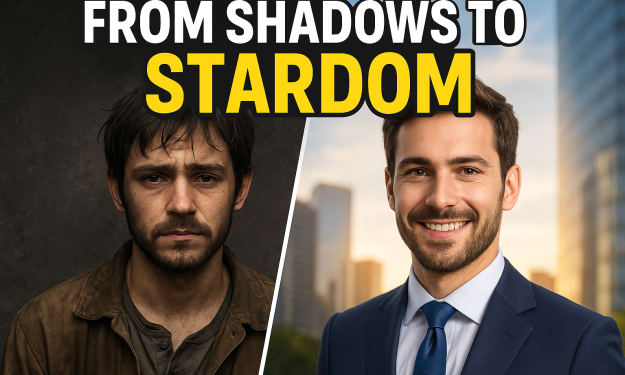
From Shadows to Stardom
Born into a humble village where opportunities were as scarce as the food on the table, Alex’s early life was a daily fight against poverty. His parents worked tirelessly from dawn till dusk, but the family barely managed to get by. Alex was the eldest child, and from a young age, he saw the weight of responsibility on his shoulders. The clothes he wore were worn out, and his schoolbooks were second-hand, often missing pages. Despite all this, Alex nurtured a dream—to break free from the chains of poverty and build a life filled with hope and success.
By The 1%about a year ago in Motivation
The One Man Who Changed the World Forever
In the golden sands of 7th-century Arabia, where tribal warfare and inequality ruled the land, where the weak were silenced and the strong walked tall, a man was born who would change the course of human history—not by sword or wealth, but by truth, patience, and divine purpose.
By Mohammad Ashiqueabout a year ago in Motivation
The Relentless Curiosity That Changed the World
In a small town in Italy in 1452, a child was born who would never receive a formal education, never attend university, and never be accepted by the elite of his time. Yet his name would echo through centuries as the symbol of genius, innovation, and boundless curiosity.
By Mohammad Ashiqueabout a year ago in Motivation
The Power of Starting Over: Why It’s Never Too Late to Begin Again. AI-Generated.
Life doesn’t always go according to plan. We all face moments when we look back with regret, feel lost after failure, or find ourselves standing at a crossroads, unsure of what comes next. Starting over might seem overwhelming in these moments, like admitting defeat or beginning from scratch with nothing. But in truth, starting over is not a setback. It is a powerful act of resilience, hope, and transformation. It’s never too late to begin again; in many cases, starting over is the beginning of something far greater than what came before.
By Voice of Simplicityabout a year ago in Motivation
The Light of Hope
The Darkest Night Sohrab was a poor boy who lived on the outskirts of a bustling city with his mother. His father had passed away years ago, leaving behind a void that life never truly filled. His mother worked long hours as a cleaner, and though they barely had enough to eat, she always told Sohrab, “Never let poverty steal your dreams.”
By Rahimullah Mohmandabout a year ago in Motivation
The Return of the Outsider: A Story of Donald Trump's Relentless Rise
Donald John Trump is one of the most controversial, disruptive, and unforgettable figures in American political history. Long before he stepped into the White House, his name was already a brand — of luxury, excess, and media spectacle. But when he entered politics, he didn’t just run a campaign; he launched a cultural earthquake. Born in Queens, New York, in 1946, Trump grew up in wealth and ambition. His father, Fred Trump, was a successful real estate developer. Young Donald studied business, graduating from the Wharton School, and soon took over his father’s empire. Unlike his father, Donald wanted fame along with fortune. In the 1980s and 1990s, his name began appearing on casinos, hotels, airplanes, even steaks. Trump wasn’t just building properties — he was building a personality. Loud, confident, and unapologetic. In time, he became a media fixture, famously hosting the reality TV show The Apprentice. His catchphrase — “You’re fired!” — became part of pop culture. But behind the glamour were bankruptcies, legal battles, and relentless headlines. Yet none of it stopped him. In 2015, Donald Trump announced his candidacy for President of the United States. Pundits laughed. Analysts dismissed him. But the people listened. His speeches were raw and unscripted. He didn’t speak like a politician. He attacked political correctness, mocked opponents, and promised to “Make America Great Again.” To many, he was a voice against the establishment. A billionaire who said what others wouldn’t. His rallies were massive, emotional, and sometimes chaotic. He built a loyal base not with policy papers but with slogans and fury. In 2016, he stunned the world by defeating Hillary Clinton. It was a political upset unlike any other. Donald Trump, a man with no political or military experience, had become the 45th President of the United States. His presidency was a whirlwind. He pulled out of international agreements, enforced harsh immigration policies, clashed with allies, and redefined diplomacy — meeting with North Korea’s Kim Jong-un, praising authoritarian leaders, and calling the media “the enemy of the people.” He appointed conservative judges, including three Supreme Court Justices, shifting America’s legal landscape for generations. Every day under Trump felt like a new headline. His Twitter account became a tool of direct governance, insults, and unpredictable announcements. The traditional rules of politics no longer applied. He didn’t pivot, apologize, or conform. He reigned through disruption. But his presidency also deepened America’s political divide. Racial tensions flared. Institutions were tested. The pandemic response in 2020 was criticized as disorganized. And when he lost the 2020 election to Joe Biden, Trump refused to concede, claiming widespread fraud. The tension culminated on January 6, 2021, when a violent mob stormed the U.S. Capitol — a dark day in American democracy. Trump was impeached for the second time, becoming the only U.S. president to face impeachment twice. Yet even after all this, he remains a dominant force in American politics. To his supporters, Trump is a warrior — someone who stood against corrupt elites, protected American jobs, and put “America First.” To his critics, he is a danger to democracy, a narcissist whose leadership was reckless and divisive. But beyond love or hate, one thing is undeniable: Donald Trump changed the way politics is done in America. He proved that media dominance could outweigh traditional qualifications. He showed how one man’s personality could reshape a party. And he ignited movements that continue to ripple through the nation. As he eyes a return to politics, the world watches. Can he regain the throne? Or has his fire faded? Whatever happens next, the Trump era has already carved its mark deep into the pages of American history. His legacy is still a battlefield — between those who saw him as a savior and those who saw him as a threat. But Donald Trump doesn’t wait for history’s judgment. He creates his own.
By Noman Afridiabout a year ago in Motivation
Frozen Moments: The Magic of Antique Cameras
In an era where every smartphone captures high-definition memories with a tap, it’s easy to forget the roots of photography—the bulky, mechanical, and magical antique cameras that once defined human memory. Before digital pixels and instant selfies, there was patience, passion, and an almost sacred silence surrounding the act of taking a photograph. Let’s rewind to the late 19th and early 20th centuries, when photography was a mysterious art form. Cameras weren't carried in pockets; they were revered instruments—made of polished wood, leather bellows, and gleaming brass. The process was as much about craftsmanship as it was about science. Every click was a commitment. These early cameras, like the Daguerreotype, Box Brownie, and Large Format Bellows Camera, were more than tools. They were portals through which life was frozen, one exposure at a time. Back then, having a photograph taken was a serious event. Families dressed in their finest clothes. They sat stiffly under the open sky or in candle-lit parlors, trying to remain perfectly still. Why? Because the exposure time could take several minutes! A blink or a smile could blur the face. That’s why most portraits from that time look so still, so serious. The photographers themselves were artists, engineers, and inventors rolled into one. They worked with chemicals like silver nitrate and collodion, mixing solutions under red lanterns in darkrooms. They loaded glass plates carefully and used tripods to steady their cameras. One wrong move, and the whole shot was lost. Some of the most iconic photographs in history—Abraham Lincoln’s portraits, war-time images, early cityscapes—were taken with these antique machines. Each frame told a thousand stories. Unlike today, you couldn’t take 20 pictures and delete the bad ones. You had one chance, and that made it priceless. One fascinating aspect of old cameras was their ability to surprise. The long exposures sometimes caught faint movements—ghostly hands, blurred footsteps, or whispering leaves—adding an eerie charm. In some cultures, these blurry anomalies were believed to capture spirits or unseen energies. Antique cameras also had unique aesthetics. The images they produced were rich in contrast, deep in shadow, and full of character. Sepia tones added a nostalgic warmth, while the imperfections—light leaks, vignetting, grain—gave the pictures soul. Perhaps the most charming element was the box camera photographer on the streets. You might find him in old cities, sitting beside a tripod-mounted wooden camera, with a black cloth draped over his head. For a few coins, he would capture your image, dip it in chemicals, and give you a photo minutes later—freshly printed and wet to the touch. Such photographs weren’t just memories; they were milestones. A child’s first photo. A wedding portrait. A last goodbye. Every image had weight, meaning, and permanence. Today, these vintage cameras are collectors' dreams and history buffs' treasures. They remind us of a time when photography wasn’t just about clicking—it was about connecting. With each image, we see not only the faces of the past but the soul of a moment. In the age of digital abundance, where thousands of images are stored and forgotten, the antique camera teaches us something precious: the value of a single, well-taken photograph. These old machines, with their ticking timers and wooden bodies, whisper stories to those who listen. They remind us that sometimes, the slower you go, the deeper you feel. In their silent frames lie entire lifetimes—paused, remembered, and revered. --- AI Image Prompt (for matching image generation): A vintage photography scene showing a 1900s box camera on a wooden tripod. A man in old-fashioned clothing (vest, pocket watch, round hat) is standing under a black cloth, taking a picture. A serious-looking family sits still in front of the camera—father, mother, children in formal 1900s attire. Background shows a dusty street or old studio setting with soft natural light and sepia tones. The atmosphere is quiet, nostalgic, and timeless.
By Noman Afridiabout a year ago in Motivation