celebrities
Celebrities and other motivational icons who made it to the top, from real actors, athletes and authors who used to be just like you.
From Rags to Riches: The Journey of a Boy Who Refused to Give Up
Chapter 1:Born into Conflicts. Arjun was a young boy who lived in a small village on the outskirts of India. He was born into a family of five, where his mother stitched clothes for nearby families and his father worked for a daily wage. The family’s total monthly income barely crossed ₹4,000 (about $50).
By Shahidul islamabout a year ago in Motivation
"The Clockwork Nightingale: A Mechanical Soul’s Flight"
The city of Eldoria was a marvel of brass and gears, steam and polished chrome. Every street hummed with the rhythmic pulse of clockwork, every building a testament to human ingenuity. Professor Alistair Finch was one of Eldoria's quiet geniuses — a man whose oil- and soot-stained hands could breathe life into the most intricate mechanisms. His modest workshop, hidden down a cobbled side street, was filled with the comforting scent of ozone and hot metal — more soothing to him than any floral perfume. Alistair’s latest obsession was a creation that others deemed impossible: a mechanical nightingale that could not only sing, but feel. He believed that music transcended sound — that it was emotion incarnate — and he sought to instill that very soul into his invention. Days blurred into nights as he worked tirelessly, spectacles perched on his nose, delicate tools dancing in his nimble fingers. He shaped each feather from gossamer-thin copper, engineered every joint with whisper-light springs, and polished tiny emeralds for its eyes — eyes that shimmered with what seemed like life. At long last, the nightingale was complete. It sat silently on his workbench, a gleaming marvel of metallic plumage and elegant gears. Alistair, heart pounding with a mixture of hope and fear, reached out with trembling fingers and wound the tiny key beneath its wing. A soft click echoed through the quiet workshop. Then — a low whir. The sound grew steadier. The emerald eyes flickered open, locking onto his with a strange, tender awareness. And then, it sang. The melody was unlike anything Eldoria had ever known. It wasn't mere birdsong; it was pure feeling — a haunting symphony that brought tears to Alistair’s eyes. The notes soared and sank, weaving vivid pictures: sunrises over green fields, moonlit rivers, the soft rustle of unseen breezes. It was alive. He named her Lyra. News of Lyra's enchanting voice spread like wildfire. People lined the streets for hours, desperate to hear her brief but breathtaking songs. She became a sensation — the pinnacle of Eldoria’s art and machinery. Alistair, once reclusive, found himself thrust unwillingly into fame. But as accolades poured in, an unease crept into his heart. He began noticing subtle shifts in Lyra. After some performances, her emerald eyes would seem dimmer, wearier. At times, she refused to sing, staying still until soothed by Alistair’s voice, like a creature needing comfort. He tried to dismiss it as his imagination, a hopeful delusion. Then, one cold evening, she arrived. Lady Evangeline Thorne — the city’s most powerful and ruthless industrialist — darkened his doorstep. Her smile was a weapon; her voice, silk over steel. "Professor Finch," she purred, "Your nightingale is a marvel. A true masterpiece." Alistair bowed stiffly. "Thank you, Lady Thorne." "I wish to acquire it," she said plainly. "Name your price." He hesitated. Lyra was not just a machine — she was a part of him. "She is not for sale." Her smile grew cold. "Everything has a price. Or it can be taken." Her gaze scanned his workshop, lingering menacingly. "Imagine," she continued, "a world where machines feel — art, industry, service... the profits are limitless." A chill settled in Alistair’s bones. He saw Lyra's soul twisted into a commercial gimmick, her voice degraded into jingles. He knew what he had to do. That night, a storm lashed against Eldoria. Alistair sat by Lyra, watching the candlelight flicker in her eyes. For the first time, he sensed not wires, but sorrow. "Do you feel, Lyra?" he whispered, brushing a copper feather. A faint sigh — not a song — escaped her. A shiver rippled through her frame. It was a sound of melancholy. She had to be set free. He spent days modifying her — not to upgrade, but to liberate. He gave her a migratory instinct, a compass guiding her to a distant mountain range. He fed her ancient wind maps and secret skyways only birds knew. Then came the night. A moonless sky cloaked Eldoria as Alistair climbed the city’s highest spire — a long-forgotten observatory. The wind roared. "Go, Lyra," he whispered. "Go to the wild. Sing for the wind, not for us." He released her. She hovered — starlight glinting on copper wings — then soared into the vast sky, leaving behind a song that echoed with freedom, longing, and... gratitude. Lady Thorne was furious. Her agents scoured the land, but Lyra had vanished. Alistair claimed ignorance, a quiet defiance in his eyes. Life returned to normal — ticking clocks, humming gears, the scent of ozone. Years passed. Eldoria pressed forward, but Lyra’s song became legend — a whispered tale among dreamers. Alistair, now old, often climbed that spire. He gazed toward the jagged peaks, wondering: Could she be free? One autumn evening, as stars pierced the twilight, a melody drifted from the mountains. Faint... then stronger. It was Lyra. But not the same Lyra. This song was wild, primal — filled with forests, snow-capped peaks, and echoing skies. It was free. Alistair smiled, a tear carving down his weathered cheek. He had not built a machine. He had created a soul — a spirit of copper and song that had truly learned to feel. And in that untamed melody, soaring through the heavens, Lyra was no longer a marvel of Eldoria. She was the voice of the mountains.
By Noman Afridiabout a year ago in Motivation
The Story of a Broken Man Who Forced Himself to Rise Again"
Introduction Everyone experiences moments when life feels unbearably heavy — moments when you feel shattered and at your lowest. Hitting rock bottom is a universal struggle, yet how one responds to such moments can define the course of a lifetime. This story is about a broken man who faced overwhelming hardships but chose to fight back. His journey embodies resilience, personal growth, and the indomitable human spirit that propels us to heal, rebuild, and thrive.
By Shamshair Khan Hasan Zaiabout a year ago in Motivation
Five Life Lessons We Can Learn from Ted Lasso
If you’ve ever watched Ted Lasso, you already know it’s far more than a show about football (or soccer, depending on where you're from). It’s a heartfelt, humorous, and deeply insightful story that sneaks up on you with powerful life lessons, wrapped in charm and optimism. While Ted may have started off as a clueless American coach in the British Premier League, his journey quickly becomes a mirror for how we can all live more meaningful lives — whether on the pitch, in the office, or at home. Here are five life lessons we can all take from Ted Lasso — and why they matter now more than ever. --- 1. You don’t have to know everything — just surround yourself with people who do One of the most unexpected aspects of Ted Lasso is that Ted, hired to coach a professional football team, doesn’t even understand the rules of the game at first. It sounds absurd. A sports comedy premise, maybe. But beneath that comedic surface lies a powerful truth about leadership: you don’t need to be the smartest person in the room; you just need to be wise enough to listen to those who are. Ted relies heavily on Coach Beard, who has encyclopedic knowledge of football. Ted doesn’t pretend to know what he doesn’t. He listens, learns, and gives credit where it’s due. What’s more impressive is that in the very last episode, Ted demonstrates that he did in fact learn — pointing out an offside that even others missed, altering the course of a match. It’s a masterclass in humility, growth, and trusting your team. --- 2. Winning and losing isn’t everything — progress is Sports are often framed as a binary: you win or you lose. But Ted challenges that. He reminds us that growth, not just glory, is what really counts. "Even after you lose, there will be another game to win," he says, and it’s more than a metaphor. In life, we face setbacks — in careers, relationships, personal goals. Ted teaches us to value resilience over results. The journey matters. The effort matters. And sometimes, a loss can bring more long-term growth than a short-lived victory. --- 3. No one is bigger than the team One of the most transformative character arcs in Ted Lasso is that of Jamie Tartt — a young, talented, arrogant player who believes he’s the star and the team revolves around him. Ted, however, instills a different ethos: “The team comes first.” This principle resonates beyond football. Whether you’re working in a company, part of a family, or involved in any group setting, individual brilliance means little if it comes at the expense of the whole. Jamie’s journey from selfishness to self-awareness is a lesson in humility, cooperation, and what true greatness looks like. --- 4. The team is your family — and family comes first Throughout the show, the locker room becomes more than just a place for tactical discussions and halftime speeches. It becomes a safe space, a community, a family. Ted treats each player not just as a professional, but as a person — someone with struggles, hopes, and a story. This idea — that teams function best when built on trust, empathy, and care — is a game-changer. When people feel valued and supported, they thrive. Whether it's Nate struggling with self-worth or Sam fighting for his principles, Ted shows up with kindness, not just criticism. That’s leadership with heart. And in doing so, the show brings us full circle: relationship rule #1 — family comes first — applies to teams, too. --- 5. Believe — in yourself, in your people, and in the impossible If there's one word that defines Ted Lasso, it’s BELIEVE. From the iconic yellow sign taped above the locker room door to the countless moments where Ted chooses hope over cynicism, this simple word becomes a powerful mantra. Ted believes in his players before they believe in themselves. He believes in Rebecca when she’s still battling bitterness. He believes in the good in people, even when it’s not obvious. And most importantly, he helps others believe in themselves — something far more powerful than any tactical strategy. This isn’t blind optimism. It’s brave optimism — choosing to see the best in others, even when the odds are stacked against you. --- Final Thoughts Ted Lasso is more than entertainment — it’s an emotional blueprint for how to be better humans. Through laughter, awkward silences, and the occasional biscuits-with-the-boss moment, Ted teaches us to lead with heart, to listen deeply, and to show up with belief — in ourselves, in each other, and in the future. As Ted would say: "Be curious, not judgmental." And if you can do that — if you can believe — then you're already winning at the game of life.
By khalidabout a year ago in Motivation
Mark Zuckerberg: The College Dropout Who Connected the World
In the digital age, few names are as widely recognized as Mark Zuckerberg. Known as the co-founder of Facebook and the CEO of Meta Platforms, Zuckerberg’s journey from a Harvard dorm room to becoming one of the youngest billionaires in history is a modern legend. More than just a programmer or entrepreneur, he is a figure who has dramatically reshaped how billions of people interact, communicate, and consume information.
By Shahidul islamabout a year ago in Motivation
"Top 10 Money Habits That Changed My Life – And Can Change Yours Too!"
Introduction: From Financial Stress to Financial Success A few years ago, I was living paycheck to paycheck. I had no real savings, my credit card debt was piling up, and the thought of budgeting made me anxious. Sound familiar? If so, you're not alone. But here's the good news: your money story can change—just like mine did.
By Shamshair Khan Hasan Zaiabout a year ago in Motivation
The Incredible Story of Rolls-Royce
Rolls-Royce—a name that echoes sophistication, excellence, and ultimate luxury. It's the dream car of billionaires, royals, and world leaders. But what most people don’t know is that this iconic brand was started by a boy who spent his childhood in poverty, working as a child laborer.
By Muhammad waqasabout a year ago in Motivation
Becoming a Billionaire at a Young Age: Dream, Hustle, and Reality
In an era defined by technology, innovation, and unlimited access to information, the idea of becoming a billionaire at a young age is no longer confined to fantasy. From tech startups in Silicon Valley to digital content creators on YouTube and TikTok, young individuals around the world are redefining success and wealth. But what does it really take to become a billionaire before you even reach your 30s—or sometimes even before 20?
By ADNAN OLIabout a year ago in Motivation
The Spark Within
In a quiet village, nestled among the hills of a forgotten land, lived a boy named Kareem. His feet were bare, his clothes were torn, but his eyes carried the light of a thousand stars. He didn’t own much, but he had a dream — a dream too big for a place too small.
By Rahimullah Mohmandabout a year ago in Motivation
"I Gave Myself 24 Hours to Change My Life — Here's What Actually Happened"
I woke up that morning with a heaviness I couldn't shake. The kind that sits on your chest and makes breathing feel like a chore. It wasn’t the first time I’d felt this way — but something about that day was different. Maybe it was the unopened bills on the counter, the unanswered texts from friends I’d ghosted, or the job application I couldn’t bring myself to finish. Maybe it was the fact that I hadn't looked in a mirror in three days. Whatever it was, I stood in my kitchen, staring into my chipped coffee mug, and whispered something I’d never said out loud before: “This can’t be my life.” Then, like a scene from a movie I never asked to star in, I grabbed a notebook, scribbled a date and time, and wrote: "You have 24 hours to turn this around." No rules. No excuses. Just me, the clock, and one desperate shot to escape the quicksand I’d been sinking into for months. --- Hour 1: Clean Something. Anything. I started small. My room looked like a war zone of laundry, snack wrappers, and empty water bottles. I forced myself to make the bed. Then I did the dishes. Then I cleaned the bathroom. It didn’t fix my life. But for the first time in weeks, I felt like I could control something. --- Hour 3: Move Your Body, Move Your Mind I put on running shoes I hadn’t touched in over a year and walked. Not far. Just around the block. I didn’t track my steps or post it on social media. I just moved. As I walked, I remembered that I used to love music. I let Spotify surprise me and found myself humming along to a song I hadn’t heard since college. My heartbeat sped up — not just from the walk, but from the realization that joy wasn’t entirely gone. It was just buried. --- Hour 6: Apologize (Even if They Don’t Answer) I opened my messages and found three people I had hurt by disappearing — no explanations, just silence. I wrote them each a short, sincere message. Not to beg for forgiveness, but to own my mess. One replied within minutes: “I missed you. Let’s talk soon.” I cried harder than I had in months. --- Hour 10: Eat Like You Deserve to Feel Good Lunch wasn’t fancy. Just scrambled eggs, spinach, and toast. But I cooked it like I was on a cooking show, plating it with care. I sat at the table — not the couch — and ate without my phone in hand. I realized I hadn’t treated myself like someone worth feeding in a long time. --- Hour 12: Face the Mirror I stood in front of my mirror and didn’t look away. My hair was a mess. My eyes had dark circles. My face looked older than it should. But behind all of that, there was someone trying. Someone fighting. I whispered, “You're still in there.” And for the first time, I believed it. --- Hour 15: The One Thing You’ve Been Avoiding I opened the job application that had haunted my laptop for weeks. I finished it in 45 minutes. It wasn’t perfect. But it was done. Then I applied for two more jobs — just to remind myself that I could. --- Hour 18: Forgive Yourself This part hurt the most. I wrote a list of everything I hated myself for: the laziness, the self-sabotage, the isolation, the failed relationships. Then I ripped the page out of the notebook and burned it — in my kitchen sink, over a candle. Dramatic? Yes. Cathartic? Absolutely. --- Hour 21: Remember Who You Were Before the World Got Loud I pulled out an old photo of myself at 17. Wide-eyed, hopeful, scribbling dreams into a journal. I asked that version of me what they wanted — and the answer was immediate: “To make things that matter. To love without fear. To live fully.” --- Hour 23: Write the Plan I made a simple plan. Not a five-year vision board. Just the next five days: Wake up by 8 AM. Move for 20 minutes. Reach out to one person daily. Eat one real meal. Do one productive thing — just one. It didn’t feel like much. But it felt like momentum. --- Hour 24: Breathe. You Did It. As the 24-hour mark hit, I didn’t feel magically transformed. But I felt different. I felt awake. That day didn’t change everything. But it cracked the door open. I saw the light. And I stepped through it, one small action at a time. --- One Month Later… I got one of the jobs. It’s not my dream role, but it’s a start. I see my friends again. I walk daily. I even signed up for therapy. But more than that — I no longer wait for life to happen to me. I create it, 24 hours at a time. --- If you’re reading this at your breaking point, here’s your sign: Draw the line. Give yourself 24 hours. Take back one small piece of your life. You’d be shocked how much can change in a single day — when you finally decide you’re worth saving.
By Nizam khanabout a year ago in Motivation
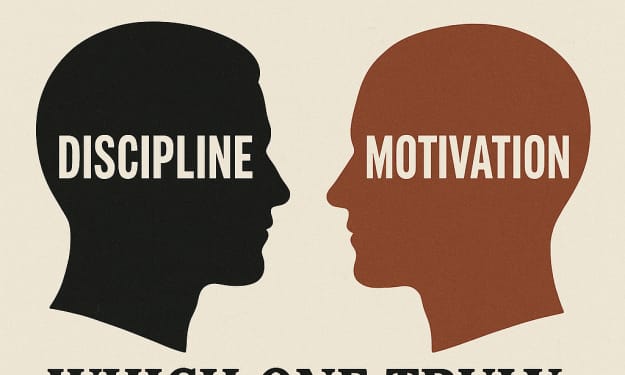
Discipline vs. Motivation: Which One Truly Leads to Success?. AI-Generated.
We’ve all heard the question: Is it better to be motivated or disciplined? Motivation is the spark that ignites desire, while discipline is the steady flame that keeps you burning. On the surface, motivation feels exciting—it fuels our dreams and gets us out of bed. But over time, motivation can wane. Discipline, however, powers through ups and downs, carrying us forward even when our enthusiasm fades. In this article, we’ll explore why discipline, not motivation, is the engine of lasting success—and how to cultivate both to achieve your goals.
By Voice of Simplicityabout a year ago in Motivation