
He Was Right About Everything—And It Destroyed Him
A young CEO’s discipline killed his company. Then it showed him what he was actually hoarding.
The meeting was twenty minutes old when Adrian opened his laptop and turned it around so everyone could see the spreadsheet.
"We need to talk about downside scenarios," he said.
The room was small—six people around a table that still had coffee rings from the morning. They were three months into building something that might actually work. The numbers were trending up. The term sheet from Birch Ventures sat in everyone's inbox, unopened by some, read six times by Adrian.
Leo, his co-founder, leaned back. "Adrian. We haven't even signed yet."
"That's exactly when we should have this conversation." Adrian's cursor hovered over a column labeled Liquidation Preference — Series A. "If we take their money, I need to know what happens if it doesn't work."
"If it doesn't work, we all go get jobs," said Priya, who ran product. She said it lightly. She was already thinking about the UI changes they'd discussed earlier. She had not thought about the term sheet once since reading it.
Adrian didn't smile. "That's not a plan."
He walked them through four scenarios. In scenario three—the one where revenue flattened and Birch pushed for a sale—Priya's equity would be worth roughly a third of what she was assuming. She hadn't done the math. No one had, except Adrian.
When he finished, Leo said, "We haven't made a single dollar yet and you've already measured us for coffins."
It wasn't a fight. Adrian didn't hear it as an insult. He heard it as a failure to be serious. He closed the laptop and thought: Someone has to think about this stuff.
No one said it out loud, but the energy in the room had shifted. Not because Adrian was wrong—the math was correct—but because he had brought death into a room that was still trying to be born.
The dinner with Maeve Costigan was supposed to be informal. She had suggested the restaurant—a French place in Tribeca where the waiters didn't introduce themselves and the menu had no prices. Adrian had Googled it beforehand and calculated what a three-course meal for six people would cost, plus wine. He put the number in his phone.
Maeve was in her late fifties, silver hair cut short, a former hedge fund partner who now wrote checks to early-stage companies and said things like "I invest in people, not spreadsheets." She ordered for the table without asking. She told a story about a founder who'd pitched her while surfing. She was the kind of person who made money feel like an afterthought—which Adrian knew, intellectually, meant she had so much of it that it had become invisible to her.
When the bill came, Adrian did it.
He didn't grab the check. He did something worse. He said, "Let me figure out everyone's share."
The table went quiet for half a second. Maeve looked at him—not with anger, with something closer to curiosity, the way you look at a bird that's flown into a window.
He divided the total by six, then adjusted for the fact that Priya hadn't drunk any wine. He was precise. He was fair. He was, in his own mind, being responsible.
Maeve put down her credit card without looking at him. "I've got this one," she said.
"No, really—"
"I've got this one." The same words. The tone was different now. A door closing.
She didn't call again. Leo called her assistant two weeks later, just to check, and the assistant—a young man named Derek who was loyal to Maeve the way altar boys are loyal to the ritual—said, after a pause, "She said she could smell the fear on him. She doesn't back founders who are already calculating the exit."
Leo didn't tell Adrian. Not then.
Adrian's apartment was in Yorkville, a fourth-floor walk-up with radiators that hissed and a landlord who hadn't updated the kitchen since the nineties. His income, by any reasonable standard, was good. He had money. He just didn't use it.
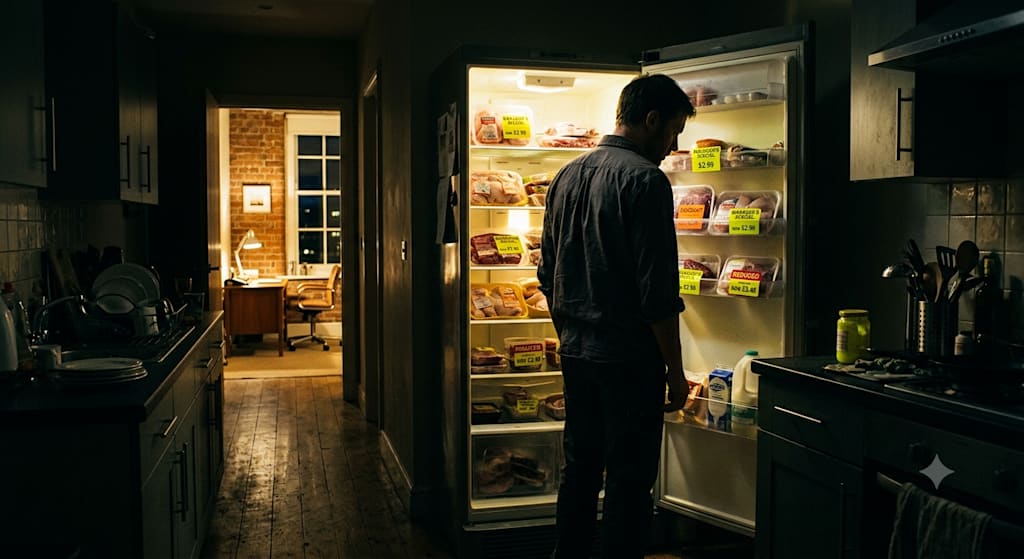
The fridge was the giveaway. Ella figured it out on the third date.
She was a graphic designer, freelance, a friend of Priya's. She liked him—he was sharp, he listened, he had good shoulders. She came over on a Saturday and opened the fridge to get water and saw three shelves of yellow discount stickers. The ones that said REDUCED FOR QUICK SALE. The ones that grocery stores slap on meat that's about to turn.
She didn't say anything. She got the water. She closed the fridge.
But Adrian saw her see it. He saw the brief pause, the recalculation behind her eyes. She was nice about it. She stayed. They watched a movie. She kissed him goodnight.
The next morning, her text took three hours instead of the usual fifteen minutes.
He didn't blame her. He didn't even understand what the problem was—the food was still good, he was being smart with money, he wasn't poor, he was prudent—but he felt, in a way he couldn't articulate, that he had failed some kind of test.
Not a test of wealth. A test of something else. Ease. Confidence. The ability to let food go bad and not care.
He kept the stickers on the fridge anyway. He wasn't going to waste food just to impress someone. That would be stupid.
That was what he told himself.
The deal fell apart in a conference room on the thirty-fourth floor of a building in Midtown. Eight lawyers, three term sheets, six months of work.
Adrian fought over the drag-along clause for two hours. He didn't need to. Leo told him, quietly, twice, that this wasn't the hill to die on. Priya sent him a text under the table: let it go. The other side's lead counsel, a woman named Sinclair who had done this for twenty years, gave him three separate off-ramps. She said, "This is standard language, Mr. Chen." She said, "We can revisit this post-close." She said, "Is this a dealbreaker?"
Adrian said, "I need to know what happens if it falls apart."
She looked at him over her glasses. "You've been asking that since minute one."
"It's a reasonable question."
"It's a reasonable question for a liquidation. We're not liquidating. We're building. You're treating this like a divorce before the wedding."
At 4:15, Sinclair closed her binder. She didn't slam it. She just closed it, and the sound was louder than any slam.
"I think we're done here."
They were. Birch walked. The money walked. Leo sat in the empty conference room after everyone else had gone and said, "You won every single line item. You know that, right? Every clause. Every comma. You beat them."
Adrian said nothing.
"And it doesn't matter," Leo said. "Because they're not coming back."
He didn't say you killed it. He didn't need to. The body was on the floor.
There was a period after that—Adrian would not remember it as months, only as mornings—where he kept waking up and thinking about the yellow stickers in his fridge. Not the stickers themselves. What they meant. The version of himself that hoarded things that were about to expire, because he couldn't trust that more would come.
He didn't have a breakthrough. There was no scene where he cried or apologized or said the right words. He was still Adrian. He still believed in spreadsheets. He still thought most people were reckless with things that mattered.
But something shifted. Not in what he believed. In what he did.
The company survived, barely. A smaller fund came in. They moved into a real office, a converted warehouse in Gowanus with exposed brick and too many windows. Adrian's name was still on the door, but Leo ran the day-to-day. Adrian had let that happen. He didn't remember making the decision. It had just happened, the way water finds the lowest ground.
When they assigned offices, Adrian took the one with no windows.
"No," Leo said. "You're the CEO. Take the corner."
Adrian looked at the corner office—the light, the view of the canal, the exposed shelving that someone had painted a very serious shade of gray—and then he pointed to the smaller one next to it.
"You take it," he said. "You'll use the light."
Leo stared at him. "What?"
"You're the one who talks to investors now. You should have the office."
It wasn't a grand gesture. Priya walked past with a box of cables and didn't even notice. The office manager had already labeled both doors and had to reprint the nameplates.
But Leo noticed. He didn't say anything. He just looked at Adrian for a beat longer than necessary, the way you look at a photograph that doesn't quite match your memory of the person in it.
Adrian walked into his smaller office—no view, a desk that someone else had picked, a chair that needed adjusting—and sat down.
He didn't feel generous. He felt, for the first time in a very long time, like he could afford to lose something and still be fine.
He opened his laptop. He started a new spreadsheet, not for downside scenarios, but for the things they'd build if nothing went wrong.
That night, he went home and opened the fridge. The yellow stickers were still there. He stared at them for a long time.
Then he took the package of chicken—two days from expiring, forty percent off—and he threw it out.
Not because it was bad. Because he didn't need it.
He ordered takeout. He didn't check the delivery fee.
About the Creator
Jin
Writer of reamstories
https://reamstories.com/jin
Enjoyed the story? Support the Creator.
Subscribe for free to receive all their stories in your feed. You could also become a paid subscriber, letting them know you appreciate their work.
Comments
There are no comments for this story
Be the first to respond and start the conversation.