
Coffee-Stained Conscience
A Short Poem; A Fond Remembrance of Dad; With All Apologies to the Cows...

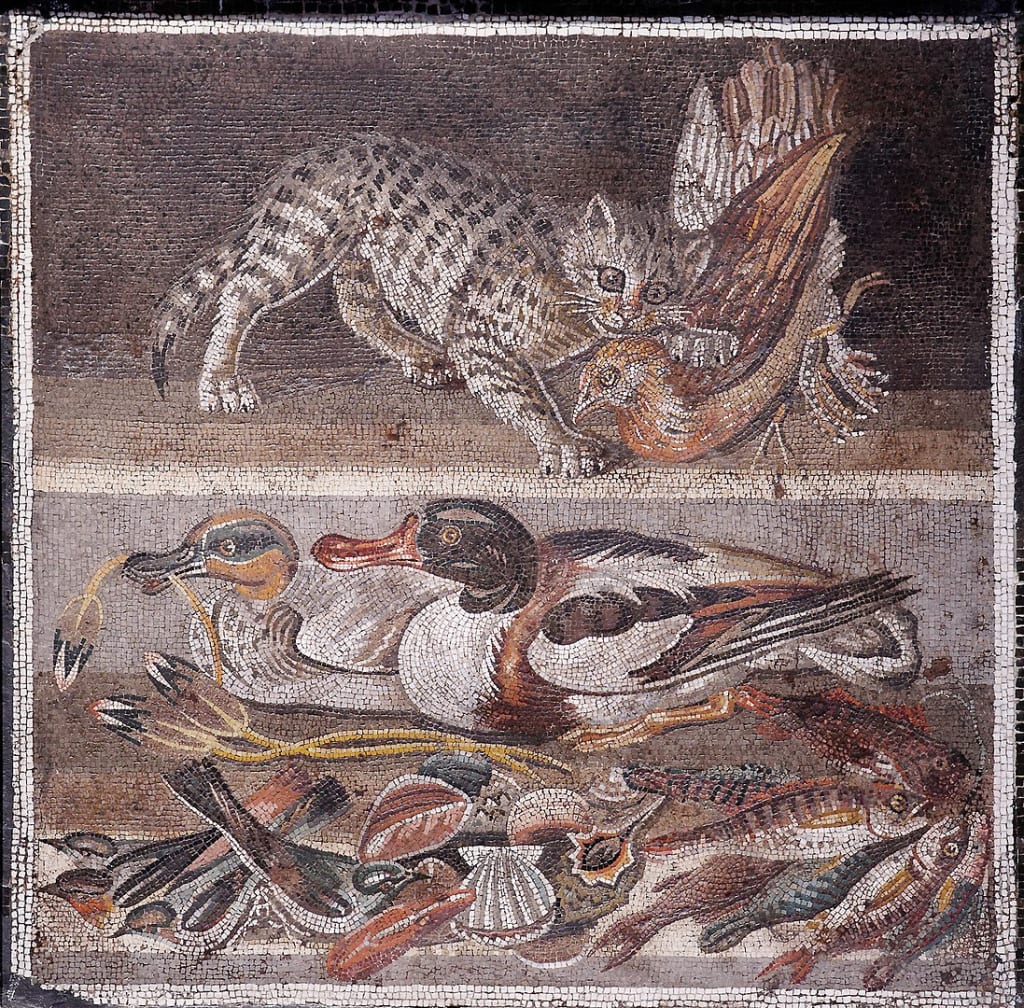
Coffee-Stained Conscience
His conscience, coffee-stained; like his favorite cup, a ring remained down at the bottom where the sponge won’t reach, like his SO(U)L, which ignores the lies they preach, doing NOT what he’s TOLD but what he SHOULD, and recalling the line from the struggling feline: “Tough titty said the kitty but the milk’s still good!”
***** * *****
Rommentary:
Growing up, my dad used to sing-song that line any time I complained something wasn’t just the way I wanted.
I asked him when I was older where he got the line. He said he grew up hearing it, though I took the sing-song delivery to be pure Bob Butler!
The best I can tell, this saying has many variations, but its primary origin is from the farming community of the Midwestern U.S. and can be traced to at least the 1920s.
The cow’s udders get harder to milk the more they're worked, and this makes for tough titty.
Interposing the barn cat into this quaint bit of colloquial dialogue leaves us ample room for interpretation, and here I want to use it as a lesson in the importance of punctuation.
“Tough titty,” said the kitty, but the milk’s still good.
As if the farmer, upon hearing the cat’s lament, might retort: “Listen, pussy, you don’t have to milk these udders so what’re you complaining about? Drink the milk! And catch some mice while you’re at it!”
“Tough titty,” said the kitty, “but the milk’s still good!”
As if the cat were to remark to the farmer (who is no doubt cursing under his breath as he wrangles with his task): “Quit yer bitchin’, pal! At least you got cows to milk! Ain’t nothin’ free! And you’re welcome for the mice. We pussies been saving your grain stores since ancient Egypt! Now where’s that milk?”
Coming from Dad, the old line was certainly playful, and there was never a time when it wasn’t immediately followed with a complimentary saucer of milk for the whining pussy.
The unconquerable spirit of our ancestors who survived harsh winters with the stores and rations they worked so hard to maintain during the warmer months was passed down, not just by example, but through humor.
I spin out my own middle age with one kid grown and two more crossing over into adolescence.
I review the many glorious misadventures of my youth and hope that future generations will learn enough from our mistakes to have the adventures without the misses!
I step fully, consciously into an unwinding life, for better or worse, which I created with my own hands, laboring for others and left with only “a handful of dimes.”
I nurse sore muscles and creaking bones with milk and laughter.
The milk was indeed good but better was the company kept while slurping it down.
Dad was a good man who deserved better for all the work he put in. He tried to warn me not to be such a sourpuss, but never made me feel bad for mewing at my own misfortune.
He’s still here, even if only as a welcome voice in my head, echoing in the chasm of my coffee-stained conscience that fateful, sing-song line…
Tough titty said the kitty but the milk’s still good.
Attempting to review what lessons this last year taught me, I can’t help but see my entire life rushing to meet this moment, and I find myself recalling Janis Joplin’s soulful laments about melancholy and lost love, especially these lines from a live performance of Ball and Chain:
“Because as a matter of fact, as we discover on the terrain, tomorrow never happens, man. It’s all the same fucking day, man.”
Could any two dynamics be farther apart than a hippy and a Midwestern farmer?
Yet we must co-exist.
If you take the time to listen to Janis, you’ll hear wise words about love spoken from a broken heart.
If you really listen close and think about what she says, you’ll realize that she and the old Midwestern farmers meant the same thing:
Love is worth the work.
About the Creator
C. Rommial Butler
C. Rommial Butler is a writer, musician and philosopher from Indianapolis, IN. His works can be found online through multiple streaming services and booksellers.
Enjoyed the story? Support the Creator.
Subscribe for free to receive all their stories in your feed. You could also become a paid subscriber, letting them know you appreciate their work.
Comments
There are no comments for this story
Be the first to respond and start the conversation.