
A Sovereign for a Stranger
He thought he was helping a beggar — but fate had a greater surprise waiting.

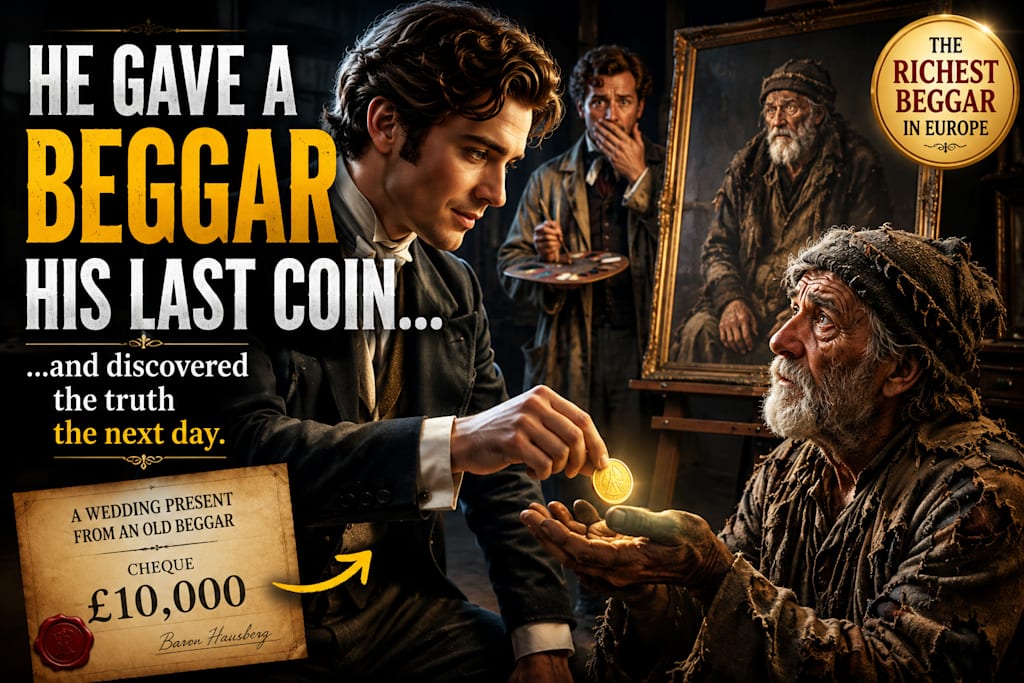
Hughie Erskine, a French aristocrat was soft-hearted, well-mannered and good looking with brown curly hair and grey eyes. He was very popular in his circle because of his good demeanour, gentle heart and unaffected plainness. He was once a successful tea merchant but a slump in tea trade badly affected his business. Consequently, he had to dismantle his trade. After that he tried his luck at everything but could not succeed in any business at all. Ultimately he became nothing but a delightful, ineffectual young man with a perfect profile and no profession except meagre resources from his farms. Another predicament that troubled him greatly was the issue of his unsettled marriage. In the hey days of his tea-trade, Hughie’s mother asked Colonel Martin for the hand of his daughter, Laura Martin, for her son. Seeing the thriving business of Hughie, the colonel readily agreed to give his daughter’s hand in engagement. However, the consistent fiasco of his career in business made the colonel changed his mind. Whenever Hughie’s mother would approach the colonel for the marriage of her son with Laura Martin, he would bluntly say, “Come to me, when your son has got ten thousand pounds, and we will see about it.” Hughie looked very glum in those days, and would often go to his friend, Alan Trevor, for consolation. Trevor was a painter and famous artist. He was a real master, and his pictures were eagerly sought after.
One morning, when Hughie came to Trevor’s studio he found him giving finishing touches to a wonderful life-size picture of a beggar-man. The beggar himself was standing on a raised platform in a corner of the studio. He was a wizened old man, with a face like wrinkled parchment, and a most piteous expression. Over his shoulders was flung a coarse brown cloak, all tears and tatters; his thick boots were patched and cobbled, and with one hand he leant on a rough stick, while with the other he held out his battered hat for alms.
“What an amazing model!” whispered Hughie, as he shook hands with his friend.
“An amazing model?” shouted Trevor at the top of his voice; “I should think so! Such beggars as he are not to be met with every day. Poor old chap!”
said Hughie, “How miserable he looks! But I suppose, to you painters, his face is his fortune?”
“Certainly,” replied Trevor, “You don’t want a beggar to look happy, do you?”
“How much does a model get for sitting?” asked Hughie, as he found himself a comfortable seat on a divan.
“A shilling an hour.”
“And how much do you get for your picture, Alan?”
“Oh, for this I get two thousand!”
“Pounds?”
“Guineas,” replied Trevor. “Well, I think the model should have a percentage,” cried Hughie, laughing; “they work quite as hard as you do.”
“It’s all very well, Hughie, for you to talk, but I assure you that there are moments when art almost attains to the dignity of manual labour.”
After some time the servant came in, and told Trevor that the frame maker wanted to speak to him.
“Don’t run away, Hughie,” he said, as he went out, “I will be back in a moment.”
The old beggar-man took advantage of Trevor’s absence to rest for a moment on a wooden bench that was behind him. He looked so forlorn and wretched that Hughie could not help pitying him, and felt in his pockets to see what money he had. All he could find was a sovereign and some coppers. “Poor old fellow,” he thought to himself, “he wants it more than I do,” and he walked across the studio and slipped the sovereign into the beggar’s hand.
The old man started, and a faint smile flitted across his withered lips. “Thank you, sir,” he said, “thank you.”
Then Trevor arrived, and Hughie took his leave, and walked home.
That night he strolled into the café at about eleven o’clock, and found Trevor sitting by himself in the coffee-room drinking hot cappuccino.
“Well, Alan, did you get the picture finished all right?” he said, as he ordered his cup of black coffee.
“Finished and framed, my boy!” answered Trevor; “and, by the bye, you have made a conquest. That old model you saw is quite devoted to you. I had to tell him all about you - who you are, where you live, what your income is, what prospects you have -”
“My dear Alan,” cried Hughie, “I shall probably find him waiting for me when I go home. But of course you are only joking. Poor old wretch! I wish I could do something for him. I think it is dreadful that any one should be so miserable. I have got heaps of old clothes at home - do you think he would care for any of them? Why, his rags were falling to bits.”
“But he looks splendid in them,” said Trevor. “I wouldn’t paint him in a frock coat for anything what you call rags I call romance. However, I’ll tell him of your offer.”
“You don’t mean to say you talked to him about me?” said Hughie.
“Certainly I did. He knows all about the relentless colonel, your marriage, and the £10,000.”
“You told that old beggar all my private affairs?” cried Hughie, looking very red and angry.
“My dear boy,” said Trevor, smiling, “that old beggar, as you call him, is one of the richest men in Europe. He could buy all London to-morrow without overdrawing his account. He has a house in every capital, dines off gold plate.”
“What!” exclaimed Hughie.
“What I say,” said Trevor. “The old man you saw to-day in the studio was Baron Hausberg. He is a great friend of mine, he gave me a commission a month ago to paint him as a beggar. And I must say he made a magnificent figure in his rags.”
“Baron Hausberg!” cried Hughie. “Good heavens! I gave him a sovereign!”
“Gave him a sovereign!” shouted Trevor, and he burst into a roar of laughter.
“My dear boy, you’ll never see it again. I think you might have told me, Alan,” said Hughie sulkily, “and not have let me make such a fool of myself.”
“Well, to begin with, Hughie,” said Trevor, “it never entered my mind that you went about distributing alms in this reckless way. And when you came in I didn’t know whether Hausberg would like his name mentioned. You know he wasn’t in his own dress.”
“What a duffer he must think me!” said Hughie.
“Not at all. He was in the highest spirits after you left; kept chuckling to himself and rubbing his old wrinkled hands together. I couldn’t make out why he was so interested to know all about you, but I see it all now.”
“I am an unlucky fellow,” growled Hughie. “The best thing I can do is to go to bed; and, my dear Alan, you mustn’t tell anyone.”
“Nonsense! It reflects the highest credit on your philanthropic spirit, Hughie. And don’t run away. Have another cup of coffee.”
However, Hughie wouldn’t stop, but walked home, feeling very unhappy, and leaving Alan Trevor fit of laughter.
The next morning, as he was at breakfast, the servant brought him up a card on which was written, “Mr. Gustave Naudin, from Baron Hausberg.”
“I suppose he has come for an apology,” said Hughie to himself; and he told the servant to show the visitor up.
An old gentleman with gold spectacles and grey hair came into the room and said, “I have the honour of addressing Monsieur Erskine?”
Hughie bowed and said, “Yes sir.”
“I have come from Baron Hausberg,” he continued. “The Baron -”
“I beg, sir, that you will offer him my sincerest apologies,” stammered Hughie.
“The Baron,” said the old gentleman with a smile, “has commissioned me to bring you this letter,” and he extended a sealed envelope.
On the outside was written, “A wedding present to Hugh Erskine, from an old beggar,” and inside was a cheque for £10,000.
When he married Alan Trevor was the best man, and the Baron made a speech at the wedding breakfast.
“Millionaire models,” remarked Alan, “are rare enough; but, by Jove, model millionaires are rarer still!”
About the Creator
Kamran khan
- ✨ "Writer of ideas and emotions. Sharing motivational journeys, creative reflections, and inspiring stories to spark thought and connect hearts — one story at a time." ✨
Enjoyed the story? Support the Creator.
Subscribe for free to receive all their stories in your feed.
Comments
There are no comments for this story
Be the first to respond and start the conversation.